


On Monday, early adopter and
Web provocateur Robert Scoble suggested that my use of
Google Reader to share the best of the tech Web each day was antiquated. In fact, he called Reader "a dead product" compared to
Twitter, which he believes will grow in importance for information discovery, especially as the lists feature is released more widely into the network. I respect Robert a great deal and we're good friends, so this kind of discussion doesn't bug me at all. As usual, it got me to thinking about why I do what I do, and whether it should change.
As discussed many times here, I share the best RSS items that enter my Google Reader in box per day. Lately, I have been sharing upwards of 30 items each day, up from the previous 20 to 25. These hand-selected items are then
available on my link blog, in Google Reader for comments to other connections on that service, and downstream on other networks, including
FriendFeed,
Facebook and
Socialmedian.
Last month, I noted the introduction of
a new PubSubHubbub-enabled application called Reader2Twitter, that made it easier to share these items directly to Twitter as well. I even created a new Twitter ID for this, called
@lgshareditems.
In parallel, Robert has been trying to do something similar, using not RSS, but Twitter, to share the best of the technology Web as it streams on his screen. While I have chosen to read 716 different feeds, Robert has chosen to follow more than 8,000 individual Twitter users. Similarly,
his favorite Tweets are sent to an account called
@scoblefaves, via
FavStar.fm.
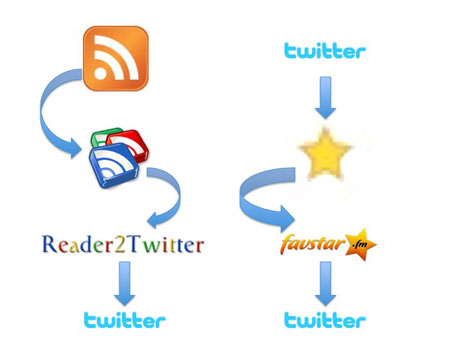
My Approach on the Left, Scoble's On the RightIn theory, both of us have the same goal. Both of us want to act as aggressive information filters, passing along the very best data to those downstream. But we are using different tools. My tools haven't changed much in the last two years, and Robert thinks that he is on to something. I like that he is being innovative, and once again, taking a chance by using a familiar tool in a new way, but there are more than a few reasons I won't be giving up the link blog in exchange for a Twitter favorites list any time soon. Not the first of which is that I have typically used
my Twitter favorites to highlight positive mentions, similar to
how I run my Delicious account, not to highlight news of the day.
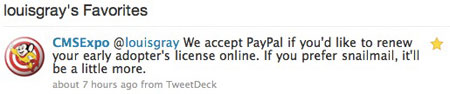
See How Self-Centered I Am?
In Contrast, Robert Is Acting As a News FilterIn the discussion Monday, Robert said that Google Reader was "slower and lamer than Twitter is". That's been a common refrain from people who have said
RSS "is dead". He also mentioned that Twitter doesn't have full text. So let's compare the two.
Advantages: Twitter FavoritesAssuming that Robert is following the same people I am, but on Twitter instead of in Google Reader, Robert is correct that many people post their blog items to Twitter faster than they make it to Google Reader. This assumes that there could be a delay for RSS readers to get new posts of about 20 minutes. Many pieces in the ecosystem are PubSubHubbub-enabled, but not every leg, and therefore, there can be delays.
If Robert favorites a Tweet and that goes to his @scoblefaves account, it can be easily retweeted downstream, further into the network.
3. Some Native Content Is Not Link-Based
There are some interesting observations or comments on Twitter that are not links to a third-party site.
Advantages: Google Reader Link Blog1. Sharing of the Original Source
A shared Google Reader item is one click away from the full source data. A favorited tweet is essentially a share of a share, as the original content is somewhere else.
2. Full Content Beyond 140 Characters
Google Reader items contain as much data as presented in the RSS feed, going beyond the headline, but also including the body text, layout, etc.
Twitter today is still text. Pictures and video from third party services are displayed as URLs, not as the content itself, with one key exception being the Brizzly Twitter client.
4. Integrated Comments On Each Item
Each shared item in Google Reader offers connections the option to have a parallel discussion away from the blog post - something impossible with Twitter, which would instead require a series of replies or retweets.
5. Not All Blog Content Gets Sent To Twitter
I cannot safely assume that every blogger I follow also posts their content as links to Twitter. I cannot also believe that I am following them all, or that I see their every update. Therefore, RSS cannot be replaced.
I am a big believer in RSS and in blogging. I believe
Twitter is infrastructure, and that
it has many uses. I believe that even if it is possible to find links to some content as much as a half-hour before, that it is worth seeing the full content from its original source, and sharing the content in its entirety. I also have two years' worth of inertia into the Google Reader link blog, which is powering my social graph everywhere else. Lastly, I believe that the speed discrepancy we see today is going to improve with greater adoption of tools like
PubSubHubbub.
With the potential for FriendFeed to disappear, I fully understand Robert moving away from his "likes" initiative he had on the service, hoping that moving to Twitter favorites would fill that need. It's a noble approach. Maybe in time others will do the same, much like I followed him to cultivating an active link blog two years ago, and continue today. But we are far from the point where I am going to trade out my current process for something that not only seems less useful, but would certainly be less fun. As long as Web sites still publish and bloggers still blog, there will be room for RSS and room for a great reader and room for sharing. Until that ends, I'll keep going.
 Simler, a fledgling interest-based social network, which I covered in early September (See: