Silicon Valley Technology Commentary & Archives · Est. 2006 3,031 Posts · 2006–2026

December 9, 2009

December 9, 2009 · 3 MIN READ · BY LOUIS GRAY

Fighting Bots With Bots on Twitter, Leveraging SocialToo

Fighting Bots With Bots on Twitter, Leveraging SocialToo

Many Twitter users are caught in an odd conundrum - between being open to random connections and being open to a glut of unfocused spam-like bot behavior. While I believe the allure of high follower counts has largely been eroded, thanks due in part to the controversial Suggested User List and growth of spam accounts with high connection numbers, many still see higher "value" in the raw numbers of the network. So how does one maintain an open door policy that allows for two way direct messaging all while keeping one's stream clean? the answer is different for everyone, it seems, but I thought I would share some of the ways I am leveraging SocialToo, a service I advise, to improve my Twitter experience.

When I first started using Twitter, I enabled autofollow by SocialToo, so I could automatically be connected to people, enable two way direct messaging, and not look disconnected. But as junk followers figured this out, my steam became overwhelmed with direct marketers and news repeaters that didn't add to the conversation. So, while avoiding the option to do a mass unfollowing of all (see a post on that from September), I first turned off the autofollow option and have taken subsequent steps to clean up the results.


TwitterCounter Shows the Drop In My Following Counts


First Step: Block all direct messages that are spam or for viral games.

SocialToo lets me block DMs that contain keywords or search strings like "Mafia Wars". I can either block those DMs outright, or have that person be unfollowed.

Second Step: Block all direct messages that are for phishing schemes.

SocialToo, once notified of an ongoing scam, blocks all direct messages that match a specified string for all SocialToo users, myself included. This way, even though I use a Mac instead of Windows, I won't even be tempted to click on a fake URL, because I'll never even see it.

But even then, I still saw a lot of marketing and garbage in my feed. Preferring not to unfollow everybody and make a mess of things, I started to unfollow junk one by one in my stream, separating the bots from the people. That worked, but it doesn't scale to the thousands of folks who might need 1-1 attention this way. But what I did notice was a pattern. The spammers and repeat Tweeters were almost all using automated tools to generate their dreck, usually from "API" or from TwitterFeed.

Third Step: Ask SocialToo to unfollow all Twitterfeed or Blip.fm or API bots.

I reached out to Jesse and asked him if he could enable SocialToo to automatically unfollow the bots in my stream who I identified were using these tools. In the first two days, more than 1,000 bots were cleaned up, and in the last few months, as I've used this unreleased feature, about 3-4,000 followed have evaporated, leaving me with a still large following count, but a much more relevant count.

Yes, there are some legitimate people using Twitterfeed, and so they too got unfollowed, which leads to stage four.

Fourth Step: Add people to my SocialToo whitelist to never unfollow.


Some of the people I automatically unfollowed noticed and let me know. On other occasions, I found it out myself, and thought that was silly, so I just logged into SocialToo and added them to my whitelist which means no matter the tool they use, they will still be connected.

In the few months of reducing the noise on Twitter, I have reduced the people I have been following from almost 15,000 at peak, to just over 10,000 today. I expect that barring my following more groups of people, this week I should drop below 10,000 total and the service will look better and better.

I may advise SocialToo, but I do so for reasons just like this. Sometimes issues I find can lead to real product features. And while Jesse hasn't yet rolled out the option to unfollow based on a specific source, he may in the future, and you'll see real benefit.

Disclosure: I am an unpaid advisor to SocialToo and have a minor percentage equity stake.

December 4, 2009

December 4, 2009 · 1 MIN READ · BY LOUIS GRAY

FTC Disclosures Made Simple For Bloggers With Conflicts

FTC Disclosures Made Simple For Bloggers With Conflicts

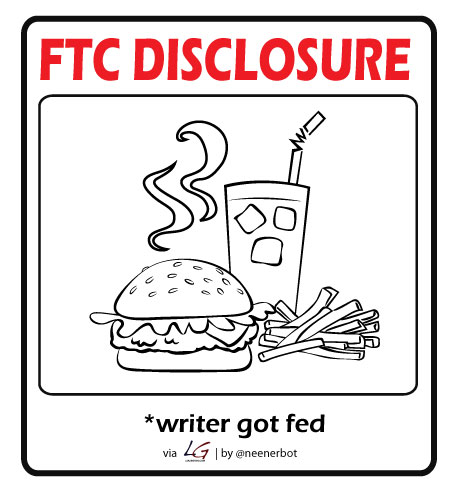
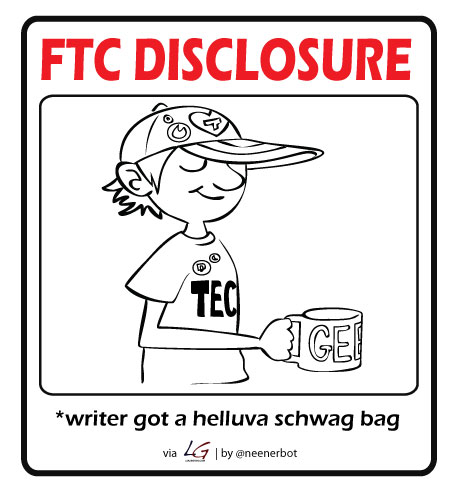
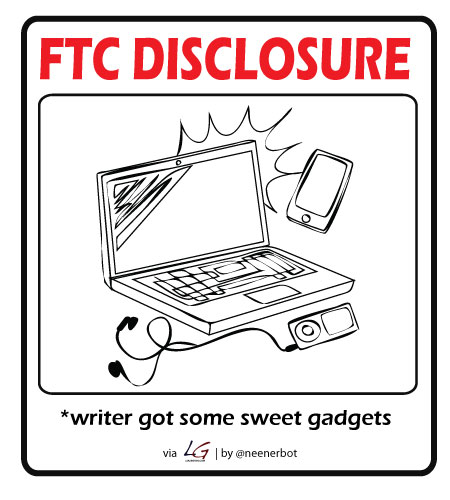
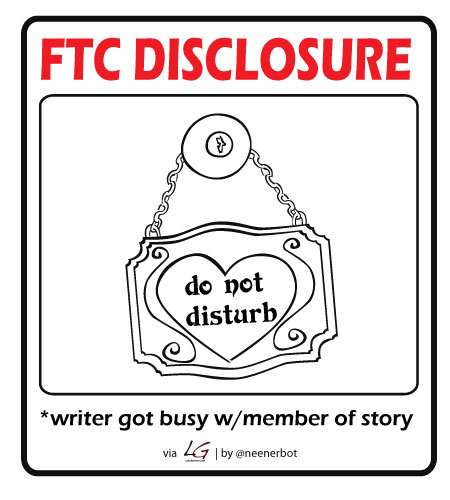
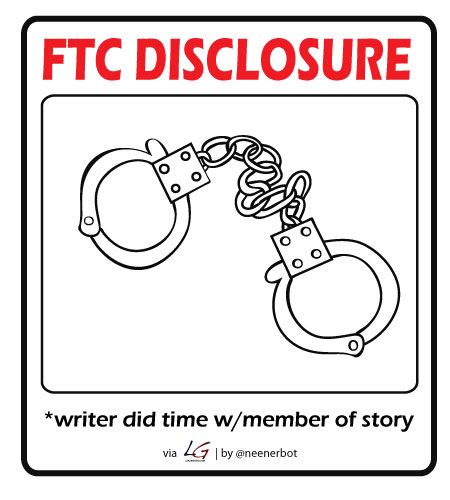
The new FTC disclosure rules for bloggers can be confusing. While many people do their best to explain when they may have received gifts or food or books for free, it's not very easy to know just how to disclose, and when! That's why, with the help of talented artist Jeannine Schafer (@neenerbot), we prepared a set of FTC disclosure icons that will see you through practically any possible conflict of interest.

Scroll down to see them all.

Download your favorites, or grab the entire pack here.


Feeling Guilty from Cover to Cover? (500 px | 250 px | 150 px)


Are Your Stomach and Conscience Both Full? (500 px | 250 px | 150 px)


Did You Make Out Like a Bandit? (500 px | 250 px | 150 px)


Are You On the Take? (500 px | 250 px | 150 px)


Sporting Some New Geek Cred? (500 px | 250 px | 150 px)


Watching the Market A Bit More? (500 px | 250 px | 150 px)


Are You Shacking Up With a Source? (500 px | 250 px | 150 px)


Did You Do Time for A Crime? (500 px | 250 px | 150 px)

Download the Full Set Here. Follow @neenerbot on Twitter. And disclose like your wallet depends on it!
December 4, 2009 · 1 MIN READ · BY LOUIS GRAY

Lazyfeed Real-time Topical RSS Preps Multi-Column Revamp

Lazyfeed Real-time Topical RSS Preps Multi-Column Revamp

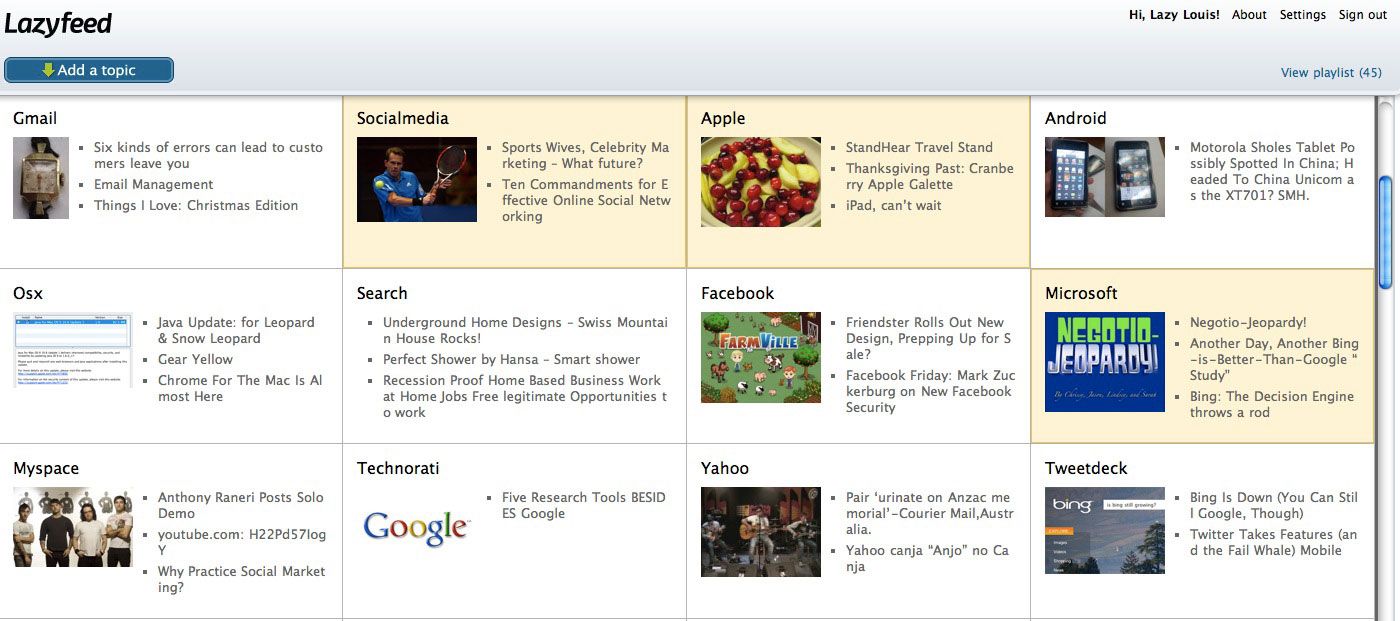
Lazyfeed's real-time discovery engine for following topics has been among my favorite services to debut this year. The service has made following terms I am interested in, and getting live updates as they pour in, very simple - helping me to further populate my Google Reader and other services with new blogs that I can discover as I see their stories on terms I've hand-selected as my favorites. Early next week, the service will see its most-dramatic overhaul thus far, branching out from a single column interface to one that can take up your entire browser window, with a cascading of news, making the experience feel much more visually rich and watchable, like a TV screen.


The New Lazyfeed: Click to See Full Size


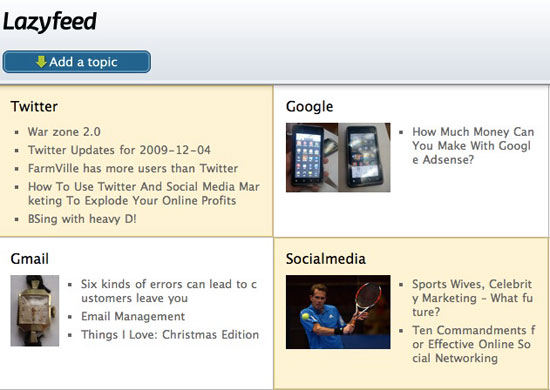
One Corner of the New Lazyfeed as Two Panels Update


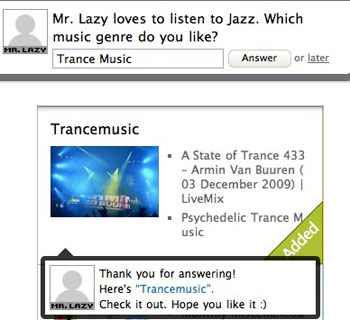
In addition to the revamp, Lazyfeed has introduced a new character, Mr. Lazy, who can prompt you to provide more information about popular topics you may be following, such as your favorite director, if you are tracking Movies or the genre of music you like best, if you are following tunes. When you answer, that answer becomes a new tracked topic, further enhancing your stream.


Mr. Lazy Helps Me Populate More Topics. Lazy!


The new experience of Lazyfeed is one that will make you want to avoid blinking. Instead of a passive "3 new updates" type of approach common to many social networking sites (including Facebook and Twitter), the new Lazyfeed's updates cascade in from the top, by topic, prioritizing headlines and showing featured photos. It's an entrancing visual not unlike the first time one experiences TweetDeck and sees the multi-column format come to life.


I've included a quick little silent film to show the new Lazyfeed in action. Until it debuts, you can still get to all your updates at http://www.lazyfeed.com.

December 3, 2009

December 3, 2009 · 3 MIN READ · BY LOUIS GRAY

Still Waiting for An Evil Google? It's Not Going to Happen.

Still Waiting for An Evil Google? It's Not Going to Happen.

Like many other early adopter technology watchers did today, I tweaked my computer settings to utilize Google's new Public DNS system - letting my Internet usage flow through Mountain View instead of through my cable Internet provider, Comcast. I did so for a few reasons - namely the promise of improved speed during Web surfing and because I trust Google implicitly, almost to the point of unbridled naivete. Google is very publicly working to improve the Web experience for everyone - which has their own best interests in mind, yes, but for the right reasons that extend beyond simple commerce.

While others such as Threat Level and CenterNetworks expressed concern about Google's increasing knowledge base, which now includes the totality of your Web activity, I tend to believe, as Jesse Stay does, that this is just yet another move to prepare the way for the growth of Chrome OS and more Web apps from Mountain View, which will demand greater speeds, reduced load times, and fewer barriers - barriers which other gateways to the Internet have used to block specific application types, Web sites, or protocols, and Google promises not to do.

The more programs and services that Google introduces, the more I see people start talking about Google the way they once talked about Microsoft. Google's mantra to "Don't Be Evil" is seen as a target for detractors who are waiting for the company to slip and become distrusted or hated, the way Redmond, Washington was during their battles with Apple, Netscape and others in the 1990s. But unlike Microsoft, Google has been above board. After a slow start when it came to blogging and transparency, the company is doing, in my opinion, a fantastic job of keeping people updated, and letting its developers be visible to explain away any questions. (See also: The Era of the Faceless Giant Corporation Is Over and Could A Real Apple Fan Completely "Go Google"?)

Google may be creating an incredible ecosystem of interoperating applications, and is setting up connections that set the stage for the way computing is going to be done over the next decade, but just because they have unprecedented resources and remarkable forethought doesn't make them evil. Today, on FriendFeed, as one commenter suggested Google could be sharing this information with the government or other entities, Google engineer DeWitt Clinton answered with clarity, "half the company would quit in protest on the spot if Google even contemplated doing something like that. Including our own founders."

While other services and companies are becoming less trusted over time, be it due to unclear approaches to openness, or inconsistent rejections of third party applications, Google is actually getting better. The company whose name you see on top of new protocols that are setting the standards of tomorrow, like HTML5, potential replacements for OAuth, PubSubHubbub, WebFinger, Salmon, and others, time and again is Google.

One doesn't need to ask Jeff Jarvis "What Would Google Do?" to figure if the company is going to lie to customers and act in an uncompetitive fashion - because they have established a track record of doing the right thing. Introducing a better product than existing services and competing on features is to be respected, not feared. It's when you see companies like Microsoft making inferior products and trying to create side deals to force customers' hands that you see the very definition of evil. And that is why Microsoft is a much smaller presence now than it once was - because it lost the war of trust and is now fighting a battle on its legacy, rather than in a leadership role.

Google is not going to be evil because it hasn't been built to be evil. Will they work to speed up browsers and Web sites to give them more traffic on their search engine and more ads in more places? Sure. But that's just good business, not trickery. For people to think Google would change overnight and start diving into a dark world of privacy violations simply because they launched a new public DNS is silly. Even if Google were to have the #1 Web browser in the world, the #1 OS in the world and #1 mobile handset in the world, they have a track record of establishing trust with their customers, continually working to make their products more accessible to more people. So for the wingnuts wearing the tinfoil hats waiting for the roof to cave in, it's not happening today, and will never happen.