Silicon Valley Technology Commentary & Archives · Est. 2006 3,031 Posts · 2006–2026

December 14, 2009

December 14, 2009 · 4 MIN READ · BY LOUIS GRAY

Companies That Set the Market's Agenda Win

Companies That Set the Market's Agenda Win

When I was very young, I remember hearing the debate in advertising of whether you should mention your main competition by name, or simply allude to them, such as saying "the leading cola brand", or "the leading paper towel", when comparing your product to theirs. While I've often been told you should never introduce your competition into the conversation when with a potential client, the vagueness of alluding to the competition actually has the reverse effect - getting the viewer or reader to think in their mind of just who that leader is, instead of taking in your message - defeating your sneakiness.

If you are a frequent consumer of news or advertising, you can see who is also being smart in terms of setting the agenda by which other competitors are measured, or putting them on the defensive. As a big Apple fan, it is very easy for me to see when Cupertino is pushing the agenda, and when they are not. When they are not, the situation is always much worse. But for any company, if they can set the agenda, and the stage, forcing competition to play by their rules, they have a significant advantage.

The iPhone Agenda: Thousands and Thousands of Apps

First, take a look at the iPhone's success and message:

The phrase "There's an app for that" and the climbing total number of applications has had Apple in a happy place - blowing past 100,000 individual programs. By setting the focus on how many total applications, the handfuls available for the Palm Pre, and the admittedly rapid growing ten thousand from Android seem relatively small. Apple set the stage in terms of how smartphones were measured, not just in terms of forcing a touchscreen, but also in the yardstick being the application store itself.

So long as Apple keeps the lead in total applications, other companies are going to be in a defensive posture when talking about how many programs they offer, or trying to suggest that most people only need a few, or that they have higher quality. It's not a good message.

Verizon's Agenda: Our 3G Coverage Is Better

But look how Verizon changed the game, and threw AT&T under the bus:

After months and months of hearing "There's an App for That", Verizon got sick of it, and started their "There's a Map for That" campaign, saying that Verizon's 3G service is much more widely available than is AT&T. Even if most pundits say that AT&T's 3G service is faster than that of Verizon, the image that remains with people is one full map for Verizon, and a sparsely dotted one for AT&T. AT&T's response to Verizon has been lackluster, not just because they were thrown together quickly, but because they were fought on Verizon's turf, by their rules.

Apple has even had to jump in to bail out their ball and chain network buddy, by trying to highlight the use of the iPhone for voice and Internet at the same time. But the whole time, we're thinking of those darn maps. Point to Verizon.

I'm a Mac, and You're a PC

Sticking with Apple for a bit, the company's Mac vs. PC commercials, as long in the tooth as they are, have set the agenda for how PC users are perceived and how Mac users are perceived, for better or for worse.

Microsoft tried to fight back, on Apple's turf, with it's "I'm a PC" ad line, but that was largely panned and ineffective, because they were unable to wrest control away from Cupertino's mindset.

It wasn't until Microsoft was able to turn the conversation away from "I'm a PC" and to "Lauren" with her low budget to push a different agenda around price that Apple was caught on the defensive.

Setting the agenda is important for any company to promote their agenda. If you are Google, you might once have said your search index is bigger, due to its billions of indexed pages, and that was why you are better - forcing competition to try and show how large their own index was, and coming up short. If you are Facebook, you will highlight your vast population of users, in the hundreds of millions, making competitors fade in comparison.

Will Android Force a New Agenda?

The battle for an agenda is especially interesting in markets that are unsettled, or at a point of change. In addition to the Verizon vs. AT&T battle mentioned before, we are at a very interesting point in the smartphone battles, with Google pushing Android into the market with Motorola's Droid, HTC's Eris and the rumored Google branded phone (coming soon). Droid has tried to make a mark on Apple by saying it "Does" things that Apple's iPhone cannot, but there hasn't yet been a cohesive approach by all Google-powered handsets to promote whatever their agenda will be. Will it be on openness in software? Will it be on openness in terms of supported voice and data carriers? Will there be a killer app that is on Android and not the iPhone at all? And if you are Microsoft or Symbian, or God forbid, Palm... what do you do? You can't win on total apps or touch, or openness, so do you make a new agenda, or call it quits?

I've seen the agenda game play out at previous jobs, and seen colleagues struggle to try and meet the criteria set by the competition - fighting a never-ending battle of certifications and partnerships or benchmarks. While we (and others) spun in place trying to catch up to others' previous mark, the competition nimbly pushed ahead with the new agenda, and changed the game again. It would make more sense to find out, for each of us, what your benefits are and how you can present the agenda to win.

December 13, 2009

December 13, 2009 · 3 MIN READ · BY LOUIS GRAY

Icerocket's Blog Search, Twitter Search Tough to Top

Icerocket's Blog Search, Twitter Search Tough to Top

With all the recent news around Bing and Google making deals with Twitter to gain a foothold in the world of real-time search, not much has been said about the often frustrating world of blog search, and not a peep has been made about Icerocket, a company I'd myself largely neglected until a few months ago, having mentally relegated it to the Technorati-like category of Web 2.0 dustbins. But very quietly, Icerocket has built out what I believe to be the best blog search out there, and its Twitter search is quite potent as well. I have been using it exclusively to find links to my blog, and its relevancy blows Google Blog Search out of the water, barring any upgrades from Mountain View.
Aside from an October post from Doc Searls, Icerocket's improvements have practically been invisible. But it's a disservice to the site, which has easy to find RSS feeds for any search, total number of positive hits in the database by URL, and improvements on the standard Twitter search that include the "smack your forehead and say 'duh'" additions of retweeting and replying to any successful search result, which Twitter's search engine lacks today.

In years past, most bloggers have turned to Technorati or Google Blog Search to find relevant posts. Google Blog Search does a great job finding keywords, and until the most recent revamp, Technorati did the best job in finding which sites were linking your way. (In March, I even said Technorati was trumping Google for blog reactions) The October update to Technorati (covered here) added some interesting twists, but the "reactions" function that I liked has pretty much become impossible to use, or disappeared.

Icerocket, which CrunchBase reports gained its first funding round way back in 2004, from Mark Cuban, has not gotten some of the buzz that other real-time search companies, including Collecta, Topsy and OneRiot, have, but its results are top-notch. Like any good blogger, I've bookmarked a search on the site to find links my way, and more often than not, Google's Blog Search doesn't find them for me in the database.

Compare for yourself: Google Blog Search vs. Icerocket Blog Search


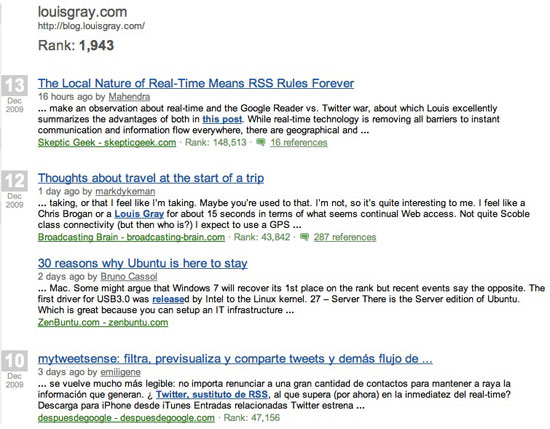
Recent Links to the Blog, Via Icerocket


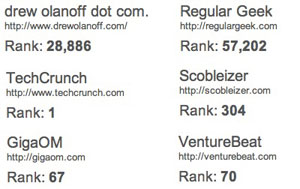
Icerocket does more than just find the most answers. It highlights the ranking of the domain being searched in its database (mine has hovered just below 2,000), and shows the rank of linking blogs - a simple way to assume "Authority", including the total number of references these downstream blogs have. Also, helpfully, the results are sorted by date! Not bad. Google Blog Search won't do that. Icerocket also lets you display total results for a specific post, by URL.


Some Notable Blogs' Rankings in Icerocket


More than 20 Blogs Linked to My Recent FTC Badges Post


Similarly, Icerocket thumps Twitter Search for the same results.

Compare for yourself: Twitter Search to that of Icerocket Twitter Search


Some Twitter Results from Icerocket's Search


Icerocket's Twitter search results are the same as those presented by the microblogging giant, but in addition to the standard responses, you see the number of people following those mentioning a keyword, you see more results on one page, and have the smart additions of "Reply" and "RT" at the end of each result, having you one step away from making an action on the search. In contrast, to do so on Twitter Search, you would need to click the timestamp of the specific update, and then, from that window, hit reply or retweet.

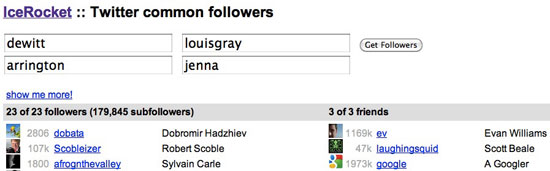
You can even tell Icerocket to show all tweets, just those containing links, or those without links. Also helpful? A cool tool that shows common followers on Twitter of selected users, up to four, saying who follows all of those specified, and who all four follow. (Here's an example with @dewitt, @louisgray, @arrington and @jenna.)


Want to See Who Follows Who? Try Icerocket.


Just about the only thing Icerocket is not doing when it comes to Twitter search results is having the newest flow in from the top to present the illusion of real time. Instead, to get the newest answers, you still have to refresh. It's a small price to pay for a single site that offers great blog search and Twitter search results in one. I've switched. I just wonder if Icerocket, considered an older property, can have new users recognize its new life.

December 11, 2009

December 11, 2009 · 1 MIN READ · BY LOUIS GRAY

Spotify Plans Early 2010 US Launch, Updates Android App

Spotify Plans Early 2010 US Launch, Updates Android App

Spotify, the streaming music service that has taken Europe by storm, has amassed more than 7 million tracks and promises to debut in the US in early 2010, once licensing issues are resolved, according to a conversation I had with Shakil Khan the company's professed consigliere at LeWeb yesterday afternoon in Paris. The company has also embraced mobile access to music, delivering both an application for iPhone and Android handsets (the latter updated just yesterday).

Shakil even said the company could be ready to launch in the US "tomorrow" if it wasn't for business licensing issues, visas, etc.

I gained access to Spotify in early August, and it's the first streaming music service I have ever really liked, going beyond Pandora, Last.fm, Real Player, Napster or any of the others. Once the service hits the US, and I get hold of the iPhone app as well, I could be able to listen to my playlists or selected tracks anywhere, even when offline, thanks to the company storing some songs locally on both the PC and the handset.

Today, Om Malik of GigaOM asks, "How Hot Is Spotify?". Be sure you check out his summary. I have embedded my quick conversation with Shakil below, made via CinchCast. Enjoy.

December 10, 2009

December 10, 2009 · 2 MIN READ · BY LOUIS GRAY

Google Expands Web Elements, Adds Reader, Translate

Google Expands Web Elements, Adds Reader, Translate

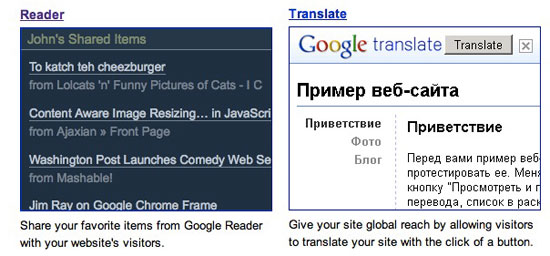
Google is trying to make it ever easier to take little pieces from Google and bring them to your Web site. As the company embraced YouTube embeds following their 2006 acquisition, which have helped the video site become far and away the leader on the Web, the company is extending and centralizing its "Google Web Elements" property, hoping users from around the Web will see how easy it is to add Google content to their Web pages. Each code snippet now leads viewers back to the company's expanding Web Elements section, and today, the company added tools to highlight shared items from Google Reader, enable automatic translation of your Web page into viewers' language of choice, and the ability to share content to their social network, Orkut.


Example Web Elements for Reader and Translate

In a recent meeting I had with Google engineers at the company's Mountain View campus, I was told the expansion of Web Elements is an extension of the company's goal to be open and enable data to flow between sites, rather than keeping all the traffic for itself in a central location. But it is perceived that Google hasn't yet done a fantastic job of highlighting this available content, so, starting today, Web Elements on downstream sites will feature a Web Elements logo and click through to the service's directory.

The addition of the three new items brings the list of currently available Web Elements to eleven, joining Calendar, Conversation, Custom Search, Maps, News, Presentations, Spreadsheets and YouTube News. One assumes that Picasa albums or other Google properties can't be all that far behind.

The Google Reader shared items Web Element isn't all that different from the JavaScript code I have featured on my site the last few years, but it puts the option in a more visible place, and sports the Web Elements logo. The Translate feature doesn't rely on a pull-down menu option on each active blog, but instead, gets triggered when it is detected the visitor has a native language other than the content's tongue. Sharing on Orkut is nothing dramatic, acting like the "Share to Facebook" icons common around the Web.

The story of content going viral is well-known. Seeing YouTube on practically all downstream videos made YouTube a market leader. Similarly, in earlier days, the Hotmail text in Hotmail messages encouraged friends to sign up. If Google can provide enough widgets in their Web Elements area and can show real value that is easily discoverable, it isn't too far out of line to see these new products popping up more and more around the Web. Go find them at www.google.com/webelements.