Silicon Valley Technology Commentary & Archives · Est. 2006 3,031 Posts · 2006–2026

January 8, 2010

January 8, 2010 · 2 MIN READ · BY LOUIS GRAY

The CES News River Sends Gadget Blogs Into Overdrive

The CES News River Sends Gadget Blogs Into Overdrive


Google Reader Volume Spikes During CES

Watching the trends in technology news publications is a lot like watching the seasons. It's fairly predictable, and has its ebb and flow. The more sites and stories you read, the greater the value, and the more "liquid" the pace seems to be, as spikes and valleys are smoothed. But no more evident is the acceleration clear from one week to the next as the week of CES, the Consumer Electronics Show, following the hangover doldrums of a post-Christmas holiday. The glut of news from this week, with CES kicking off in Las Vegas, not to mention Google's Nexus One announcement earlier on Tuesday, has most prominently put gadget blogs Engadget and Gizmodo into hyper mode, with many other tech outlets looking to draft behind their lead.

While this is not a huge surprise that both blogs are stepping on the accelerator for this event, the data shows just how much more.

In the last few months, it has not been uncommon for me to scan about 1,000 articles a day in Google Reader - skipping most, sharing a few, and reading others in full. Giving 10 seconds to each story means about 3 hours a day, and 5 seconds a story makes the time needed about 90 minutes.

In the lead-up to Christmas, and the week afterward, my usual forays into Google Reader, as well as FriendFeed and Twitter, were significantly lightened, with news at near standstill, saw fewer items at a pass, totaling about 700 items a day, and half that on the holidays themselves, or on weekends, scraping just over 200. Quiet indeed.
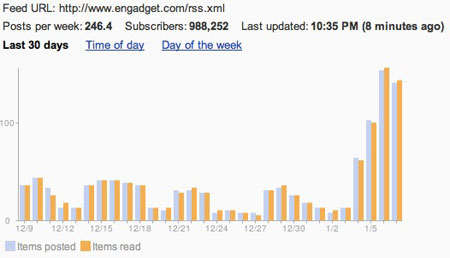

Engadget's Coverage Skyrockets During CES Week


But in the last two days, by themselves, Gizmodo and Engadget have delivered well more than 200 posts per day. While Engadget delivers an already-aggressive 40-50 stories on a given workday, the CES waterfall has pushed them to triple or quadruple output, with about 150 new stories flowing. (Keep in mind they are the official blog of CES, so many stories are no doubt prepared in advance.) Meanwhile, Gizmodo, no slouch at about 70 items a day per usual, is keeping apace with just under 150 items a day. This acceleration with both sites, as well as the padding from traditional tech networks that are also following CES, has pushed my aggregate workload to about 1,300 items a day, double the holiday rate, and 25% ahead of normal.
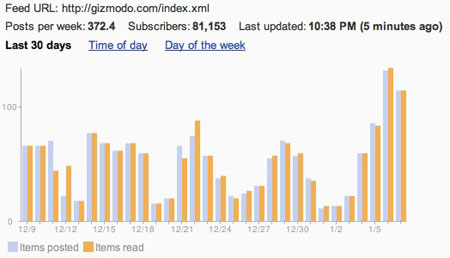

Gizmodo Doubles Down Efforts for CES

There are other ebbs and flows you can count on from the tech Web. You can always expect spikes around Macworld and other Apple events, and you can expect drops on US-only holidays like Memorial Day and the Fourth of July. But there's nothing like CES for pushing the sheer volume of coverage up to a new level. The coordination required by an editorial team at Engadget and Gizmodo on the week of CES is sure to be intricate, and is something to be impressed with indeed.

Of Note: Chris Saad recommends checking out CNET's CES River as well for CES News and updates.

January 7, 2010

January 7, 2010 · 2 MIN READ · BY LOUIS GRAY

eBay No Bargain for Nexus Ones, Pricing Well Above Market

eBay No Bargain for Nexus Ones, Pricing Well Above Market

In the wake of Google's Nexus One introduction on Tuesday, many tech writers were abuzz not just about the company's new self-branded Android model, but the ease of how the product was being sold, at http://www.google.com/phone, and with the option to select an unlocked model, one with a T-Mobile contract, or soon, bundled with contracts from Verizon or Vodafone. Some saw the move as Google's big step into e-commerce, letting you buy the phone direct from them, and not through a carrier. But this hasn't stopped some aggressive folks from flipping the phones on eBay, where excited buyers are ignoring the sticker price, and plowing well beyond the $529 offering (for an unlocked phone), resulting in no bargain at all.


Google Will Give You an Unlocked Nexus One for $529

It isn't much of a surprise to see Nexus Ones springing up on eBay so soon after the launch. Be they phones from Google employees themselves, from those who attended the press junket, or just fast buyers, it's common to see people send them to the popular auction site in a chance to make a few bucks. But bidders who see the price crest toward $529, should they be savvy enough to know about the Nexus One, probably should be savvy enough to know they aren't getting a great deal.

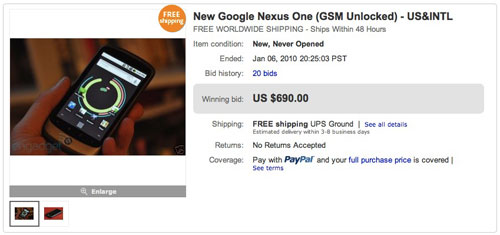
If you look at Nexus One offerings on eBay, you can see many phones offered to "Buy It Now" for about $750, but those aren't getting a whole lot of bids. In fact, most are at zero. But you scroll a bit lower, to the $650 level, with time remaining, and you can see bids happening, as folks are paying premiums of $100 or more for the privilege of buying on eBay instead of from Google directly.


Just $810 Gets You a Nexus One on eBay

No... it doesn't make much sense to me either. I even found one auction that closed this evening where the final price for a Nexus One soared to $810, a premium of nearly $300.


Or You Could Pay Almost $700 In A Different Nexus One Option...

Google has also made links to the Nexus One phone visible on the Google.com home page. Some are noting the new "ad" on the site, which in conjunction with the Chrome dropdown if you aren't using their browser, makes two house ads. But it looks like even this promotion isn't getting to those who don't know they can go direct and save themselves some cash. That's what happens when a hot product hits a market and people want to get their hands on one fast, to be first in line. Forget rationality. They just want it ASAP.

January 6, 2010

January 6, 2010 · 2 MIN READ · BY LOUIS GRAY

Cliqset Upgrades Aggregator With Groups, Activity Streams

Cliqset Upgrades Aggregator With Groups, Activity Streams

Despite my comments last week on the mainstream's reticence to adopt aggregation sites on a wide scale, there remains a desire by many in the technology community to build a site that pools all one's activity from around the Web while setting a foundation for discussion. Today, Cliqset, which is chomping on the heels of FriendFeed in the features department, if not the activity department just yet, added several new capabilities that make the site very compelling - including my personal favorite, highly customizable streams by service and individual.

Today's announcements include major revisions and a redesign of the product's user interface, the ability to share files natively to the site, a new (for them) groups functionality that lets people talk on specific topics, and the aforementioned activity stream filters.

I talked with Darren Bounds, Cliqset CEO, yesterday, and he said "the biggest problem with aggregation is handling the firehose and being able to manage it in a good way."


Setting Up an Activity Stream Filter on Cliqset

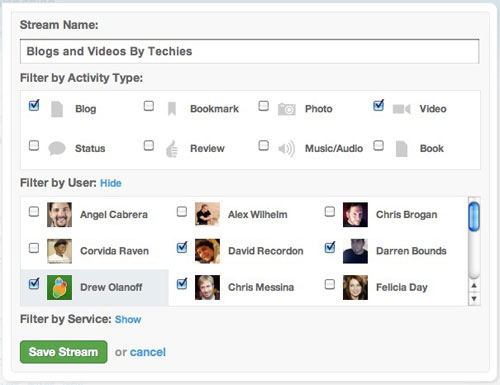
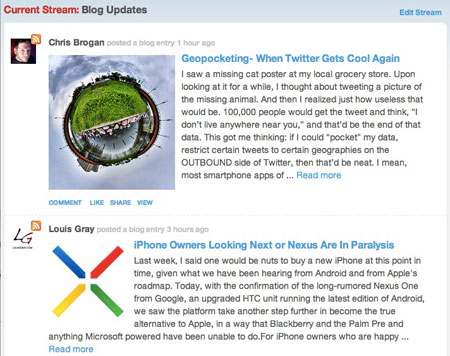
As many users of aggregation sites can find the overall activity intimindating, the new activity stream filters let you granularly create personalized sections of the site which can display specific types of updates, specific services, or even selected users. For example, I could decide to see all blog posts from all Cliqset users in one stream, or make a dedicated stream just for the busy Twitter streams from Chris Brogan and Robert Scoble.


A Filtered Stream of Blog Updates on Cliqset

The additions of file sharing and groups match those from FriendFeed, who similarly lets you share office files, MP3s and PDFs with the community - an interesting but not often used capability. The addition of Groups similarly matches FriendFeed's Groups functionality, once called Rooms.

Like FriendFeed, Cliqset is also making the rapid discovery of data and real-time streaming of content a priority. Last month I highlighted the service's adoption of PubSubHubbub, and Darren reiterated that focus yesterday.

"Every activity that is generated for groups or users gets pushed to the Google Hub," Darren said. "For subscribers, we look at every feed and API we integrate with and look for PubSubHubbub information and look for those feeds."

Today, Cliqset has a relatively small population of users, but as with many sites like these, the potential for more activity through growth provides serious potential. The company is focused on become a highly functional swiss army knife for Web service updates from around the Web, and now, native on the site. You can find me at http://cliqset.com/user/louisgray

January 5, 2010

January 5, 2010 · 2 MIN READ · BY LOUIS GRAY

iPhone Owners Looking Next or Nexus Are In Paralysis

iPhone Owners Looking Next or Nexus Are In Paralysis

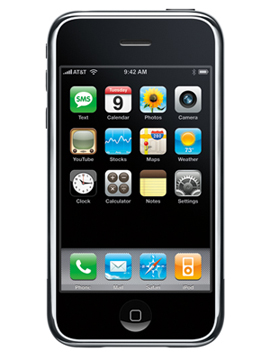
Last week, I said one would be nuts to buy a new iPhone at this point in time, given what we have been hearing from Android and from Apple's roadmap. Today, with the confirmation of the long-rumored Nexus One from Google, an upgraded HTC unit running the latest edition of Android, we saw the platform take another step further in become the true alternative to Apple, in a way that Blackberry and the Palm Pre and anything Microsoft powered have been unable to do.

For iPhone owners who are happy with their platform, and think it's amazing, the news of the increased competition may mean very little. They still have access to the most robust application store in the world. They still have excellent integration with their desktop machines, especially their Macs. And they can be confident knowing that the product will continue to be upgraded.

But if you're an iPhone owner who is either tired of the limited carrier choices, or if you're simply curious about Android, or if you prefer Google's applications and approach moreso than you do the Steve Jobs way, today's announcement has to give you immediate pause. Not because it instantly vaporizes the iPhone's lead, but because of the same reason we all should be watching the creep of the Chrome OS - because it's not just about now. It's about next.

Switching smartphones (no superphones for me, thank you) is not as easy as it used to be when one dropped a Nokia for a Sony Erricson or a Motorola with little thought. Now, you're as married to a platform as you are to your operating system. Now, because of the application store, and all those hooks that I warned about in September of 2008, you are going to be giving up a lot more than one unit for another, but literally throwing away tens to hundreds of dollars of applications you may have purchased, which will either have to be purchased again on the new platform, or may have no equivalent at all.

With the cost of data plans and voice plans and hardware and applications, the true cost of a smartphone over the lifetime of the product rivals that of top of the line laptops, so the same kind of thought and shopping around once reserved for a day to day computer is the same kind of thinking now necessary for the unit you're going to clip on your belt and call your parents with.

In December of 2008, I said there are two phones in this world, those that are iPhone and those that are not. That's clearly no longer the case. You either have an iPhone or an Android, or an also-ran, and I believe that BlackBerry's position is niched in businesses, away from the consumer, with Apple and Google in the driver's seat for the foreseeable future. But even if you've run the specs and like the iPhone better, or you have an iPhone and think it's still the best, when it comes time to buy again, you just might take serious pause, and have to go through analysis paralysis.

I talked more about this very real issue this afternoon on a CinchCast, embedded below: