
Silicon Valley Technology Commentary & Archives · Est. 2006 3,031 Posts · 2006–2026

February 22, 2010

February 22, 2010 · 1 MIN READ · BY LOUIS GRAY

Latest Twitter Hires Pull from Yahoo!, IBM for Search and UI

Latest Twitter Hires Pull from Yahoo!, IBM for Search and UI

Today, Todd Kloots (@toddkloots) joined Twitter after more than seven years at Yahoo! as a front-end engineer focused on the Yahoo! User Interface (YUI) library for interactive Web applications, after previous work on the company's massive Yahoo! Mail product, where he worked on the service's front-end and design. Todd's joining Twitter continues the company's growth, pulling like a massive magnet from Silicon Valley's top companies toward the blue-logoed beacon in San Francisco, following hires from Facebook, Google, and other Valley leaders.


Kloots, who is credited with 10 years of web dev experience, joins Twitter a week or so after Michael Busch (@michibusch), who worked at IBM for the last five years as a software engineer and architect, joined the company as a search engineer. His LinkedIn profile says he was focused on "indexing, search and scale-out" for IBM's eDiscovery Analyzer product. As mentioned frequently here, Twitter's mountain of data badly needs some strong attention toward indexing and scale-out, so his hire looks to bode well for making their search tools more relevant.


Jesse Stay and others highlighted Busch's hiring last week. Also noted last week was Twitter's crossing the 140th employee mark, a milestone for the company obsessed with 140 characters. (In the comments, a fellow Twitter employee says Michael was not #140) Jesse also highlights Busch's background with the open source Lucene search project.

You can see Kloots' presentation of the new YUI 3 at Yahoo! from the fall of 2009 at the Yahoo! Developer Network for an idea of his previous work.

February 19, 2010

February 19, 2010 · 1 MIN READ · BY LOUIS GRAY

Google Buzz Reduces Power Users' Bumpage

Google Buzz Reduces Power Users' Bumpage

Being a top Google Buzz user, or even engaging with one, has come with some assumed disadvantages, as one of the product's built-in features has been to highlight activity on a feed by bumping active items to the top. For users with a few dozen followers, this is fantastic and keeps their feed moving. But for those with a few thousand, it can seem like they are "dominating" the discussion, and I've even seen people say they are unfollowing said "popular" folks for this very reason. As of this evening, that problem is being lessened.

Using the Buzz service as their blog, the official Google Buzz Team account said quickly:
"If you're following someone with a ton of followers, you're probably used to seeing their posts at the top of your stream all the time, since we've been bumping them back up with every new comment. Starting a few hours ago, we made some changes to not bump them up as often."
With about 2,200 connections, and some active participants who have been used to acting on my feeds from Google Reader and FriendFeed, I have seen the consequences of this multiple times, and it's been among the major sources of pain for the young service.

So, if you unfollowed me, it just might be safe to come back. If you were scared to make a comment, for fear your in box would be abused, don't hold back. You can get connected here: http://www.google.com/profiles/louisgray. It's probably also safe to refollow Pete Cashmore, Robert Scoble, Jason Calacanis or Kevin Rose again too, so go nuts.

While not all folks are fans of Buzz, the team has made a lot of visible changes in an action-packed two weeks. To me, that bodes well for their future development, and today's move aids the signal to noise ratio once again.
February 19, 2010 · 2 MIN READ · BY LOUIS GRAY

Blogger and Google Reader Speed Up, Suggestions Improve

Blogger and Google Reader Speed Up, Suggestions Improve


Two of the major outlets where I produce content and consume content, both from Google, took steps forward on Thursday, as Blogger announced new improvements to load slow-performing pages more quickly, and Google Reader unofficially made a big move, with the likely addition of Pubsubhubbub support, which makes the service real-time enabled both incoming and outgoing. Meanwhile, in a separate announcement, Reader promised improved recommendations for you to find new sources to follow - including similar sites per feed.

I've been talking up Pubsubhubbub for months now, because it is the engine that is playing an ever-increasing role in pushing my data faster and faster from site to site. Google Reader shares had already been powered by Pubsubhubbub to flow downstream, but it had been widely assumed Google Reader was not using the same kind of lightning speed to get updates as blog posts were added. Starting today, Jesse Stay and others figured out they had flipped the switch.

An Instant Update from Posting to Reader

As others confirmed, and I saw later also, posts that used to take upwards of half an hour to hit Reader, without manual polling, were there practically instantly, showing 0 minutes to 2 minutes of delay. With FeedBurner also Pubsubhubbub enabled, there should be no latency between when I hit the publish button, and the posts hitting FriendFeed, Buzz Twitter and Reader all at once now.

Google has recently been talking a lot now about making page load times a more important element of how they are ranked in the company's search engine. This leads to the next announcement, from Blogger, who says that traditionally slow-loading pages, including label pages and archive pages, are now going to auto paginate these pages to deliver speedier load times in the browser. They are guessing not only will pages load more quickly, but total page views will go up. Always a good thing.

Reader Puts Me In Good Company

Recommendations from Coding Horror

Reader's move to Pubsubhubbub was likely part of a larger code push from the team, which did announce improved recommendations for new feeds. Now, in addition to tailored recommendations for you, you can click any feed and see what they believe are similar sites. For example, I found that Reader finds me most like Lifehacker, ReadWriteWeb, Engadget, GigaOM and Walt Mossberg. All very cool recommendations. I also found out that Reader finds Loic LeMeur's blog to be most similar to TechCrunch, Seth Godin's blog, Guy Kawasaki and Robert Scoble. I doubt Loic is complaining either.

The amazing thing about this new feature? It was my #1 request way back in March of 2007. It took almost three years, but it's finally here, and I'm going to spend some time finding new sources to follow.

February 18, 2010

February 18, 2010 · 4 MIN READ · BY LOUIS GRAY

Quality Music by Cloud, Managed by iPhone, at Home

Quality Music by Cloud, Managed by iPhone, at Home

The new musical centerpiece in our home doesn't have an LCD display to tell me the music playing. It doesn't have preset stations, or an antenna. It doesn't have a slot for one or more CDs, and it doesn't even have a dock to hold my iPhone. It just looks like a fashionable speaker , and the only buttons it has are small and simple. Volume up and down or Mute. Why? Because this new device, the Sonos S5, pulls all of its music from the Web, and is fully controlled by my iPhone or desktop application, without suffering any of the tinny, lower quality audio I've come to accept through computer speakers and other devices. And if I had a bigger house, I could play the same music throughout the house simply by getting another unit. Someday...


The Sonos S5 Unit Has No Face, But Lots of Good Sound


On Saturday, the doorbell rang with a somewhat surprising delivery package. Sonos' PR team, which contacted me late last year, which I hadn't been thinking about, had sent me the stereo, and a hub to connect to my home network to try. Within 15 minutes, I had the hub connected to my Airport network, the stereo sitting in our living room, and was tapping in to my Last.fm account, Sirius Radio account and could even get local radio stations of all sorts.

The stereo's arrival couldn't have come at a better time for two reasons. The first reason is that the Bose soundsystem with iPhone dock I got a little over a year ago recently stopped working, for who knows what reason, and we have had to take it out of commission for repair. Second, the Sonos extends my continued efforts to be less reliant on local media, and more reliant on data stored elsewhere - best exemplified by my purchase of the MacBook Air and recent avoidance of iTunes, iPhoto, PhotoShop and other "heavy apps".
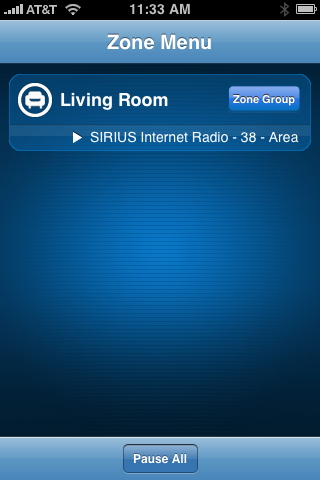

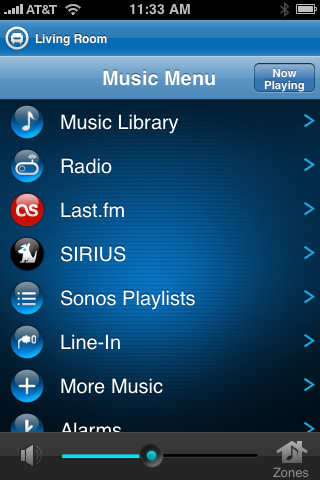

Sonos' iPhone App Controls the Stereo's Music
And Where It Is Played In the House


I am no audiophile, but I do listen to music a ton, and enjoy having good songs on when I am at home - especially as the twins both enjoy dancing to tunes with any kind of rhythm. With the Sonos, I've played with getting one of the kids to be dancing in front of the unit, only to pause it remotely with my iPhone, which stops them in mid-shake, only to look back at me with curiosity and disdain.

Managing the Sonos via iPhone has been a huge plus to a home already covered in a fine layer of remote controls. Instead of yet another remote to chase down when lost, or moved by a toddler, I just use the Sonos Desktop controller or the free iPhone app. From the iPhone app, I can navigate between different music sources, and see which song is currently playing. If I had multiple units, I could see what song is playing on each unit, and possibly even play different songs in different places. The absence of setup is also a solid benefit to the Sonos. The first step was to configure a small hub, to sit atop my Airport Extreme, looking like its younger brother, and the second step was to connect the Sonos to power. It pulls down the music wirelessly from the hub, and no other wires had to be configured - as it should be.
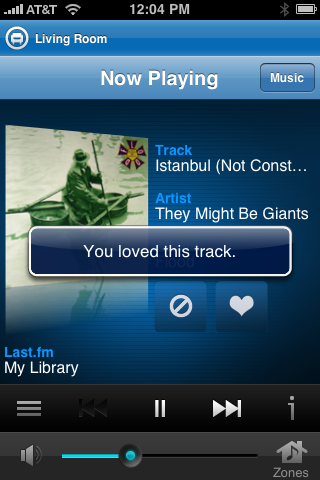
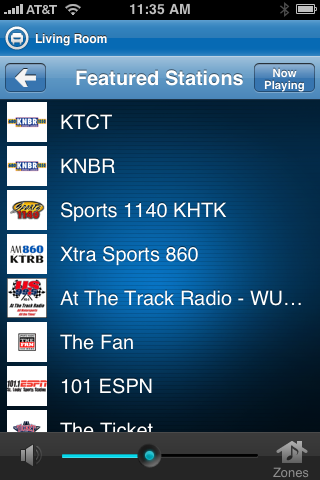


Sonos Shows Local Radio Stations
And Lets Me "Love" Last.fm Tracks


If there is anything to complain about with the Sonos, it's that it doesn't feature Spotify support right away. But considering that Spotify is not truly out in the US yet, I can't make too much of a fuss. If the music is available on a hard drive from your network, Sonos can find it, and Sonos also supports Pandora and Rhapsody in addition to Last.fm and Sirius, which I use.
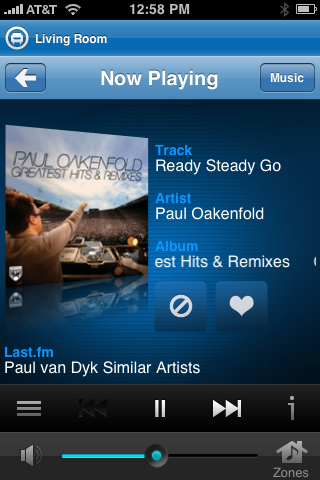


Cranking Tunes from Sirius and Last.fm
Brings Paul van Dyk to the Home Stereo


If you were curious, and in the interest of full disclosure, as always, yes, the device was initially shipped to me free of cost, but in the interest of being fair, and not seeming biased, I have already contacted the Sonos PR rep to make sure I can purchase the unit. As for that old broken Bose, if we ever do get it fixed, maybe we can let it be handed off to someone else in the family who needs one, because it looks like we have a real replacement.

For another review of the Sonos S5, which is making its way around many tech blogs this month, see Rick Klau's extensive writeup. He has been a loyal customer for three years.