My first two years in Silicon Valley were spent in Burlingame at a dotcom that hoped to revolutionize telecommunicatons online - with Web meetings, conference calls and even faxing from the Web. They had great services, but not enough customers, and eventually ran out of funding in early 2001, jettisoning marketing, sales and business development folks, before selling for scraps to Oracle.
Being in Marketing myself, this meant it was my first trial to try and find a full-time job, in a world where online job databases were taking over. I'd polished the resume and started applying at anything that sounded close to what I thought I did...
Web Marketing Manager... E-Marketing Manager... Marketing Manager... Internet Marketing Manager...
Keep in mind this was a time when companies knew the Internet was a humongous deal, but were still trying to figure out where the money was coming from. The dotcom stocks had gone to the moon and crashed down. E-Business firms were raising tens of millions to figure out how put supply chains on the Web, and it could be hard to separate the real from the fake.
Meanwhile, with the crush of aspiring gold-seekers flooding to the Valley, hoping to win the stock option lottery, traffic was a mess. I used to compare driving 101 South to parallel parking at 70 miles an hour -- just a zoo. So very quickly, the location of where I could start was just about as important as the starting salary. Belmont was better than Palo Alto. Mountain View better than San Jose. Maybe I could even walk.
I tweaked my CV as best I could and threw it on Monster and Dice.com and all their clones, hoping to break through the noise. Here's what Dice.com looked like back then.
One of my job hunting volleys reached a company who so obviously needed my help. Their website was this hideous reddish purple and their icon looked like a squished crow. But they promised big things with revolutionary shock waves. I applied for the role of eMarketing Manager, to aid with promotion and copy, and redo their Website.
They asked me to come in for an interview and I pored over their site, ready to talk about how they needed to tailor their content for who their visitors would be -- investors, partners, analysts, and yes, customers. I studied the site in and out and felt prepared.
That Monday, sure their headquarters was in some garage somewhere, with like maybe 5-8 guys who couldn't write, I rolled in ready to tell them the ins and outs of marketing and publishing on the web. I pulled into the parking lot on Bernardo in Mountain View. Across their lot was Placeware, the Web meeting company eventually purchased by Microsoft. And one building down -- Handspring, the exciting handheld company run by Jeff Hawkins and Donna Dubinsky in their follow-on from Palm.
Instead of less than a dozen people, Synaxia had a quiet swarm of folks. About 50 were in Mountain View, and they'd raised two rounds of funding, for about $35 million. I still didn't really know what they did.
The first interviewer, a director of product marketing, and I went back and forth as I kept sounding confused as to their promise. He said they made the Web faster with specialized network servers. I thought they competed with Akamai. He said no. Maybe Akamai would be a customer? No. I felt a little stuck, as he talked about host bus adapters, raid arrays, and fibre channel.
So I went to what I knew - Web sites. As I began my spiel, he shook his head and stopped me.
"Louis, the Web site is a fake. The company name is a fake. In two months, we're going to rebrand and launch our product, so none of this matters."
I felt like my legs had been pulled out from under me, that I may as well just leave, but I was young enough (and likely cheap enough) that they didn't give up on me, even as I got through two more people.
My final interview was a friendly, older, and heavier guy, with short cropped white hair, folded arms resting on his belly, and an ability to talk your ear off. He was the vice president of marketing. I had 30 minutes with him, and for 20 minutes or so, he yammered on about the state of Catholic high school athletics, and told me about his kids, or told me stories about his career. He seemed very nice, but I was scared he wouldn't get a chance to learn about me at all - let alone figure if I was worth hiring.
Before I had felt like I even had a chance to get a word in edgewise, he interrupted, and said, "Look, if you got to me, you'll be fine," and just as quickly, he was gone -- off to the next meeting.
Years later, he would constantly tell me how he had been the reason I was hired, that I had been his discovery, and he took all the credit for my accomplishments. A fantastic boss, but an even better story teller.
A few days later, I got a call that offered me the job. I had no idea, really, what kind of salary to ask for, but, having just finished my double major from Berkeley, and getting two years under my belt, I was looking at a 50% raise over my last job. It seemed like so much money -- commensurate with being able to deliver a brand new website in about 30 days (which my designer and I managed).
I agreed to the job, and the pay bump, and my excitement lasted almost a full workday.
On the first day, HR asked me to sign papers to complete my employment, and I added my signature with enthusiasm. I walked back to the HR manager's desk, and she opened a folder titled "E-marketing manager". The first page in the folder was a job description (mine) with a salary range.
The bottom of that salary range was above where I had signed, and the top of that range went a full $30,000 higher. I immediately felt like I was underpaid, and I'd have to work a decade before I felt like I'd caught up. But I managed to get the job at the stealth company, and their fake website -- lasting 8 1/2 years, until I left in 2009.
Above is one of the last real ones I published, after multiple generations of product and many hundreds of customers. (And eight bosses. I outlasted everyone I interviewed with)
Showing posts with label Work (88 posts). Show all posts
October 17, 2018
January 9, 2018
Space Fillers and Superstars: Silicon Valley's Divergent Career Arcs
Career Paths Are Often Circuitous Routes
My career in Silicon Valley started before I'd even graduated from college. Rather than plug away at Berkeley and try to get top grades, I split my time my senior year between going to classes and commuting across the Bay Bridge to Burlingame, working for a revenue light startup during the initial dot com boom. By the end of 2018, I will have completed twenty full years in the Valley.
In these twenty years, I've been laid off. I've been promoted. I've fought for raises and rejected stock offers. I've co-founded my own consulting business. I've worked at startups with three people, ten people and two hundred. And for the last six plus years, I've been at Google, which can hardly be called a startup.
In these two decades, I've seen companies lay everyone off firsthand, and had another acquired. I've pitched Sand Hill Road for venture capital funding, been part of corp dev talks about a possible acquisition, and even filed for IPO. I've worked with billionaires, millionaires, neighbors, and colleagues straight out of college, with debts to pay.
And while I've been lucky enough to accumulate 15 years of work at just two jobs, that is fairly unusual for the industry. Some estimate the average software engineer, used as a metric for the average employee in our tech-centric world, is only 1 to 3 years. (Source)
Underneath the headlines and noise of product announcements, and seeming get rich quick ideas, the reality is the overwhelming majority of Silicon Valley employees are role fillers, who just get things done. Some are living month to month, and others are more comfortable. But for each example of wunderkids who get lucky on their first try, you have cubicle dwellers whose LinkedIn history won't have you blinking an eye. And the Valley needs these people. Hundreds of thousands of them.
The Intersection of Skill, Luck and Loyalty
Marissa Mayer famously put together a rubric after completing a Symbolic Systems degree at Stanford to determine where she would take the leap from her 14 job offers, and Google was seen as having the greatest upside. Tough to argue against those results, and hindsight is 20/20. Yet a close friend of mine who graduated from the same school with the same major is as anonymous as they come, with a pedestrian career. There's no discounting Marissa's hard work and ambition, but not everyone gets lucky.
In 2009, I wrote about this magical intersection of skill and luck - where good people work incredibly hard at toxic companies, or doomed dinosaurs. There are tomes to be written about the worker bees of the Valley who come in and work hard for a full day's pay to make all the services go, but aren't job hopping for the latest startup du jour, instead hanging on with loyalty to the company even if the company doesn't return the favor.
Roll the Dice or Buy a Lotto Ticket
For every superstar like Marissa, there are thousands more stories like my friend and others who just missed. A decade plus ago, I had a roommate who passed up being one of the first 25 employees at Google, so he could instead finish his PhD. (He is now a professor at NYU)
The more cynical among us could say that aggressively enterprising workers should quickly hop from job to job and ride the rocket to financial happiness, and yet another group will say that if the current workplace isn't looking like a lottery ticket, you should quit and form your own startup. It certainly looks easy enough, with so many ideas landing venture funding.
Venture capitalists will tell you they are looking for that elite leader, the masterful person with unique product vision and market awareness - a founding team with impeccable credentials. But every decision is a bet. The VCs and companies make bets on the staff, and the staff makes bets on the companies each day they show up. Sometimes you win the jackpot, sometimes you push, and other times, you could lose it all and have to start over.
Among a world of aspiring superstars, a much more common, but also important, role played out daily amidst the rows of cubicles and open office spaces in the Silicon Valley is an army of people making it all run, quietly.
Disclosures: I briefly overlapped at Google with Marissa from 2011 to 2012. Also, if you must know, I attended UC Berkeley, a natural rival of Stanford. But that's not really super relevant.
October 13, 2015
Layoffs and Loyalty in a Liquid Valley
Layoffs Are Painful. Even if the X Doesn’t Land on You
(Image: Dreamstime)
(Image: Dreamstime)
In two cases, the startup I worked for ran out of funding, and once, the new VP wanted to change things up, bringing in somebody they previously worked with instead of going with the team they inherited. When it comes to a debate between the company succeeding versus your being comfortable, the CEO will never pick you.
Layoffs initiate feelings of numbness and outrage, fear and self-doubt. People cry at almost every layoff, even if their jobs were spared. Others yell or curse under their breath as they are escorted out of the building, having already handed in their security badges and seeing their work files, along with hundreds or thousands of email threads, no longer relevant, slip from their view.
I’ve seen companies hire armed guards to patrol the building, in case of retaliation, and once arrived at work the morning after a reduction in force to find a brick had been hurled through the HR VP’s office window, making the premises a crime scene.
Layoffs suck. Getting laid off sucks. Seeing coworkers lose their jobs sucks. Laying people off.. sucks. When a company cuts staff, they are admitting something has failed and needs to change. They’re not growing fast enough. Too many people were hired to do not enough things. Something isn’t working. Today, Twitter laid off 336 people. That’s a lot. Not the 30,000 reported layoffs at HP, but a significant number, one that wasn’t supposed to happen at one of the tech industry’s most discussed companies.
In recent months, gallons of digital ink have been spilled on the frothy technology market we see today. Talk of unicorns and skyrocketing Bay Area housing prices focuses a microscope on the top one percent of success, while many on the outside look in wonder why they haven’t joined the vaunted three comma club. Effort and skill aren’t enough. You need luck too.
I’ve been lucky enough (so to speak) to be present at a number of layoff rounds in my near two decades in the Valley. Let’s talk about it. It’s human.
After eight months as an E-commerce analyst at a low-revenue startup during the dotcom heyday, my boss rolled up to my desk in his chair, and in halting English, crowned by his Russian accent, told me the lead investor was done with his little experiment, and we, in two weeks, would no longer have jobs.
His crowning quote: “You and Ferris (my colleague) are laid off. I am fired.”
More: Real Valley Stories: You Stay, Your Boss Has to Go
Somehow I escaped that layoff with my desk intact. I took a different role with the sister company in the same building. While that was unusual, and I put in nearly two solid years at the company, it too fell on hard times.
Our $1 million in seed funding (at a $10 million valuation) was running dry. By the end of 2000, we were asked to work without salary, waiting for a follow-on round that never came.
A few weeks into the new year, my boss, the VP of Marketing, called me into a meeting to say he was laid off. In fact, all of sales, business development, and marketing, myself included, were done. Only the engineers would stay behind to clean up the mess.
I lingered around the full workday, wasting time on the Internet, until a friend flew into the San Francisco Airport, as we were set to go to MacWorld Expo the next day. He helped me lug my PowerMac G4 and monitor to my car, and I was done. The next day we saw Steve Jobs introduce iTunes.
After a brief three weeks out of work, which seemed like an eternity, I landed at a fast-talking hardware storage startup with $30+ million in the bank, en route to a 72 million Series C round that May, which valued us above $300 million. But our gaudy goals, combined with product slips, ruthless competition and a shocked economy after 9/11 meant we just weren’t meeting expectations.
With rumors buzzing in the hallways for weeks, we cut 15–20% of staff on a Friday after Halloween, said goodbye to our crying coworkers, and were battered by a huge reality check. Our charismatic CEO swore up and down in a mandatory all hands meeting that afternoon in the company breakroom that we would never have to experience this again. He was wrong.
Five months later, we had another all hands meeting. But our CEO was missing. In his place, the chairman of the board, who informed us that he, not kidding, was the new CEO and that our previous CEO was visiting family, in Italy.
There was no mob hit, but the following week, we browsed the Active Directory from our Windows machines at the office, and quietly sat shocked as we saw red minus signs on dozens more of our coworkers, whose accounts were immediately made inactive.
I looked up to see two of my best friends in the hard working Inside Sales team grab boxes at their desk, and punched the cubicle wall.
That afternoon, our Marketing Communications Manager, on his honeymoon, called me at my desk to ask about the rumors. I couldn’t tell him that by the time he got back to the office, he’d be without a job. The next Monday, he packed up and joined the ranks of the unemployed.
Having somehow lived through the post 9/11 recession, raising money when we needed it, and delivering a product that just enough customers liked for us to keep the VC checks flowing in, we were on our third CEO, fifth head of marketing, and fourth sales lead. Or something like that. Our stock options had been reverse split twice, first at a 550–1 exchange, and later, 40–1. They were worthless. So there was a lot of grumbling.
Amidst the grumbling, some things were working. The product was starting to find a niche. A few verticals swore by it. And we were able to raise a series AA - a recapitalization that essentially rebooted our financial valuation, and trashed the cap table, wiping out previous investors.
One of the requirements to the raise? Another reduction in force. But this time, instead of sacking the underperforming or most-recently hired, the company excised the bad apples who talked badly about leadership and expected failure.
When their pink slips came, they were happy to get them, and the company was happy to see them go. My old boss, and the IT manager, who closed his own account, literally had tee times set up at the golf course that afternoon, and groused about how long the layoff was taking, so they could make their appointment.
As I pored over the tech newswires, I saw news that our chief competitor,NetApp, had missed earnings, and cut hundreds of jobs. Our newest marketing VP, the sixth to hold the role, had joined us from the NAS storage giant, so during our sales meeting, I tapped her on the shoulder and gave her the news. Her eyebrows shot up. She got up from her laptop, grabbed her phone and went to the hallway to start making calls.
One of those calls was to an ex-colleague of hers who had been impacted. The new marketing VP’s vision? Bring her old friend in as someone she knew, and give me the gift I’d watched play out in front of me many times — the layoff.
By April, I too got pink slipped and was on my own. My running clock of eight and a half years of loyalty got reset to zero.
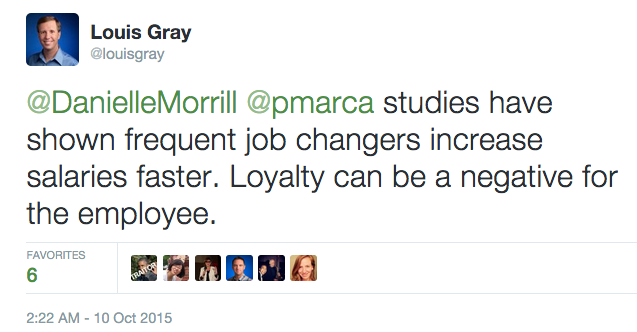
You can lament the frequent job changers,
but the company doesn’t have loyalty to you.
In business, and particularly in the insular, navel gazing, Silicon Valley, it’s easy go Pollyanna and only talk about good news. The billionaires. The parties. The VC funds and App Store rankings. On the flip side, it can be easy to demonize the bad actors or complain about traffic, and the ripples of corporate decisions. But the truth is always in the fuzzy middle.
Loyalty is wonderful when you find a passion and team you can believe in. But it can all be discarded in an instant, through a fight with a manager, or a merger or acquisition that sees you as redundant. A stock market crash. A change in heart. A bad quarter.
Layoffs happen. They can make you question everything you worked for. All the thousands of hours you put in caring about the little things that got you to where you are. All the conversations and debates that made the product you own.
You have to reexamine what’s important and decide on a new trajectory. And it’s okay to take time to both feel and to heal. Being emotional is part of what makes us human, even in a data-driven world being taken over by robots. So yes, it hurts, and you are going to be angry. Furious even. But being laid off in 2015, in an active tech job world is a much different event than in the tighter, pessimistic environments of 2001 and 2008.
Twitter’s job losses today won’t be the last we’ll hear from current and past unicorns. Those who ride the highest, like Icarus, can be burned by the sun.
Disclosures: I work at Google, which is an occasional partner to Twitter, and assumed competitor in some ways. I have friends at Twitter. And any examples I use here related to my previous work experience are intended to be accurate, even if I missed a date or anecdote.
November 26, 2013
Working at Google is Living in the Future
It's been about two and a half years since I joined Google.
After years of getting to know the company's people and culture nearly as well as I knew their products as a user and as a blogger, I picked up a badge in 2011, and have spent most of my waking hours during the weekdays since in Mountain View. I currently run Google Developers Live.
There are many assumptions about Google out there. I read lots of them. I hear others. Knowing the company and its people as I did when I joined meant I wasn't dramatically surprised by much - but one of the core things that is assumed to be true externally and remains true internally is that working at Google is like working in the future. That's true not just for visibility into longer-term projects which are secret or fall into the category of speculative, but also when it comes to day to day.
It's not uncommon, as an employee, to be aware of future announcements, to be using new services and applications, and more commonly, future versions of these services. Those of us who actively participate in 'dogfooding' of new things have to do an internal check to remember just what features are already out and which ones aren't yet, which devices are launched and which ones aren't, and where's a safe place to use apps to avoid curious eyes and hands. It can even get exciting when one makes a screenshot on their computer or phone, and has to take a quick scan to make sure nothing that's not supposed to get out to the public yet does.
Keeping a mental checklist of what's launched, about to launch, and hasn't launched requires some sort of cerebral gymnastics - making public discussion a challenge for those who have an engaged community, and cementing some introverts' decisions to remain quiet, for the best avoidance of risk is to say nothing and let those who run comms to run comms, after all.
Getting my occasional glimpse into the future here at Google was a definite contributor to the slowdown of posts and observations of the tech industry at large, starting in 2011, after regular daily posts for years many of you got used to. It wasn't just that people assumed I had newfound biases and conflicts due to working for one of the most active and influential companies on the planet, but also because, as you can expect, knowing our future roadmap made comments on current deliverables by us or by others more problematic.
For example, since the world adores car analogies, it's hard to get excited about the 2013 Audi S4, if you work in BMW's concept car division. "Hey! Nice car... now get back to work."
Google's openness is no ruse. It's well-documented that the company, for the most part, has an open sharing policy internally, so those working on one product likely know what the other products are doing. One can easily discover launch schedules and product cycles company-wide. Often, products depend on the other to release improvements to bring value to their own. Instead of a completely siloed organization where working on one project means that's all you know, the average Googler can know, with some small effort, what's next from most places. And this is a good thing in my view. For some incremental risk of leaks, you gain improved collaboration, expanded testing, additional rounds of feedback and reduced paranoia.
Living in the future can be good, especially when you get access to the newest phones, apps and Chromebooks, all in the name of testing. It can be fun to test new services, like Shopping Express, all in the name of being a good corporate citizen. And yes, it can also be challenging, especially, as you can imagine, if you're using two new things in combination, and can't figure out which team should get your filed bug - only that you know it should work better. So yes, we file the bugs so you don't have to see them. We also shield you from a good amount of user experience awkwardness, and in rare cases, can completely change the face of a product before it reaches your computer or smartphone.
By definition every technology company is by some extension working in the future. What's shipped is usually the most stable version of whatever build had to be cut that day, or the highest quality device that could be shipped to the retailer or in time for the scheduled launch event. The one that's not shipped has more features, costs less and is faster, or so they always say. But Google is a different beast, given its incredible ambition.
The company that was once easily defined as "the Mountain View search giant" is doing much more and thinking about ways to leverage technology to improve many facets of our existence. You could be measured by what you used to be, or who you are today, or you could set your sights further ahead, toward the realm of improbability. We call them moonshots. And that stretch goal is where the future is. That's the excitement. We may be experiencing the future every .1 upgrade at a time, or with every notification on Android that our apps need to be updated, but there's more to it, and being inside the Googleplex is a unique experience.
If you want to join us at Google, check out http://www.google.com/about/jobs/ and send me an email.
Disclosure: I work for Google. That's what this post is about. Nobody reviewed this.
August 15, 2013
Real Valley Stories: Emailing the Company About Future Layoffs
Editor's Note: Part 9 in an irregular series of stories from my 15 years in Silicon Valley. Part 8 talked about how I determined I was undervalued at work, and started a process to catch up. This time, another real example from the trenches, about how I once prematurely notified the entire company layoffs were coming - and the effort to undo that mistake.
After the dot-com crash and subsequent recession in the early part of the last decade, many venture-backed companies, including my own, were fighting to stay relevant and alive in a suddenly more challenging environment, where customers were exceptionally risk-averse, going with what the vendors they knew and not the ones they didn't yet know. With this challenging landscape as a backdrop, one of the storylines that emerged was not so much one of thriving, but simply survival - and if there was an opportunity to get positive press simply for sticking it out, even if we weren't hitting on all cylinders, it was one we'd go for.
At that time, in early 2002, one of the roles I held for the company in marketing was internal communications. As we gained customer wins, case studies, press releases and press mentions, it was typical for me to take the story and send it to one of our many Exchange distribution lists to the company so we could all share in the good news. I'd add a one-paragraph intro, send it off and watch the backslapping and replies come in. Sometimes, I didn't even have to do a lot of the work, but I always got some of the credit.
One morning, my news alerts on the company turned up an interview our CEO had done with the Wall Street Journal. I'd known the story was coming, and as I read it, the CEO talked about how we had scaled back our goals from our original unrealistic expectations, had tightened our budgets and had even been forced to do some staff reductions. That last part seemed odd to me, as we hadn't done any reduction in force, but seemed to make sense, as two of our senior vice presidents, one in product marketing and one in sales, had left the previous month.
As with all our news bites, I copied the text in full, excerpted the relevant quote and emailed it to the company, positioning the news as our showing strength in a tough economy. This bit of work done, I then went to the next task at hand, where my desk voicemail was lit, showing I had a message. I listened, with some horror, as it was a message from my boss, having been left earlier in the day, saying specifically, "Louis, don't send the Wall Street Journal story to the company," which I had, of course, just done.
I stopped what I was doing, and sheepishly made my way to his office, not only ready for a verbal dressdown, but also curious why this piece was so particularly volatile. I knocked on his door and told him what had happened.
"Goddamnit, Louis," he snapped. "You have to recall that message, immediately..." along with a few other choice words, saying that the very first thing I should be doing every day is checking my voicemail and I should have known better.
Attempting to recall the message from the few-hundred person company wasn't perfect, as you can imagine. Those who had already seen the story hit their Outlook inboxes wondered why I'd recall a story from a paper as impactful as the Journal, which only further raised suspicion about what the CEO had said, or I had relayed. My own inbox filled with each individual recall success or failure, and needless to say, I was in my boss' doghouse for the remainder of the day, if not a bit longer.
Two days later, the layoffs preannounced in the Journal came true. That Friday, Silicon Valley's traditional day for eliminating positions, welcomed us with moving boxes and practically every conference room booked for a series of brief one on ones. There was frustration for some, tears for others, and relief for those who probably wanted out. More than one person came by my desk, knowing then what we had figured out earlier in the week, that the layoffs made the Wall Street Journal before they had even taken place, and the CEO had so matter of factly mentioned it, in a national publication.
For months afterward, as you can imagine, the very first thing I did when I got to the office each day, before email or grabbing a Diet Coke even, was checking my voice mails. I became even more careful as I shared news and announcements with our internal mail lists, to avoid anything that could possibly be interpreted as bad news, or an executive saying something he shouldn't. And yes, we had future rounds of layoffs, as the company cut itself practically in half before growing again to surpass its original peak, eventually filing for IPO, twice, and getting acquired.
Telling the Wall Street Journal about planned layoffs before the people impacted were told was bad. Sending news about that layoff to the very people who were going to lose their jobs was bad too. I never made that mistake again.
After the dot-com crash and subsequent recession in the early part of the last decade, many venture-backed companies, including my own, were fighting to stay relevant and alive in a suddenly more challenging environment, where customers were exceptionally risk-averse, going with what the vendors they knew and not the ones they didn't yet know. With this challenging landscape as a backdrop, one of the storylines that emerged was not so much one of thriving, but simply survival - and if there was an opportunity to get positive press simply for sticking it out, even if we weren't hitting on all cylinders, it was one we'd go for.At that time, in early 2002, one of the roles I held for the company in marketing was internal communications. As we gained customer wins, case studies, press releases and press mentions, it was typical for me to take the story and send it to one of our many Exchange distribution lists to the company so we could all share in the good news. I'd add a one-paragraph intro, send it off and watch the backslapping and replies come in. Sometimes, I didn't even have to do a lot of the work, but I always got some of the credit.
One morning, my news alerts on the company turned up an interview our CEO had done with the Wall Street Journal. I'd known the story was coming, and as I read it, the CEO talked about how we had scaled back our goals from our original unrealistic expectations, had tightened our budgets and had even been forced to do some staff reductions. That last part seemed odd to me, as we hadn't done any reduction in force, but seemed to make sense, as two of our senior vice presidents, one in product marketing and one in sales, had left the previous month.
Wait... You're Saying I've Been Sacked?
As with all our news bites, I copied the text in full, excerpted the relevant quote and emailed it to the company, positioning the news as our showing strength in a tough economy. This bit of work done, I then went to the next task at hand, where my desk voicemail was lit, showing I had a message. I listened, with some horror, as it was a message from my boss, having been left earlier in the day, saying specifically, "Louis, don't send the Wall Street Journal story to the company," which I had, of course, just done.
I stopped what I was doing, and sheepishly made my way to his office, not only ready for a verbal dressdown, but also curious why this piece was so particularly volatile. I knocked on his door and told him what had happened.
"Goddamnit, Louis," he snapped. "You have to recall that message, immediately..." along with a few other choice words, saying that the very first thing I should be doing every day is checking my voicemail and I should have known better.
Attempting to recall the message from the few-hundred person company wasn't perfect, as you can imagine. Those who had already seen the story hit their Outlook inboxes wondered why I'd recall a story from a paper as impactful as the Journal, which only further raised suspicion about what the CEO had said, or I had relayed. My own inbox filled with each individual recall success or failure, and needless to say, I was in my boss' doghouse for the remainder of the day, if not a bit longer.
Two days later, the layoffs preannounced in the Journal came true. That Friday, Silicon Valley's traditional day for eliminating positions, welcomed us with moving boxes and practically every conference room booked for a series of brief one on ones. There was frustration for some, tears for others, and relief for those who probably wanted out. More than one person came by my desk, knowing then what we had figured out earlier in the week, that the layoffs made the Wall Street Journal before they had even taken place, and the CEO had so matter of factly mentioned it, in a national publication.
For months afterward, as you can imagine, the very first thing I did when I got to the office each day, before email or grabbing a Diet Coke even, was checking my voice mails. I became even more careful as I shared news and announcements with our internal mail lists, to avoid anything that could possibly be interpreted as bad news, or an executive saying something he shouldn't. And yes, we had future rounds of layoffs, as the company cut itself practically in half before growing again to surpass its original peak, eventually filing for IPO, twice, and getting acquired.
Telling the Wall Street Journal about planned layoffs before the people impacted were told was bad. Sending news about that layoff to the very people who were going to lose their jobs was bad too. I never made that mistake again.
March 11, 2013
Video: Getting the Attention of Influencers and Bloggers
Having been somebody on both sides of the startup and blogger equation, I know how hard it is for new companies, products and ideas to get visbility and break through the noise, grabbing the attention and sustained interest of early adopters, influencers and users. Today on +GDL (Google Developers Live, the program I run at +Google), I sat down with colleague +Don Dodge to share some of my own experiences and talk about this very thing.
In the discussion, about 20 minutes, I talk about working with +Edwin Khodabakchian of +feedly, +Iain Dodsworth of TweetDeck and more, as some examples of sharp people who engaged with me in the many thousands of posts that have found home on +louisgray.com. This event is one in a series we're calling Root Access, targeting startups and developers on Google Developers Live. Find many more events, publishing every workday at https://developers.google.com/live.
February 10, 2013
Don't Confuse Effort With Results
Posting that you're "Hustlin'" doesn't provide you with a higher paycheck.
"Hustlin'" doesn't make your product better, or your sales pitch any more strong. It probably doesn't have a lot of impact on the macroeconomic climate, and shouldn't sway consumers to your company instead of that from the competition. Similarly, there are no certificates given for the most harried-looking people, who can often be seen running around stressed from meeting to double booked meeting, and saying they can't possibly be aware of your last update, let alone the outside world, because they are snowed in under a mountain of e-mail.
What I've seen from my near 15 years working in Silicon Valley is that, often in concert with our "burn the midnight oil" philosophy, people aggressively try to prove their value through how busy they appear. Yet for every salesperson or product marketing manager who can't get back to you, there are anonymous genius coders who still manage to surf Reddit and take casual lunch breaks without the company falling apart.
Being excessively "busy" is not to be celebrated. Instead, it could be displaying that you are overmatched in your role. Work is not supposed to be a life of leisure, but if you really do have thousands of unread items in your email box (I've seen people with almost 100,000 and usually have zero myself), or can't find a hole in your calendar to "catch up", there's probably something wrong with your time management.
Meanwhile, the simple fact that you took an effort isn't something you can cash. After one too many failed demand generation campaigns or trade shows that didn't pan out, I remember my boss, the VP of Marketing, saying "Don't confuse effort with results." Just because I, and my team, had worked hard didn't mean the numbers were there to justify what we had done.
Admittedly, it's especially easy in Marketing to do activity for activity's sake. How many weekly status meetings have I endured, hearing people run through their list of completed tasks that may not have pushed the ball forward, but instead kept them occupied the previous week? How many client meetings and vendor calls and messaging workshops were less than impactful? After a while, it's as if there are three different groups in the room - those who realize the activity is just to say something happened, those still talking, and the last people who haven't gone yet, waiting to fluff up their own reports to outdo the last guy.
The secret comes in determining the right measurements and data that shed light on where you can make impact. Carving away the bits that are trivial, and hitting the Archive button instead of reply, can be transformative for you and your goals.
That's not to say a strong work ethic isn't valued. I've never been very good at taking vacations and often joke that if you are a salaried employee, there are no days off, as you're paid the same any hour of the day, year round, not just Monday to Friday. But being good at what you do is made even stronger when you're efficient at it, and accomplish all you need to. That means not feeling the need to tell the world you're "Hustlin'", not having to declare email bankruptcy, or looking like you're in the midst of drowning when deadlines approach.
Being busy doesn't make you incredible. Being incredible can make you busy. Some of the best people in technology know when to turn off all the distractions so they don't crush everything in their path. Even Facebook's COO, Sheryl Sandberg, famously leaves work at 5:30 every evening, and maintains successful life balance. The thought is, "if she can do it, why can't you?", but the underlying issue is one of prioritization, filtering and execution when much is expected.
Just because you put in the hours, hustled a little bit and did what was expected, doesn't always mean the results will be there. You have to know what your goals are, and watch your results constantly to tie activity to impact. So the next time you read that someone is "Hustlin'" or run into a colleague who can't wait to tell you how busy and overloaded they are, just wonder why that is, and how you can avoid it.
November 27, 2012
Real Valley Stories: Rejecting the Closed Envelope
Editor's Note: Part 8 in an irregular series of stories from my 13 years in Silicon Valley. Part 7 talked about the leveraging your assets to get your way. This time, a real example of knowing when you're undervalued, and how to get what you deserve.
Not every Silicon Valley company has a smooth trajectory, and neither does the average career. Startups fail and career paths stall. You can run into bosses that don't get you, miss promotions, or find yourself excelling as a rare star at a company that simply isn't going anywhere. Fairy tale stories are often just that - fairy tales. In the real world, you need to be executing on what you've been asked, but constantly assessing your place, if you are rightly fit, or on a path to what you want to achieve.
Being a long-time employee for most of the last decade at a startup that went through many funding rounds and saw a practical carousel door in the VPs and CEO office, it probably comes as no surprise that I accrued a solid amount of company history and irreplaceable knowledge, but had to continuously reprove myself to new people who had just joined. Sometimes, the convincing was easy, through consistent work, but other times, it seemed nearly impossible, as if we were two people speaking a completely different language.
If explaining one's work product or role in a shifting company was hard, it was equally challenging to assess if an employee was compensated appropriately relative to their peers, if promotions had regularly taken place, and if one's stock options were valuable or worthless, depending when they came into the company, what round of funding we were aiming for at the time, or how well they had negotiated coming in the door.
After one recapitalization round, which had essentially wiped out our existing shareholders and started over, I found myself in a meeting with our VP of Marketing, talking about my job performance and how the company planned to reissue options to employees so we weren't completely underwater, having watched our existing stock reverse split to hell. As he tried to put me at ease that I was being taken care of, he reached forward, past his computer monitor, to a stack of white envelopes, the top of which had my name on it.
Inside the envelope, presumably, was the latest stock option grant - a new gift of shares in the company, which, once again, would maybe be worth something if we went public or were purchased, but were just as likely to expire worthless, as all the others had. As he lifted my envelope up and tried to give it to me, I interrupted and said, in a rare point of clarity, that I didn't want it, and no matter what it said, it wasn't what I deserved.
This startled him a bit, and I explained that I was familiar with how stock options were allocated, with the CEO and board of directors taking their share after the VCs had their stake, followed by the senior management team, the VPs, the Directors, and eventually, the working stiffs like me. I knew that my previous humility and hard work had set me up to get screwed, again, because I hadn't fought harder for a bigger title and all the rewards that came with it, from salary to stock.
Following on, I addressed the issue directly, saying I'd never been one to fight for promotions and titles, that I just wanted to do a good job, but that I had seen the only way one could get promoted or get a raise at the company was to solicit an offer from a competitor, only to rescind it later. I looked my boss straight in the eye, and coldly said, "Let's skip that step."
The move was a gutsy one, but one I felt I had every right taking, having committed untold hours and several years of my career already into the company, without being promoted, and getting the stock options others with higher job titles were no doubt getting. My boss and I spoke further, and he heard me loud and clear. The envelope went back on his desk, and we wrapped the meeting, my heart beating quickly, but my mind feeling steady. As I headed back to my desk, he did exactly what I had hoped he would, taking a two door trip down to the VP of HR's office to discuss the situation.
A few weeks went by, but shortly afterward, I was invited back into his office, this time with a plan that included a new envelope, with new numbers on it. In addition to the new stock options offer, I was given a promotion, and a plan to work my way into a second promotion the following year, that would see a commensurate salary increase and stock option bump. As time went on, true to his word, and due to my own efforts, of course, that too took place - as the company, with my VP, recognized the value I had brought for years, and continued to bring, and helped me take on more responsibility and finally be compensated the way I thought I should.
As I wrote in July about leveraging one's assets to get one's way, the risk I took was one where I was arguing from a position of strength. I was confident that I was delivering good work that I could be proud of, which could be measured. I had seen other great colleagues get stuck in their careers, and have to get alternative offers from competitors before seeing a career bump with our firm. I knew nobody wanted that headache, and that I could get other jobs if my brazen act went sideways. But it didn't. I knew the sealed envelope didn't have what I wanted, and I knew I was in the position to call them on it.
There are times to be humble, to keep your head down and do your work. There are sometimes economic realities at companies and industries which might prevent you from getting what you think you deserve. But if there's a mismatch between what you're delivering, and you see an opportunity, assess where you are and take the opportunity to make it right. Good people and good companies never want to see the strong talent go out the door, and happy employees usually end up working even harder and being more loyal. I'm glad I finally found a VP who got it and was willing to listen. And that's a real Valley story.
Not every Silicon Valley company has a smooth trajectory, and neither does the average career. Startups fail and career paths stall. You can run into bosses that don't get you, miss promotions, or find yourself excelling as a rare star at a company that simply isn't going anywhere. Fairy tale stories are often just that - fairy tales. In the real world, you need to be executing on what you've been asked, but constantly assessing your place, if you are rightly fit, or on a path to what you want to achieve.Being a long-time employee for most of the last decade at a startup that went through many funding rounds and saw a practical carousel door in the VPs and CEO office, it probably comes as no surprise that I accrued a solid amount of company history and irreplaceable knowledge, but had to continuously reprove myself to new people who had just joined. Sometimes, the convincing was easy, through consistent work, but other times, it seemed nearly impossible, as if we were two people speaking a completely different language.

If explaining one's work product or role in a shifting company was hard, it was equally challenging to assess if an employee was compensated appropriately relative to their peers, if promotions had regularly taken place, and if one's stock options were valuable or worthless, depending when they came into the company, what round of funding we were aiming for at the time, or how well they had negotiated coming in the door.
After one recapitalization round, which had essentially wiped out our existing shareholders and started over, I found myself in a meeting with our VP of Marketing, talking about my job performance and how the company planned to reissue options to employees so we weren't completely underwater, having watched our existing stock reverse split to hell. As he tried to put me at ease that I was being taken care of, he reached forward, past his computer monitor, to a stack of white envelopes, the top of which had my name on it.
Inside the envelope, presumably, was the latest stock option grant - a new gift of shares in the company, which, once again, would maybe be worth something if we went public or were purchased, but were just as likely to expire worthless, as all the others had. As he lifted my envelope up and tried to give it to me, I interrupted and said, in a rare point of clarity, that I didn't want it, and no matter what it said, it wasn't what I deserved.
This startled him a bit, and I explained that I was familiar with how stock options were allocated, with the CEO and board of directors taking their share after the VCs had their stake, followed by the senior management team, the VPs, the Directors, and eventually, the working stiffs like me. I knew that my previous humility and hard work had set me up to get screwed, again, because I hadn't fought harder for a bigger title and all the rewards that came with it, from salary to stock.
Following on, I addressed the issue directly, saying I'd never been one to fight for promotions and titles, that I just wanted to do a good job, but that I had seen the only way one could get promoted or get a raise at the company was to solicit an offer from a competitor, only to rescind it later. I looked my boss straight in the eye, and coldly said, "Let's skip that step."
The move was a gutsy one, but one I felt I had every right taking, having committed untold hours and several years of my career already into the company, without being promoted, and getting the stock options others with higher job titles were no doubt getting. My boss and I spoke further, and he heard me loud and clear. The envelope went back on his desk, and we wrapped the meeting, my heart beating quickly, but my mind feeling steady. As I headed back to my desk, he did exactly what I had hoped he would, taking a two door trip down to the VP of HR's office to discuss the situation.
A few weeks went by, but shortly afterward, I was invited back into his office, this time with a plan that included a new envelope, with new numbers on it. In addition to the new stock options offer, I was given a promotion, and a plan to work my way into a second promotion the following year, that would see a commensurate salary increase and stock option bump. As time went on, true to his word, and due to my own efforts, of course, that too took place - as the company, with my VP, recognized the value I had brought for years, and continued to bring, and helped me take on more responsibility and finally be compensated the way I thought I should.
As I wrote in July about leveraging one's assets to get one's way, the risk I took was one where I was arguing from a position of strength. I was confident that I was delivering good work that I could be proud of, which could be measured. I had seen other great colleagues get stuck in their careers, and have to get alternative offers from competitors before seeing a career bump with our firm. I knew nobody wanted that headache, and that I could get other jobs if my brazen act went sideways. But it didn't. I knew the sealed envelope didn't have what I wanted, and I knew I was in the position to call them on it.
There are times to be humble, to keep your head down and do your work. There are sometimes economic realities at companies and industries which might prevent you from getting what you think you deserve. But if there's a mismatch between what you're delivering, and you see an opportunity, assess where you are and take the opportunity to make it right. Good people and good companies never want to see the strong talent go out the door, and happy employees usually end up working even harder and being more loyal. I'm glad I finally found a VP who got it and was willing to listen. And that's a real Valley story.
August 2, 2012
All Hands Meetings: Good, Bad and the Ugly
Whether at a startup or a Fortune 500 company, culture and communication with colleagues can have an incredible impact on morale and the bottom line. Amass enough naysayers, and the negative inertia can drag down the optimists. Similarly, a well-timed rallying cry can spur troops to close out the quarter on an up note, and help others be willing to work extra hours for a shared goal. One of those opportunities for shared discussions is the company-wide all hands meeting, led by management, typically starring the CEO. In my dozen-plus years in the Valley, from the tiniest of startups, to my current role at Google, as you can imagine, I've seen a variety of ways a company's culture was approached, and how these all hands meetings could take on a life of their own. A recent story by All Things Digital's Kara Swisher regarding rumored changes at Yahoo! following Marissa Mayer's joining the company as CEO has had me thinking about some of the crazy things I've seen since the end of the '90s in such meetings, both good and bad.
The first company I worked, Internet Valley, didn't ever grow to the point where All Hands meetings made sense. We had 3-4 employees, and our boss simply had to scoot his chair back and speak to the two of us worker bees to have a discussion.
After that dalliance came and went, at my second company, 3Cube, I was one of about a dozen people, mostly engineers, we had All Hands discussions to announce good news on product, business development or in fund raising. I remember when we raised $1 million in seed funding back in 1999, at a valuation of $10 million, and spoke of plans to get the next round at $10 million with a $100 million valuation, if our goals were met. Our CEO, and the rest of us, were excited. As drinks were poured, we joked that the million bucks, split about 10 ways, would be a fun run to the Mexican border, if nothing else. We also used the All Hands format to discuss new partners, and ready product rollouts.
I joined BlueArc in 2001, and initially, during our glowing phase when we came out of stealth and made our first customer shipments, our All Hands meetings rallied the company for a common good.
But almost immediately afterward, due to our own issues and economic uncertainty, those disappeared. In a year's time, the three All Hands meetings we had were to discuss two separate rounds of significant layoffs, with a CEO change in the middle for good measure - on April Fools' Day, no less. We knew that if an All Hands meeting popped up on our calendar for the upcoming Friday, there was a good chance you should back up all your email on Thursday. All Hands meetings were brutal and scary.
As those of us left behind muddled through, we gained a new Marketing VP in 2002, and we survivors recounted the situation. Unsurprisingly, he was appalled, and helped us restart semi-regular meetings, where we didn't fear for our jobs or the company's livelihood. For the most part, the meetings, held once a quarter or so, recapped the last three months of sales, and highlighted our pipeline. But even those meetings started to take on a Twilight Zone feeling, as it seemed our CEO would talk about how we had not met sales expectations for the quarter, but we would still get some bumbling engineer to ask how his stock options were doing - seemingly oblivious to the fact that we were going nowhere fast.
Those meetings were also memorable for the inevitable sales guy calling in to the conference line in the car with the top down, and not being muted. Nothing like the entire company waiting around while the CEO barked into the Polycom for whoever it was to "PLEASE MUTE YOUR PHONE."
After a few years of this nonsense, and a few Marketing VPs later, I previewed to the latest guy exactly how the quarter's All Hands meeting would go down, with specifics on the CEO's nuances, the sales guys' excuses, the engineers' begging for stock updates, and more. When he viewed his first All Hands meeting in person and watch it unfold in front of him, just as I had told, he swore to me it was all he could do to stop from laughing. How could it have been allowed to be so bad for so long? Such a great opportunity to communicate transparently and freely with the whole company wasted.
From that day forward, we took ownership of the All Hands meetings, working with the CEO and management, to make sure the content was planned in advance, that there was a variety of speakers, and value to everyone who joined - not just a droning on of excuses that had little bearing on employees' day to day. The results were clear, as employees felt better informed, understood product roadmap and big sales opportunities, and, when appropriate, what was needed to keep the company funded or solvent. It was a remarkable change from the three straight doomsday All Hands meetings and the cries for options to mute phones on the conference line.
Google's TGIF experience is well documented on the Web. It's open to the employees and closed to the outside world, to protect the discussions and keep people informed and engaged. That Yahoo! would now be getting the same kind of regular updates and visibility into management they deserve is something that should be exciting to their team, for those who have suffered after wave after wave of bad news, in the same way our 2001-2003 All Hands seemed to flow.
Meetings for meetings' sake don't make a lot of sense. Meeting as a company, in the spirit of updating, discussing and enriching employees does, and having seen well intended executives fall flat, and others do quite well, I know there's value to getting the All Hands meeting regular, open and engaging, even if your company is small.
Disclosures: Yes, I work at Google. No, I won't tell you more about details of TGIF. Yes, Yahoo! is an assumed competitor. No, this is not an endorsement of any rumors by ATD or any official commentary on Marissa or Yahoo!.
July 5, 2012
Real Valley Stories: Leveraging Assets to Get One's Way
Editor's Note: Part 7 in an irregular series of stories from my 13 years in Silicon Valley. Part 6 talked about the a trade show booth nightmare. This time, an example of how you can leverage opportunity to achieve a goal.
Practically every employee has had a point in their career when they have run into friction with management on ideas or strategy. How you deal with this conflict, explain your ideas, and try to convince those who aren't yet sold can have a big impact on what gets implemented and how you are perceived by your colleagues. Hold to your guns too strongly, as I almost did back in 2000 over URL structure, and you could be out of a job. Become too passive, and it's unlikely you'll do much besides become a wallflower.
In the 2006-07 timeframe, about when I started posting on this blog regularly, I was sure of the impact social media and blogging would have on the way customers interacted with each other and brands. But while I was blogging in the evening hours on strategy and playing the part myself, during the daytime hours at the office, I was struggling to get my management team to go along, no matter the examples I brought up, the guidance from our current PR team, or the links I found on the web.
As sure as I had been in 2003-04 that leveraging Google Adwords ahead of the competition would give us increased visibility to customers, buying keywords for our industry, I was sure that we once again had the opportunity to be leaders in what was a fairly slow moving market. But my boss, the VP of Marketing, said my time would be better used doing a demand gen campaign than writing a blog. When the PR team and I appealed to the CEO, and asked him what blogs he read, he drew a blank, looked up, and said "those Louis sends me." Aside from being frustrated at what I perceived to be a lack of intellectual curiosity, I felt like a fraud - unable to get my company to do what I was telling others they should. My Clark Kent and Superman cape was showing holes.
But opportunity struck, surprisingly, when I was asked to solicit additional public relations firms, as we ramped up for what would be our first approach at entering the public markets and filing an IPO. The main reasoning for taking on an elite firm was that we wanted one to assist with not just the standard marketing and PR, but also analyst relations and investor relations.
While that in itself was a lot to do, I tagged on more. In creating my requests for proposal (RFPs), I made it mandatory that any firm bidding also had to propose a thorough social media and blogging strategy. In phone calls with each of the firms I reached out to, I made it clear that this was mandatory - and I would not consider anyone who did not lead with a comprehensive strategy that explicitly suggested I lead the company's blogging effort. Everyone, no doubt wanting to win the contract, agreed.
In the next few weeks, firm after firm came through our doors, telling us about their PR, AR and IR acumen, their industry expertise, and one after one said that our company should initiate a deep social media strategy, including blogging, and each one told our VP and CEO that I should lead it. After hearing this three or four times, my boss turned to me, and smiling, said, "What the hell? Did you tell them all to say this?" I played dumb, but eventually they wore down, and social media and blogging, including activity on Twitter, Facebook, Google Reader shared links and FriendFeed was part of our standard activity - at a time when larger competitors were still figuring things out.
I'd like to say the story ended up with roses. We ended up filing the IPO and later withdrawing it, and the quiet period disrupted some of our ability to be more active. Later, after I left the company in 2009, they filed again, before being acquired last year. But for me, it was good to see I could leverage the assets I had to achieve what I wanted, even when seeing executive debate. You don't always get a chance to get an external team to preach your ideas to your management, but if you do find the opportunity for leverage, it can't hurt to give it your best shot.
Practically every employee has had a point in their career when they have run into friction with management on ideas or strategy. How you deal with this conflict, explain your ideas, and try to convince those who aren't yet sold can have a big impact on what gets implemented and how you are perceived by your colleagues. Hold to your guns too strongly, as I almost did back in 2000 over URL structure, and you could be out of a job. Become too passive, and it's unlikely you'll do much besides become a wallflower.In the 2006-07 timeframe, about when I started posting on this blog regularly, I was sure of the impact social media and blogging would have on the way customers interacted with each other and brands. But while I was blogging in the evening hours on strategy and playing the part myself, during the daytime hours at the office, I was struggling to get my management team to go along, no matter the examples I brought up, the guidance from our current PR team, or the links I found on the web.
As sure as I had been in 2003-04 that leveraging Google Adwords ahead of the competition would give us increased visibility to customers, buying keywords for our industry, I was sure that we once again had the opportunity to be leaders in what was a fairly slow moving market. But my boss, the VP of Marketing, said my time would be better used doing a demand gen campaign than writing a blog. When the PR team and I appealed to the CEO, and asked him what blogs he read, he drew a blank, looked up, and said "those Louis sends me." Aside from being frustrated at what I perceived to be a lack of intellectual curiosity, I felt like a fraud - unable to get my company to do what I was telling others they should. My Clark Kent and Superman cape was showing holes.
But opportunity struck, surprisingly, when I was asked to solicit additional public relations firms, as we ramped up for what would be our first approach at entering the public markets and filing an IPO. The main reasoning for taking on an elite firm was that we wanted one to assist with not just the standard marketing and PR, but also analyst relations and investor relations.
While that in itself was a lot to do, I tagged on more. In creating my requests for proposal (RFPs), I made it mandatory that any firm bidding also had to propose a thorough social media and blogging strategy. In phone calls with each of the firms I reached out to, I made it clear that this was mandatory - and I would not consider anyone who did not lead with a comprehensive strategy that explicitly suggested I lead the company's blogging effort. Everyone, no doubt wanting to win the contract, agreed.
In the next few weeks, firm after firm came through our doors, telling us about their PR, AR and IR acumen, their industry expertise, and one after one said that our company should initiate a deep social media strategy, including blogging, and each one told our VP and CEO that I should lead it. After hearing this three or four times, my boss turned to me, and smiling, said, "What the hell? Did you tell them all to say this?" I played dumb, but eventually they wore down, and social media and blogging, including activity on Twitter, Facebook, Google Reader shared links and FriendFeed was part of our standard activity - at a time when larger competitors were still figuring things out.
I'd like to say the story ended up with roses. We ended up filing the IPO and later withdrawing it, and the quiet period disrupted some of our ability to be more active. Later, after I left the company in 2009, they filed again, before being acquired last year. But for me, it was good to see I could leverage the assets I had to achieve what I wanted, even when seeing executive debate. You don't always get a chance to get an external team to preach your ideas to your management, but if you do find the opportunity for leverage, it can't hurt to give it your best shot.
April 14, 2012
Private Companies, Stock Splits and Taxes
From 2001 to 2009, I worked at a private company in various roles, from marketing manager to director. Over my eight years there, I gained stock options from my hire date in January of 2001, to my last option grant in the fall of 2008. In addition, I purchased stock as an individual in 2005 and 2006. While we filed to go public in 2007, we eventually had to withdraw this plan, and the company never did see those options become public. Last fall, after I joined Google, the company was finally acquired, for cash. I was given some payout from my time there, and separate investing, but due to many different rounds, up and down, numerous stock splits, and the CFO position being a revolving door, getting critical details, such as how many options came from which purchases, and the dates of the acquisitions have been almost impossible to figure out.
As you can imagine, this is big problem when it comes to filing taxes. TurboTax, or any reasonable tax professional, will need to know the details of when stock sold was acquired and for how much. But the third party company that managed working with stockholders doesn't have any records of acquisition dates or prices - only the number of shares per person and value of those shares. The CFO and financial team at the company (since acquired) doesn't have access to it either. My own records, mental or otherwise, aren't a perfect match, as the stock I acquired subsequently was reverse split and diluted, so the shares I purchased don't match those I was paid out on.
So this is a fun detective game of sorts, walking through my bank records (ever try to find a check for a certain amount from 6 years ago on Wells Fargo or eTrade?), and even emailing the law firm (Wilson Sonsini) which might have this data somewhere. All in the name of trying to be as truthful as possible so I can have the benefit of paying the IRS a good chunk of money which they are owed.
Had the company been a startup acquired in its first two or three years of life, like some you often read about, you wouldn't have the complexity of multiple rounds of stock, reverse stock splits, and the changes in financial team leadership. Had it been a public company, stock purchases would be easier to find, as would the stock prices. But the meandering road of a company that fought hard for a decade, before getting purchased, makes for messy records.
I am hoping I don't have to end up filing an extension (having never done so), but the deadline to file is fast approaching, and I still have gaps. It sounds like I should have made solid marble copies of those checks I made out to the company when buying my shares and locked them away in stone. If only everything was as easily searchable in the cloud as it should be.
/via my Google+ Profile
February 24, 2012
Adam Singer of Future Buzz Going Google
Since 2008, when I first ran into Adam Singer (author of the Future Buzz) online, via his blog and other social circles, I have been trying to find a way for him and I to work together. I was immediately impressed with his analysis of search engine optimization (SEO), digital media, public relations and finding real value in social activity all of us, as individuals or brands, were doing.
Every time my partners and I at Paladin (from 2009 to 2011) would talk about expanding, and I would draw up a future organizational chart, I would write Adam's initials on the board, because from our interactions, I knew he bridged the gap between social media worship and real analytics-driven work. But I couldn't lure Adam all the way from Minnesota to join us and eventually my own efforts changed. But as Adam joined us in the Bay Area just over a year ago, the stage was set to bring him to wherever I was headed next. Today, I am excited to announce that Adam is joining Google in a product marketing role in what I think is a perfect spot for him - Google Analytics. So my dream of working together (even if not in the same group) is finally realized.
Longer-term readers of the blog may remember I opened up for guest posts for an extended period, and of course, Adam's work was highlighted. He wrote fun posts like Social Media Topics That Have Jumped The Shark and Face It: Facebook Needs A Facelift, and I've always enjoyed his regular posting on The Future Buzz. As someone who has worked multiple angles on the media front, from pitching stories in the world of PR, to being pitched, to working on a highly-watched product that has media looking for regular news, seeing someone like Adam who understands the entire process and works toward metrics is exceptional.
So this is a huge day for Adam and a cool day for me too. Pretty exciting. And yes, I referred Adam in to Google. The company's hiring some of the best people, and I look forward to bringing some of the best of you in to do incredible stuff. Check out http://www.google.com/jobs and let's talk if you want the next "joining Google" post to be about you.
Every time my partners and I at Paladin (from 2009 to 2011) would talk about expanding, and I would draw up a future organizational chart, I would write Adam's initials on the board, because from our interactions, I knew he bridged the gap between social media worship and real analytics-driven work. But I couldn't lure Adam all the way from Minnesota to join us and eventually my own efforts changed. But as Adam joined us in the Bay Area just over a year ago, the stage was set to bring him to wherever I was headed next. Today, I am excited to announce that Adam is joining Google in a product marketing role in what I think is a perfect spot for him - Google Analytics. So my dream of working together (even if not in the same group) is finally realized.
Longer-term readers of the blog may remember I opened up for guest posts for an extended period, and of course, Adam's work was highlighted. He wrote fun posts like Social Media Topics That Have Jumped The Shark and Face It: Facebook Needs A Facelift, and I've always enjoyed his regular posting on The Future Buzz. As someone who has worked multiple angles on the media front, from pitching stories in the world of PR, to being pitched, to working on a highly-watched product that has media looking for regular news, seeing someone like Adam who understands the entire process and works toward metrics is exceptional.
So this is a huge day for Adam and a cool day for me too. Pretty exciting. And yes, I referred Adam in to Google. The company's hiring some of the best people, and I look forward to bringing some of the best of you in to do incredible stuff. Check out http://www.google.com/jobs and let's talk if you want the next "joining Google" post to be about you.