
Silicon Valley Technology Commentary & Archives · Est. 2006 3,045 Posts · 2006–2026
Showing posts with label Pownce (4 posts). Show all posts

January 30, 2009

January 30, 2009 · 2 MIN READ · BY LOUIS GRAY

With Pownce Out of Commission, Schmownce Fills the Gap

With Pownce Out of Commission, Schmownce Fills the Gap

Despite Twitter's having practically owned the microblogging market for the better part of the last two years, the lesser-known Pownce had its share of loyal users, who liked the product's broader feature set, including the sharing of images and events and embedded replies. But when Pownce shut down last month, having been absorbed into Six Apart, refugees were faced with a choice - join the popular Twitter and lose functionality, or try and find Pownce clone. Though the name is silly, Schmownce, as in "Pownce Schmownce" offers the functionality of the now deceased service, and if you were a Pownce user, you can import your Pownce data by synching up your user name, or uploading a file with your history, assuming you got it downloaded in time.

I never got into Pownce, so its loss was no skin off my back, but I can see how its users could grow accustomed to doing more than Twitter's razor-thin feature set. Much like services including FriendFeed have grown their user base with a diversity of options, Schmownce shows some potential, especially when it comes to sharing messages with a small subset of your friends, with "groups", and seeing a reply stream in one place.
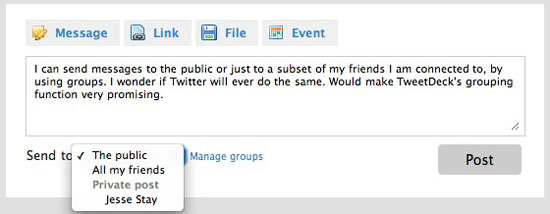

After being introduced to the service by Ajit D'Sa, who works for TRNSFR, the company behind Schmownce and other products, including TweetShrink, I checked out Schmownce, and found it to look like a quieter version of Twitter, but the major thing you'll note is instead of a simple "What are you doing?" prompt, you see a box with four options: "Message", "Link", "File" and "Event".

A message works like it does in Twitter. You write a note, without a 140 character limit, and send it, either to the general public, to an individual friend, or, in a new twist, to a group you may have created. Like in TweetDeck, you can select a subset of your followers and place them in a group, but unlike TweetDeck, you can actually message some of your followers, rather than the "blast all" option Twitter prefers.


A link adds a hyperlink to an external site. Adding a file, such as an image, either displays the graphic, or posts the file for follower's access. With a limit of 100 megabytes, that's fairly robust, though I didn't test it. You can also post an event, with a location and a date, though you can't pick an hour during the day, or a duration, so it's no replacement for Outlook - just a good way to let your followers know something's upcoming.


Unlike Twitter, Schmownce lets you have threaded replies, so I can reply to specific messages on any of my friends' accounts, see the total number of replies, and get e-mail notifications from said replies. Nothing tremendously Earth-shattering, but still... a potential future direction for Twitter, should it be interested.

Given the best benefits of Twitter are the vast community and its interlocking with developers on third-party services, Schmownce doesn't exactly have the Fail Whale provider shaking in its boots, but if you find these functions interesting and miss your Pownce, go check it out. As always, you can find me at: http://schmownce.com/louisgray.

January 13, 2009

January 13, 2009 · 2 MIN READ · BY LOUIS GRAY

Does a Service Need a Business Model to Have You as a Customer?

Does a Service Need a Business Model to Have You as a Customer?

Yesterday, following on to our discussion from earlier in the month on what further efforts FriendFeed could make to attract and keep new users, a commenter wrote:

"I'm a little nervous about investing a lot of time and effort in, or become reliant on, a product that has no business model - whether it's FriendFeed or Twitter. Sure it has plenty of VC money, but who knows when they'll pull the plug."

Given the uncertainty we've all seen in the greater business market, and with Silicon Valley in particular, there is no question that some Web services are in dicey positions. Pownce recently closed after its acquisition by Six Apart, and users weren't given a whole lot of time to extract their information. So, for some, it makes sense not to take a risk with their time and their data.

I tend to be of the opinion that as consumers, we should use those products that give us the best experience, community or enable us to do things that no other sites do. I feel that it's not typically our role to choose what sites are going to be successful and which ones are not. We don't always know the financial underpinnings of a company. We can't forecast whether something will succeed or fail. And often, if you like a product, so will many others like you, meaning that if the time comes to eventually shut the site down, there will be a buyer, and more likely than not, the service, and your data, will be retained.

As much fun as it can be for us to try and predict if Twitter will go mainstream, and much of the conversation in the echo chamber today was around the company's hiring of a new business development manager, seen as the first step toward getting revenue, I don't really care all that much what these companies' business models are - so long as my data isn't being sold or manipulated, or ads don't obscure the product itself. But that's my less conservative side showing - and maybe my position is wrong.

Have you ever liked a product, but steered clear of it because you didn't want to get attached in the event you might later have a costly breakup?

December 4, 2008

December 4, 2008 · 3 MIN READ · BY LOUIS GRAY

Blogging's Future Is Both Consolidating and Expanding

Blogging's Future Is Both Consolidating and Expanding

By Rob Diana of Regular Geek (Twitter/FriendFeed)


In the microblogging space, there are several players. Twitter is currently king and looks to dominate for quite some time. There are other Twitter-like sites around as well, like Plurk, Identi.ca, Rejaw and others. Identi.ca has not grown significantly since their initial push, but Plurk has shown some interesting growth lately. Then there are some tools that are more than just Twitter-like. Tools like Pownce, Jaiku and Tumblr allow users to share files and other media as well as short bursts of text. Tumblr has seen some very good growth over the past year, but the same cannot be said for Pownce or Jaiku, and of course, Pownce, following its acquisition by Six Apart earlier this week, is on its way to being shut down.

Does this mean there is no future for microblogging besides Twitter? Definitely not. Plurk has shown that a simple differentiating feature (the timeline) could entice people, albeit a smaller audience, to use one service over another. Other services, like Yammer and Presently, are taking a chance on the corporate microblogging audience. Open standards could change the playing field as well. If people can reply to people on another service, then there is more room for smaller services to grow.

So what about the blog platforms? Blogger, WordPress and TypePad seem to be doing well. TypePad released a new comment system and WordPress purchased one in IntenseDebate. In addition, TypePad parent SixApart just bought Pownce and its developers. We all know that microblogging is not going to kill blogging any time soon, but things are definitely changing. It looks like the blogging platforms are looking to integrate more social features and more simple sharing of information similar to Twitter or Tumblr. Long form blogging is not dead, but there is room for shorter form information sharing. The blog platforms are making moves to make this process simpler.

The acquisitions of the recent weeks are just the beginning.

I have a feeling that we will quickly see Pownce features in TypePad or other SixApart platforms. It is also likely that some of the features of I Want Sandy end up as part of Twitter, or even a subscription based feature. SixApart could do that as well with the various media sharing capabilities of Pownce. We will be seeing more sites and founders being acquired for the talent or even just a set of features. There will be a lot of consolidation over the coming year, and that is a good thing. Choices and competition are good, but too many choices gets confusing.

More importantly, the features that are getting added could likely change the way we look at these services. What if Twitter had a subscription service that included features from I Want Sandy and even tighter integration with Remember The Milk? That would absolutely be something that people would pay for. If you have a blog, would you pay money for group management and file sharing capabilities? Granted, you can cobble together the same type of service with a few blog plugins or even various third party Twitter applications, but would you pay $5 per month for the simple and integrated features? I have a feeling that many people would, enough to fund monthly costs at the minimum.

We currently have the base services and platforms that the future will be built on. So start thinking about what you could build on top of Twitter the platform. Start thinking about the features that could be integrated into your blog platform to really make it into a community. What value can be provided on top of the basic services we have now?

Read more by Rob Diana at RegularGeek.com.

July 25, 2008

July 25, 2008 · 4 MIN READ · BY LOUIS GRAY

Can Microblogs Just Talk To Each Other?

Can Microblogs Just Talk To Each Other?

Guest Post By Rob Diana of Regular Geek (Twitter/FriendFeed)

Twitter has had a bad few days. After a few weeks of wonderful stability, we started to see some Fail Whales. Then people started losing followers and subscriptions. Because of this, even more people are moving to alternative micro-blogging services like Identi.ca. Of course there have been several requests for a Twitter friend importer. I think people are getting caught up in the problem and not thinking about the best solution. Previously, I mentioned that Twitter was at the crossroads. In that post I started thinking about a possible solution:
It is now late May and they are just admitting that they have infrastructure problems. Obviously, there are the redundancy and replication issues that can be solved with known techniques. The realtime API needs to be using a replicated database and not affect the main database. This is the part that is concerning me the most as it should have been obvious some time ago.
Another post appeared from Dave Winer where he mentioned that we are inching toward federation.
Right now, today I'm using an approximation to the ideal system. I try to enter my original post on FriendFeed, then I have an agent script running on one of my machines that routes it to Twitter and Identi.ca, with a pointer to the discussion thread on FriendFeed, shortened by bit.ly.
Obviously, this is not a good solution to the Twitter problem either. There are also multi-posting services like Ping.fm and Posty which allow a user to update each of their micro-blogging services with the same message. So, with one click you can update Twitter, Identi.ca, Pownce, Jaiku and Plurk. While that sounds really cool, they only provide one-way updates. Tools like Twhirl are starting to allow posting and retrieving of tweets and dents in one application. This gets a little better, but you still have multiple accounts to deal with.

Federated Microblogging


Federation is the real answer. What does federation do and why is it different from Twitter creating a distributed architecture? A distributed architecture means you have various pieces of the application sitting on different servers. Typically, several parts are replicated or redundant and there are various load balancing devices thrown in to complete the architecture. I am not going to go into tons of detail as books have been written about distributed architectures.

Federation is different from distributed in one simple sense. Federation requires a full copy of the entire system. Federation is the cooperation between various systems to act as one. Wikipedia has a good description of a federated database system.
A federated database system is a type of meta-database management system (DBMS) which transparently integrates multiple autonomous database systems into a single federated database. The constituent databases are interconnected via a computer network, and may be geographically decentralized. Since the constituent database systems remain autonomous, a federated database system is a contrastable alternative to the (sometimes daunting) task of merging together several disparate databases.
If you replace all of the database and database system terminology with microblogging and microblogging system you will understand a federated system. So, how does this help Twitter? It does not, at least not directly. By having a federated system, people can move to Identi.ca or the next clone that appears and not lose their followers. If you think about the concepts of email, you will understand how the federated system would work. My account in the federated system would be [email protected]. A Twitter user could reply from within Twitter directly to me ([email protected]) and I would receive it in whatever client application I had. I could also follow Twitter users, Pownce users or any other microblogging user. By enabling people to communicate across platforms would mean that the server load would be spread across various services, thus decreasing the amount of traffic on Twitter directly.

The one part of the federation that is missing is the routing between servers. This can be accomplished by following the DNS model. A local DNS server has a reference to its parent or master server. This allows new servers to be built and their location and IP address propagated to other servers. This is a very effective solution and it has worked for several years.

Because Twitter and Identi.ca follow the same API, they could act as the root servers in the system. The other option to the Twitter API is the XMPP protocol, which Twitter is using for their realtime API. The protocol choice is important because a federated system requires that all of the systems speak the same language. A federated system would also require a different client application than we have now. As I mentioned earlier, Twhirl fully supports Identi.ca and Twitter. However you are dealing with two different accounts. How cool would it be if you had one microblogging client to chat with people on any service?