Silicon Valley Technology Commentary & Archives · Est. 2006 3,045 Posts · 2006–2026
Showing posts from November 2010 (26 posts). Show all posts

November 29, 2010

November 29, 2010 · 6 MIN READ · BY LOUIS GRAY

Unfriending, Unfollowing, Unsubscribing... Less Is More

Unfriending, Unfollowing, Unsubscribing... Less Is More

The world of social media and networking is much too consumed with numbers, and it seems at times, we are making sacrifices of our time and energy wading through piles of noise and indirect relationships in an effort to obtain the rare connections of serendipity that bring us value.

In the past year, my position on connections in all these networks and with all these people vying for a piece of attention has changed - from an open networking approach, to one much more tidy, and it is constantly being refined. I've had it with seeing the streams where I spend a lot of time overwhelmed by strangers and off-topic behavior, and continue to take steps to improve the experience. Lately, I've resorted to seeing my numbers go in the reverse direction - fewer connections, fewer subscriptions and fewer services.

It's often said "he with the most names wins", but while that may be true for a social network, it's not always true for an individual. You are not a social network. You are just one point in that network.

A year ago, I said to jump on the massive unfollowing trend would be a mistake. At the time, I was following more than 12,000 people on Twitter, and that number eventually climbed to more than 14,000. Similarly, as I accepted connections on Facebook to all who wanted in, that pile of flesh grew to more than 2,000 - not near the network's famous 5,000 limit, but enough that if I ever looked at the "Recent News" feed, I was unlikely to know most of the folks.

What's changed in the last year for me is that I have had to adjust and spend more time on those two networks in particular, making them central points for engagement and discovery. With that post being written on August 6 of 2009, FriendFeed's acquisition by Facebook happened 4 days later, putting the once-vibrant community into practical mummification, making its centricity for my own activity dramatically less useful.

Additionally, more and more services are launching that enable the portability of one's social graph from site to site. For every new service I try, I can automatically discover who else I am already linked to, and get the chance to add them to my network. As others do the same, this increases the volume of service notifications by e-mail, and consequently, the number of updates on each site is proportional to your social graph at the source hubs - usually Facebook, Twitter and Google. Therefore, a reduction of people on any or all of those three services reduces the noise in all other places.

When Facebook launched their new messaging platform two weeks ago, putting an emphasis on the friends in the site having access to your in box, I started to have second thoughts about all these random people I'd blindly said yes to in the last couple years. For every great person who I would meet in the future and learn from, there were others trying to invite me to events and groups that were a waste of time, or whose updates were never catching my eye. So I took the opportunity to get out of the mess I had created.

Thankfully, Facebook has made the process of disconnecting much easier of late. Under the friends tab of the site, you can click "Edit". Sort by All Friends, and you can start to remove folks 1 by 1 with the little x to the right until your feeds are clean again.

In a bloody swoop, I cut more than 1,200 people on the site this way on the 15th, going from 2200+ to less than 1,000. Does this mean fewer people will see my blog posts, my photos or my status updates? Sure. But the benefits are that I know who I am engaging with and the quality of the site has improved a great deal. Before this move, I could only get a good Facebook experience through my6sense.

Unfollowing by Source in SocialToo Cleaned Up My Twitter Stream

For Twitter, the work was a little harder, but doable. A few months ago, as discovered by Twittercism, I leveraged SocialToo, where I am an advisor. The first thing I did was whitelist hundreds of my favorite contacts in Twitter, to be sure I wouldn't drop them. Then, I set up content filters on the site to automatically unfollow all people who used any of the major Twitter platforms, like TwitterFeed, Ping.fm, TweetDeck, or even "Web". I left this brutal killer on for about 5 days, and saw the people I was following melt away from 14,000 to about 2,000. Then I stopped the bleeding and took out the noise one by one, to the point I follow just over 1,000 now. Of course, I had to refollow some innocents who were caught in the purge, but most have been fixed. While Twitter still is rough to read in real time (again, my6sense wins here), I am connected to real people I know - and their reshares of other folks' content get the best of the rest.

Twittercism Captured My Unfollowing Earlier This Year

That leaves two major repositories of content that I also have moved to thin, to reduce content overwhelming my available time. The first was to unsubscribe from services that I don't use. Despite my practical abandonment of some services, that didn't stop people from following me constantly. It's obvious the social graph synchronization with Twitter and Facebook means people aren't even looking at your content, even if you think they are. So for the most egregious notification in box fillers, I just deleted my account. I started with GetGlue and Plaxo and may hit some more if things aren't dramatically improved. The other is in Google Reader. I'm notorious for reading a lot of RSS feeds, and still do, but Reader helpfully shows me just how many updates come from each source to clutter my daily reading. Contrasting the updates to shares I make shows me what I find valuable. For those where the noise ratio was too high, I have been cutting them one by one, and it's saving me hundreds of items a day. Bliss.

After some cuts, these are the top publishers (30 days of data) I read.

Twitter and Facebook hold more value for me in 2010 than they did in 2008. With their improved abilities to hide content by source, and to use lists, friend management has improved a great deal. Plus, they, in addition to Google Buzz and LinkedIn, are practically the only games in town for centralized discussions now. So rather than fight against the grain, it's made sense to make the sites a better experience for me.

There's no harm in letting people go. It's your right to unfollow and unsubscribe. It's their right to bring you value and deliver you a good experience so you don't disconnect. But if you're finding your streams a mess, take a deep breath and do something about it. I am glad I did.

Disclosure: I am VP of Marketing for my6sense, which has an app that supports Google Reader, Twitter, Facebook and Google Buzz, and sorts by personal relevancy. I am also an advisor to SocialToo.

November 29, 2010 · 1 MIN READ · BY LOUIS GRAY

Sparkbuy Launches Personalized Gadget Recommendations

Sparkbuy Launches Personalized Gadget Recommendations

With the 2010 Holiday shopping season officially kicking off today in what's commonly referred to as Cyber Monday, Sparkbuy is hoping to give consumers a boost in finding personalized consumer electronics gear, based on a deep database that started with thousands of laptops and plans to expand to TVs, mobile devices and more soon. The goal? Leveraging the big trend of personalization and recommendations per individual and applying it to shopping, beyond that found from popular sites like Amazon.com.

Sparkbuy promises customizable results based on users' specific needs, a large database of independent research, and unbiased product information, unswayed by vendor interests or store margins.

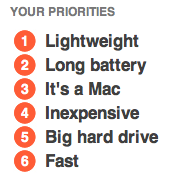
My Top Laptop Priorities on Sparkbuy

Users looking to find the best laptop for them can specific their top priorities, ordered by individual preference, including items such as "long battery", "inexpensive", "big hard drive", "high resolution", etc. For those of us Macolytes, selecting "It's a Mac" and making it a top priority gives us the best from Cupertino, hiding Asus, Dell and the rest from our view, less we end up on Windows.

Sparkbuy Recommended I go for a 13" MacBook Pro

If I Got Out of Mac Land, Sparkbuy Recommends ASUS

CEO Dan Shapiro compares Sparkbuy to popular travel search engine Kayak, and relayed his experience of buying an airplane ticket as giving him "the 'aha' moment" that pushed him to start building the site.

The talk is big, assuming the site fulfills its promise, with a deep product database and curtailing the offerings to what users are searching for. At launch, limited to only laptops, the current offering is an intriguing tease - especially for those of us just fine with our current laptop and not looking to upgrade.

If you want a boost in finding the best laptop for you, and think the database will come in handy for future products, you can get in with the code LOUIS-VIP at www.sparkbuy.com to register.

November 26, 2010

November 26, 2010 · 4 MIN READ · BY LOUIS GRAY

Apple's War On Android Escalates, But No Total War Yet

Apple's War On Android Escalates, But No Total War Yet


Apple's lock on the iTunes application store is legendary. In contrast to more "open" marketplaces that don't rely on centralized editorial control, iTunes applications are hand-reviewed by Apple employees, and the company controls what gets in and what gets out, what applications are featured, and can take weeks or even months to give your application the thumbs up. As the company's competition with Google and Android has escalated in the last year plus, we've heard stories of developers not being able to mention the alternative mobile OS in their products, and have seen those which are iPad-only getting significantly more play with Apple's marketing muscle. Today, headlines were made after one publisher's Android-centric magazine was blocked, not because of any rules infringement or legalities, but due to its content. The idea that Apple would start to police the subject matter of content in its store beyond its also-famous war on pornography, is eye opening and has many people wondering how much power the company intends to wield on the store. As of now, the ruling looks overreaching - and to be honest, it's also wildly inconsistent with existing content already available.

One major weakness for the iTunes review process is that it actually involves humans on both sides. That sounds silly, but it also gives Apple leeway if one rep overstepped his bounds, assuming that an Android-centric magazine would have no place on iTunes. It's easy to see a menacing Steve Jobs in the darkness pronouncing there is "one true phone" and that no others shall be mentioned, but it's just as likely it's a mistake. I hope it is, for the alternative is far more dramatic - one that spells an extremely unfriendly environment from a company that for the most part has its users fawning over its every move.

Curious to see how hard it was to find Android related content on iTunes, I looked around this evening, and while it's not easy to find, it's also not impossible, especially if you branch over to the iBooks section of the store.

Hey Look! A Magazine that Mentions Android on iTunes!

I even found a smartphone-centric magazine in the App Store that looks like it regularly features Android content and reviews. Smartphone Essentials Magazine uses Android as one of its keywords, and the application displays Android phones on some of its covers. If centering on Android is verboten, it looks like featuring it is just fine.

The iBooks section of the iTunes Store is overflowing with Android titles, highlighting Android apps marketing, Android application development and top apps on the Android platform for business, games and entertainment. There are books on free Android apps and wireless apps, reference apps and geeky guides. The simplest of these float for $2.99 apiece, while the developer tomes check in as high as $35.99.


Android Books Galore in the iBooks Section of iTunes


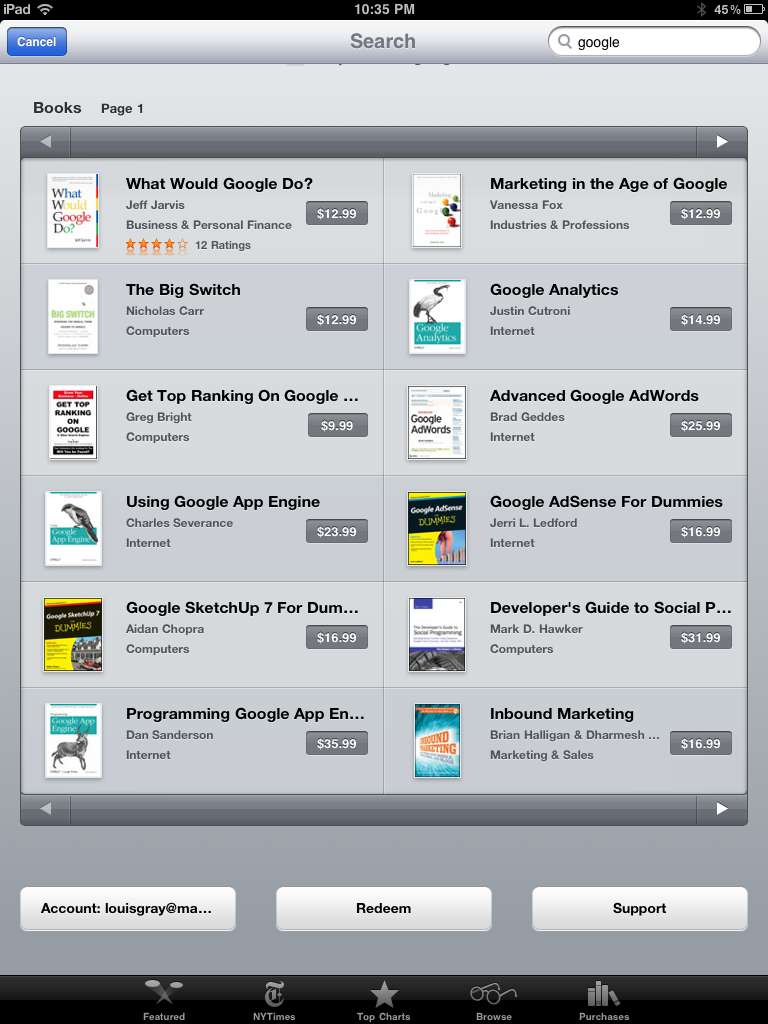
Staying in the iBooks section, and flipping the search from Android to Google also doesn't show the impact of mass censorship and whiting out of competition one could expect if Apple had escalated the war of words to an unprecedented level. The bookshelf shows "What Would Google Do?", "Marketing in the age of Google", and many more titles on analytics, ads and SEO.


What Would Google Do? Not Censor, Probably.


In the Android market, which doesn't have the notorious human filters to it iTunes does, searching for iPhone doesn't come up empty either. There's O'Reilly Media's Missing Manual, iPhone themes to skin Android, and more. Don't let the fact that less than 50 people have downloaded the missing manual fool you, it's there, even if it isn't very popular.


The Android Market Isn't Afraid of iPhone


Brutish bullheadedness on the part of Apple to try and force consumers, publishers and developers into a predefined world of what's acceptable and what's not fatigues my good will toward the company and the platform. The beauty of its apps, core OS and devices may be unmatched, but I fear they are on the brink of misusing their market position in a way that would raise fierce scrutiny if it was somebody else performing the evil deeds. The company should not expect its exclusionary behavior, if it is indeed true, to go unchecked, for even if it is not in a monopoly position, it is playing an unacceptable role with considerable market power. I cannot adhere to the belief that this company knows what is best for me and for all its customers every single time.

Apple and Google have an uncomfortable relationship now. Google's apps play a core role on the iPhone. Google search is the default engine on the iPhone and in Safari. But Apple is clearly threatened by Android and is squirming under the heat coming with the platform's market growth and feature creep that arguably brings it to near-parity in quality. That the iBooks section does not shy away from showing Android titles gives me hope that this ban is an exception to the rule and that we're not on a slippery slope that damages consumers and developers. Google would never remove Apple and Mac or iPhone results from their search engine, and the company helpfully offers Mac hardware to employees, and will keep doing so until some theoretical future where Chrome OS notebooks usurp that role.

As a businessperson, I get Apple doesn't want to help the enemy. I understand they are not a government entity, required to offer constitutionally-protected free speech. But I do not like the role they are playing as arbiters of morality and markets. The company has proven it can compete and do extremely well in offering high quality software and hardware in desktop and mobile, and should focus on marketing its own brand without its power to pretend alternatives exist.

Want to make customers forget about competition? Make something dramatically better and execute. None of this censorship garbage.

November 25, 2010

November 25, 2010 · 3 MIN READ · BY LOUIS GRAY

iPad Tablet Competition Reacting Fast, Expanding Market

iPad Tablet Competition Reacting Fast, Expanding Market


When Apple introduced the iPod, there were already a number of hard disk MP3 players out there. It wasn't clear to everyone that the move into this market was a good one for the company, and its initial sales didn't hint at the juggernaut it would later become. This was due in part to its Mac-only start, as well as its need for Firewire, but also due to needing to publicly define a market, improving upon the established competition and convincing the public that this product was a must have. Over time, the public got it in a big way, and the iPod became a cultural icon, selling nearly 300 million units. Later competition to the iPod from Dell, Microsoft and others was clunky, and sales were comparatively pathetic.

iPod Sales Growth by Year (Wikipedia)

When Apple introduced the iPad earlier this year, they were not the first tablet PC provider, but they set the standard again - helping to transition the market from a geeky niche to a consumer product millions are lusting over, just as they had done with the iPod. This time, however, it seems the competition is faster to respond, and with better quality peers - backed by able competitors, starting with the expanding variety of Android tablets including the Samsung Galaxy Tab and MotoPad, to BlackBerry's PlayBook, which are taking the iPad's queues in terms of appearance and functionality, and getting out there not years after the iPad, but only a few quarters.
The BlackBerry PlayBook

Regardless of your personal preference for Android or the iOS, it seems apparent that Apple will have a battle on its hands that is better coordinated, and on more fronts, than it did with the iPod. They don't have two years to slowly define the market and get the product right.

On Monday, it was announced that Samsung's Galaxy Tab had sold 600,000 units globally in the first month it was available. This contrasted with the iPad selling more than a million units in the same time period. Knee-jerk horse race focused reactions, like this one from VentureBeat said things like "So just a month in, the first model in a new series of Android-based tablet computers is already losing to Apple’s market-defining iPad."

It's a good thing markets aren't made in thirty days and that brands know better to ignore bloggers when it makes sense. If markets were made in thirty days, Apple should have walked away from the first generation iPod. And it's also a good thing this isn't a zero-sum game. There are going to be a lot of people who have room for Android tablets who didn't have room for iPads, and there are going to be others, like my house, no doubt, that will have both.

Apple CEO Steve Jobs roundly mocked the first Android tablet entrants to the market, saying their 7 inch screens would do them in, contrasted with the iPad's nearly 10 inches. But his comments smack more of preemptive market protection, as Apple no doubt plans to offer a family of iPads, as they have laptops and iPods for the last decade. As someone who has the Barnes and Noble NOOKColor, which has an Android foundation and one of those smaller screens, it's clear to me there is room for both. The NOOKColor review is for a later time, but there is absolutely a space for a tablet that can be held one-handed, and with the variety of Android manufacturers that are out there, there will no doubt be a variety of designs consumers can choose from - not a one size fits all strategy.

Apple is on quite a roll. There is no debate, really, with the stock at all-time highs and the company expanding its corporate offices in Cupertino, purchasing land from HP, and their product line is fantastic. But they cannot rest easy. The market is being defined, and a single month's sales are just that - a single month's worth of data.
November 25, 2010 · 2 MIN READ · BY LOUIS GRAY

Less Informed Analysts Don't Serve the Public Good

Less Informed Analysts Don't Serve the Public Good

In the wake of the first dot com boom and subsequent crash, regulation swept through the financial industry, pushing a wedge between those who rated stocks and those who backed them, buckling down on insider information and weeding out a visible few who had not exactly acted with their clients' best interests in mind. With public trust in corporations further declining in the following few years with high-profile scams led by Enron, Worldcom and others, the federal government has played an increased role in watching what businesses can say at which times, both publicly and privately. What is released from companies now comes with lengthy SEC disclosures, authors routinely disclose their stock positions, and Sarbanes-Oxley compliance puts fear into the hearts of public and would-be public companies, to follow the rules - or else.

With this background came news earlier in the week that the SEC was looking into Apple stock analysts who had relied on connections with suppliers and manufacturers in the channel to help predict the company's sales projections. This broader definition of insider trading, if it becomes commonplace, nullifies some advantage and insight the analysts had, and reduces their value to customers.

While most of the SECs' moves in the last decade can be easily tracked to protecting investors from scams, conflicts of interest and pyramid schemes, I have to wonder what this type of move signals. Is the eventual goal to eliminate any real research and intelligence used in the community to level the playing field and make the professional analyst game one that more heavily relies on a gut feel and chart reading? Neither is an exact science.

Assuming the new guide to insider trading is to be adopted, the suggestion essentially means that financial analysts should not be briefed by company employees during the quarter, should not survey those selling the products, their partners or maybe even the customers themselves. The rarified times an analyst can talk with the execs would be limited to the short conference call Q&A periods that occur after each briefing. This would make the already imperfect industry one further removed from real data. Anybody can count numbers after they have been released, but few have proven true abilities to accurately guess a company's direction - and provide real data to customers who don't exactly do this for a living.

What I worry about is not that Apple investors (or others like them) are suddenly going to be in the dark because 1 or 2 guys get slapped on the wrist for chatting up resellers. What this leads to is a company running unchecked with no communication to the outside world, except for every 90 days when they emerge from their corporate offices and tell you how they actually did.

What we need as investors and market watchers is not less access to real data, but more access to information, which we can then use to make good decisions, or bad, based on what we know. There are already enough people out there guessing and writing and throwing stuff on the wall to see what sticks. This just will make it worse.

November 22, 2010

November 22, 2010 · 3 MIN READ · BY LOUIS GRAY

my6sense Adds Posting, Smart Widgets to Android App

my6sense Adds Posting, Smart Widgets to Android App

Following a humble start as a consumption-focused RSS reader on iTunes, my6sense has grown to become a versatile intersection of news and social, consumption and sharing. The app, available for both iOS and Android, pulls in streams from Facebook, Twitter and Google Buzz, and lets you share out to each of these networks. Today, the company, where I am VP of Marketing, issued the latest update for the fast-growing Android platform - bringing native posting to the aforementioned networks within the app, and a helpful widget that brings your top news to you on your Android device.
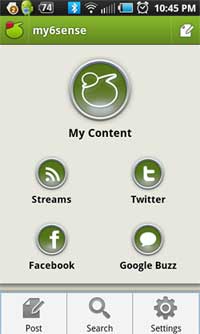
As you can imagine, creating an application that impacts social streams like Facebook, Twitter and Google Buzz presents its own challenges, as users start to expect the most advanced capabilities of native clients, such as TweetDeck and Seesmic. No sooner did we support these networks than did calls come for native replies, retweets, direct messages, likes and comments for each network. After knocking those off, the similar refrain continued as people wanted to update their status on the go directly from our app, instead of reading an update in our app and opening a second one to jump into the streams themselves.

So we listened.

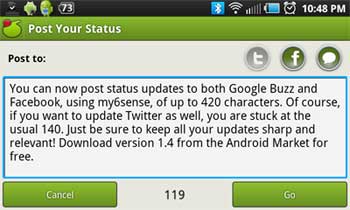
You can now Post to Your Networks in my6sense for Android.

Version 1.4 of the application, available free on the Android Market, has a "Post" button in the top right of all streams. And it's not limited to just one stream at a time, either. If you have connected your Facebook, Twitter and Buzz, you can post to any or each of the networks, much like the Seesmic-owned Ping.fm does. Of course, if you post to Twitter, the standard 140 character limit applies, and Facebook updates are similarly limited to 420 characters. That said, if you have a keyboard on your phone and you want to bang out War and Peace, point it at Google Buzz, and you can go as long as you like.

Posting to Facebook and Buzz Using my6sense

One of the benefits of building out a sharp app for the Android platform is customization of a widget for the app - unavailable on iOS. Familiar with widgets from other platforms, which tend to show the most recent update, chronologically, we wanted to leverage the strength of our service, bringing personalized top news to you - and more than one update. The widget, a stylish black, scrolls through your top messages and you can click the up or down arrows to find them yourself, without opening the app. Find the article you like and click through to read.

The my6sense Widget With Top Stories

my6sense's core focus is, and will be, on making sure the best content gets to you as an individual, and that you don't miss important updates. We're working on making this digital intuition available in more places, and with more partners. But we want to make this a versatile Swiss Army knife that lets you jump into the streams with both feet.

Brad of TheNextWeb, a great user and clear fan of the service, wrote about the updates, saying "my6sense for Android gets updates to take over as your social client of choice". Choice is a good thing. I will choose the smart apps that make me the most efficient. He also posted a great demo video you might like. If you are on Android and haven't already picked up the app, find it at http://bit.ly/m6sandroid.

Disclosure: I am VP of Marketing at my6sense.
November 22, 2010 · 2 MIN READ · BY LOUIS GRAY

Founders Moving On from Social Aggregator Cliqset

Founders Moving On from Social Aggregator Cliqset

Taking on Facebook, Twitter and Google in the fiercely competitive world of social networking and community building is a tremendous challenge that can be practically impossible to overcome, even with superior technology leadership and adherence to federated open standards. Cliqset, the wildly innovative social networking aggregator that was among the first pioneers to adopt Pubsubhubbub for real-time updates, and Salmon for cross-network comment posting, faces a murky future with news today that the company's founders, Darren Bounds and Charlie Cauthen, are going to be leaving the company, following an unsuccessful round of funding.

Despite a number of smart moves to make the site increasingly useful, such as the launch of social search in September, and the addition of Groups and Activity Streams in January, the site struggled to grow a consistent and growing community of users, with a short-lived Turkish invasion drawing a traffic bump and some amusement.

Speaking with Darren today, he said that he and Charlie are not moving on to a new project, nor have they sold the company, saying as founders of the company, it didn't seem appropriate to seek out other opportunities while simultaneously growing the site. But there are no regrets about the adherence to cutting-edge open standards with the site, which were ahead of practically any other service on the Web.

"A federated social Web agenda at Cliqset is something we chose to promote," he said. "The open standards aspect is something I believe is still the future. The roadmap to getting there is going to be a little longer than we would have liked. But where these standards can be implemented and improve efficiencies, they deliver real value."


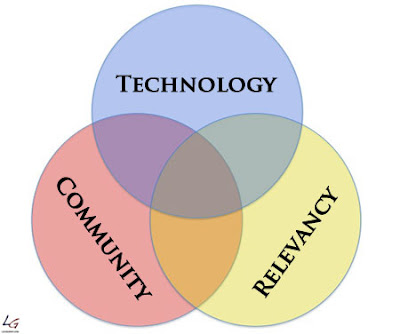
As I wrote a year ago in a post on the 3 social pillars needed for any successful network, one needs to find leading technology, community and relevancy to make a site a must-visit each day. For Cliqset, their technology was never in question, but scrapping for users was a challenge that didn't find a great deal of traction. Darren agreed.

"In order to build a community, you need massive differentiation today," he said. "It's fairly obvious in hindsight. Projects I would be working on in the future would be leveraging the existing social graph, and the need for success wouldn't be contingent on relationships and community within itself. In no means do I think Facebook is impenetrable and somebody can't build something to compete with it, but it's not an easy task."

There are no plans to shut down Cliqset.com immediately, as the company's investors have opted to keep it up and running, despite a lack of engineering and operational support. In the event the service were to be acquired, Charlie and Darren could theoretically be pulled back in, but that scenario is unlikely. As I have been saying for a year aggregation is great in theory, but sites like FriendFeed, Cliqset and Arktan haven't been able to find a unique voice that makes people go their way instead of the original sources of content - Twitter and Facebook. I am eager to learn about the team's next move - they're very sharp and were focused on pushing open standards forward. In an ideal world, their work will not have been in vain.

November 19, 2010

November 19, 2010 · 3 MIN READ · BY LOUIS GRAY

Closed to Open: Downloading Your Data from Facebook

Closed to Open: Downloading Your Data from Facebook

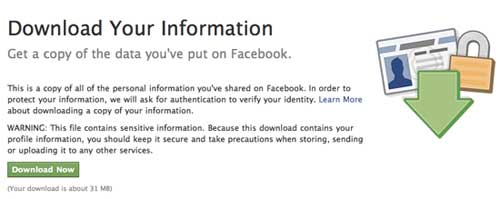
Six weeks ago, Facebook announced they would enable users to download the entirety of personal profile on the network - a big move for the company often seen as being "closed" when other sites have attached themselves to phrases like "open" and "portable". The promise was that content you put into the system could be easily retrieved, from your own personal profile (or Wall) to your photos, videos and even the friend list - while that famously does not contain e-mails, and has been at the heart of a data tug of war between the company and its occasional nemesis, Google.

The data comes as a ZIP file which expands into simple HTML pages, with each major section of one's Facebook experience hosted as browsable directories. In fact, the data is easily expandable and movable that you could choose to replicate the Facebook profile experience on your own site, simply by uploading the content to a server under your control.

My Facebook Data Weighed In at 31 Megabytes

Eager to try this, earlier this week, I set out to get a local copy of the data I put into Facebook. Not a tremendously active Facebook user, I didn't imagine it would be a huge mass of data, but it did weigh in at a compressed 31 megabytes, complete with a pair of short videos, and 13 photo albums, including "Wall Photos", "Mobile Uploads" and "Profile Pictures".

The first thing to note upon downloading and expanding is that when Facebook says they let you download all your info, they aren't messing around. The index.html file shows the data you list on your wall, from your real birthday and spouse info to religion, political party, employer, and interests (such as all those Likes you have racked up). This you probably anticipated. But it also backs up all your messages, so you now run the risk of downloading entire e-mail message threads from friends and posting them live for all to see, making the private public.

Facebook Said It Would Take A While

I Had to Confirm It Was Me Before Downloading

If you do choose to upload this content somewhere outside of Facebook, the major heft of the content is on the "Wall", which is not paginated by length at all - so you can expect it to weigh in at several megabytes.

My Downloaded Facebook Profile

Mine hits more than 7, but you can embarrassingly scroll down to the bottom of my Facebook history, when I joined late July 20th, 2007, updating my first status to read "wondering why he's looking at this facebook stuff and considering getting out before it's too late...", following on the next day, adding, "Any activity I have here will be met with serious resistance on my part. I see Facebook more like the MySpace and Geocities of the future than a serious Web platform, especially as it's password-protected and outside the range of Google."

Looks like I was wrong on that one. Point Zuckerberg.

As one's Wall can be impressively long, it actually can be fun to search for keywords posted over the lifetime of one's Facebook use. You can also scan quickly and see what applications you may have used and abandoned.

In addition to Profile, Wall and Messages, there are top level directories for Photos, Videos, Friends, Notes and Events. Photos and Videos are self-explanatory, providing the option to back up your rich media, while friends just lists your friends in alphabetical order by first name. Your Notes are included and Events shows those Events you said you participated in.

In the interest of sharing, I downloaded my Facebook details and posted them on my own site. You can find my full experience at http://www.louisgray.com/facebook if you are curious. I removed Messages for obvious reasons, but the rest is there.

Of note, according to an interview with the LA Times, the project was the last one worked on by FriendFeed cofounder Paul Buchheit before he left the company to join Y! Combinator - and not the revamp of Messaging many people thought would be under his umbrella.

Getting one's data out of Facebook is a good thing. It doesn't mean they don't still have it, unless you were to close your account, but the idea that one's posted content and personal data is available to the author is the right concept.

November 18, 2010

November 18, 2010 · 1 MIN READ · BY LOUIS GRAY

Facebook Recruiting Video Promises Bold Vision, Potential

Facebook Recruiting Video Promises Bold Vision, Potential

With a much reported "War for Talent" under way in the Valley's largest tech companies, the companies making their case for the best and brightest minds are tapping into their culture and the employees themselves to make a solid case why you should join their team. Twitter launched a recruiting video in early August, and Google has more than 2,000 job listings for interested prospects. Not to be left out, social networking giant Facebook posted a video earlier this week helping to show they think their efforts are far from complete - even after growth beyond 500 million members.

The video's main points from CEO Mark Zuckerberg and others?
  1. You don't need a lot of experience to make a big difference.
  2. Be bold, because what's being attempted has never been done.
  3. You can touch the lives of hundreds of millions every day.
  4. The company maintains a "David vs. Goliath" feeling.
  5. Passionate individuals can champion ideas, regardless of org chart.
  6. Facebook is about empowering human connections.
  7. The devices you use should feel like there are people there, and they are conduits to people you know.
The video is embedded below.


In the video, Zuckerberg says, "It's really early. If you look at the type of information that people share, it's all very simple. The amount of context that people can have about the world around them, the type of sharing that people want to be able to do, the type of things that you want to be able to learn about the people around you, it's really just getting started."

I was personally pleased to see FriendFeed alumni Bret Taylor and Sanjeev Singh, both previous Googlers, featured.

Like Twitter's fun, this too is a convincing video that just might make you jealous you don't have an FB.com address, and it just might encourage some folks on the fence about sending their resume to Palo Alto to do just that.

November 16, 2010

November 16, 2010 · 2 MIN READ · BY LOUIS GRAY

Google Hotpot Launches Social Place Reviews, Ratings

Google Hotpot Launches Social Place Reviews, Ratings

The transition of location based services from simple game-oriented exercises to valuable review repositories is well under way. From the promise six months ago by product manager Siobhan Quinn that Foursquare's value would be from friends' tips to Yelp and Facebook Places, people are sharing their thoughts and experiences about places they shop, eat and visit. Monday night, Google jumped into this fray with both feet with the simplest, most lightweight platform I have seen yet, called Hotpot. The extension to Google Places, embedded in an update to the Maps application for Android, can be accessed through the Web or mobile.

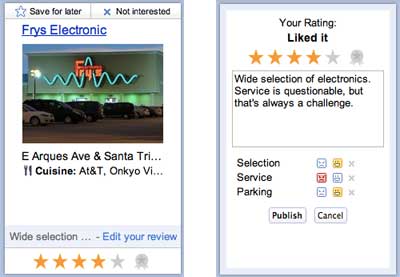
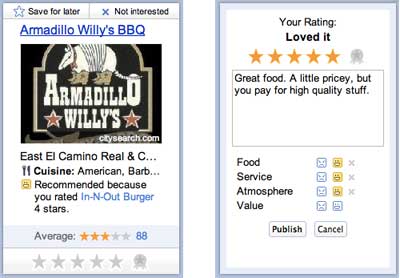
On the Web, Google hotpot starts with your home city, or places from your Web history, if that is enabled, and displays local businesses. You can rate each place with up to 5 stars, or can even present a medal if you absolutely think the place is the "best ever". When you provide a rating, the flashcard-like places flip front to back and offer a place for you to write a simple review. Then it's on to the next card. Don't want to review an establishment? Just click "not interested" and move on. I found it only took a couple minutes to rack up about a dozen reviews, probably as many as I've ever logged in Foursquare.

Rating Fry's On Hotpot via the Web

Rating Restaurants on Hotpot via the Web

While some folks are projecting a massive social service from Google to take on Facebook, Google has instead referred to adding social layers to its many products. Hotpot itself presents a social layer as well, letting you connect with friends to see places they have reviewed, and cutely, posting a leaderboard, with the most active individuals at the top. The option to add friends, instead of being a "everybody in the pool" synchronization with Gmail contacts or any other database, feels more like Google Buzz - with a screen offering you the option to connect to the people you e-mail most often.

The Google Hotpot Leaderboard Early On


Rating Sunnyvale Restaurants Via the Mobile Widget

When on an Android device, assuming you have loaded version 4.7 of the Google Maps app, you can add a widget to rate places for Hotpot on the fly. Dependent on your location, you can rate businesses, or do a quick search (for example, restaurants near Sunnyvale). Find what you like, and as with the Web site, you can post 1-5 stars, and add a comment.

For the most part, although I am sure it is not universal, it seems the majority of Foursquare users choose the app primarily to check in quickly, not to leave detailed reviews and guide to friends. This will probably remain the truth until game mechanics are introduced that push reviews. But for Hotpot, it's not about checking in that you were somewhere, but all about the reviews and providing recommendations to friends. It may have been a quiet little release pushed out from the Mountain View giant after 7:30 pm Monday night, but it could be a big deal. I have added the Rate Places widget to my Android home screen, and expect to be using it a lot.

Want to find my recommendations, just get connected through my e-mail address: [email protected].

November 15, 2010

November 15, 2010 · 2 MIN READ · BY LOUIS GRAY

MyLikes Passes 100k Influencers, Hires 3 More Ex-Googlers

MyLikes Passes 100k Influencers, Hires 3 More Ex-Googlers

MyLikes, the personal endorsement-based advertising platform best known for the ability to create sponsored tweets and YouTube videos, has seen significant growth since the company announced an initial funding round last April, opening up to the public and unveiling its advisory board, of which I am a member. The company's CEO, Bindu Reddy, reports more than 100,000 "influencers" are registered on the platform, reaching more than 160 million people. The company, who was founded by a pair of ex-Googlers, and who raised the angel round solely from former Google employees, has now added another three Xooglers to the mix, with the hiring of a new senior director of sales and engineering talent from the Mountain View search giant.

Like with Twitter, much of MyLikes' initial traction has come thanks to early engagement with notable Hollywood celebrities, and their loyal followers. Early users of the platform have included Snoop Dogg, Lindsay Lohan, Khloe and Kourtney Kardashian. Also like Twitter, many of the company's initial employees are former Googlers. Of the company's first 7 employees, 6 came via Google.

MyLikes Finds a Home With Celeb Tweeters

Of the new hires, the most visible is that of the company's new sales director John DiCola, who spent 7 years in Sales at Google, from 2000 to 2007, and is credited with opening and growing the Google offices in Chicago, Detroit and Dallas as the regional sales manager in the midwest.

John is joined by Tracy Scott, a new engineering hire at MyLikes, who was a senior ads infrastructure and system engineer at Google, receiving the prestigious founders award, before becoming the CTO of Pixelpipe, and Nick White, a senior software engineer at Google who most recently worked at YouTube on social features and personalization.

Also joining the company, the only non-Xoogler, Grzegorz Miaskiewicz, who recently blogged on updates to the MyLikes home page.

Growth on the company in terms of users, employees and clicks has also spawned new features and product improvements. As users "Like" items and share items through MyLikes, they get a unique MyLikes page, which can be shared on multiple sites throughout the Web, including Blogger, Posterous, Twitter and Facebook.

Also, an interesting twist, the company has created a patent-pending influence score that is based on user's social engagement, taking into account multiple factors like the numbers of friends and followers, clickthrough rates on shared links, mentions and retweets on Twitter, and more. The Influence score is continuously updated.

Disclosure: I am an unpaid advisor to MyLikes and hold a small equity position. Content of this post, and others, did not pass their way in advance.
November 15, 2010 · 2 MIN READ · BY LOUIS GRAY

Does an Invisible Path Draw Intrigue or Fatigue?

Does an Invisible Path Draw Intrigue or Fatigue?

As most tech insiders know, one of the more anticipated stealth startups, Path, unveiled itself to the world last night. Founded by respected Valley names with pedigrees from Facebook and Napster, and funded by a long, yet elite, list of active angel investors, the service launched on iPhones, presenting the concept of sharing photos with a smaller network of one's closest friends. This concept, a more intimate social circle, runs contrary to the "bigger, better, more" mentality of today's leading Web services, and has some appeal to those inundated by off-topic connections from friends on the periphery.

While the knee-jerk reaction to something like Path is to ask "why?", as in "why do we need yet another simple photo sharing service?", it's often the trivial and mundane concepts which get traction. The initial response of "why?" led to Twitter and Foursquare and so on, as the more intellectual pursuits that were noteworthy challenges had less success getting steam. I may want to find more places to learn and be challenged, but there's obviously a huge market for the casual and simple.

Path Photos from Drew and Robert

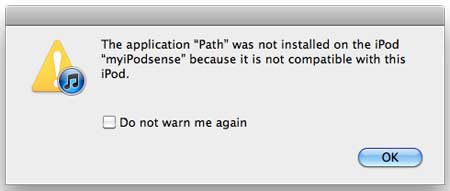
Path is notable for its limits. 50 people. If you hit 51, you drop somebody in the list, and from what I've read, they know about it. The concept of exclusivity drives intrigue - as people want to know if you really are BFF with those people you thought you were. But also limited, at least on day one? The platform. Path is an iPhone only service, and you can't even run the application on the very latest iPod Touch, let alone Android.
"The problem this app is trying to solve: we have too many friends (on Facebook) and as a result we miss key moments we should share with some of the people who are closest to us."
-- Om Malik
I made a personal decision to switch to Android away from iPhone, and bought an iPod Touch to test apps, like Path, that were made for the iOS platform. 9 times out of 10, that's not an issue. But Path, for whatever reason, detects if the device is an iPhone, and won't sync otherwise. So if you thought the service was limited in terms of scope or in terms of numbers, the limited platform ensures scarcity. The question becomes, as scarcity continues, will it drive demand, or annoyance?

Path Won't Go on My iPod, So I'm Out of the Game for Now

I like the guys behind Path. I think they've made great products together. I like the guys who I have seen already sharing their photos with me, as I teasingly have a read-only version of the service from the Web. But so far, I will have to be shown even more before I am a full believer. This looks like a test once and check in on occasionally type of app. There is definitely a hole out there for an intimate network of your closest friends. I just don't know if photo sharing is that start, and don't know if it will have value for me once it hits a platform I use.

For smart folks who get Path, see:
   Drew Olanoff: The “Intimate Social” Revolution
   Om Malik: On A Path To Nowhere

November 13, 2010

November 13, 2010 · 2 MIN READ · BY LOUIS GRAY

Under #NewTwitter, Blocked Users Can't See Your Timeline

Under #NewTwitter, Blocked Users Can't See Your Timeline

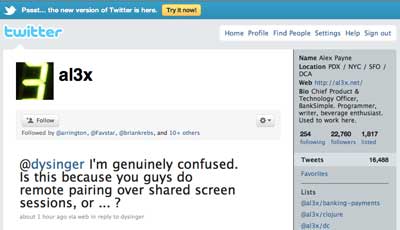
Being blocked on Twitter is a funny thing. The practice, used infrequently by most people, and more frequently by more a small segment of the population who likes to wield it as a weapon or a punitive measure following temporary flare-ups or permanent dislike, doesn't really do a whole lot. Effectlively, blocking a person means they cannot follow your account directly, and that their tweets won't appear in your own timeline, but not much else. Under the old Twitter, those people you had blocked were unable to click on individual Tweets, but still could see all your tweets, in your timeline, and yes, if you sign out or use a second account, you can still see all the tweets in their original glory.

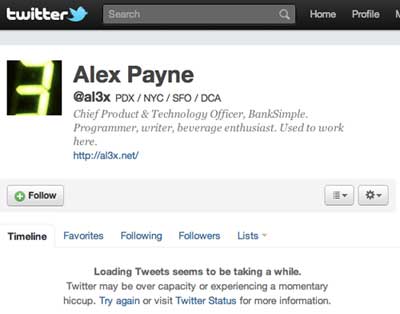
Quietly updated with the ongoing rollout of #NewTwitter, it now looks like trying to view the timeline of someone who has blocked you no longer works. Instead of a list of their tweets, you see a white lie from Twitter that says "Loading Tweets seems to be taking a while". In actuality, this means those tweets are not going to be showing up for you ever - at least until the other person unblocks you or you use a second account.

An Account Blocking Me on the Old Twitter Shows Tweets

An Account Blocking Me on the New Twitter Hides Tweets

According to Twitter's Help Center, blocked users can't:
  1. Add your account to Twitter lists
  2. Have their @mentions of you show in your @mentions area
  3. Follow your account
  4. See your avatar on their page or timeline
Even with all this, blocking remains an entirely ineffective way to hide your updates from an individual. Until there are ways to block by IP address or block a person's cookie and note they use another account which is blocked (just an example), it simply doesn't work. The new update just makes getting to those artificially hidden accounts one more step away. But if it is critical, and there is really someone you don't want seeing your updates, you could always go "private". That way, you are essentially turning blocking on its head. Instead of blocking a few people, you block everyone and bring in a select few.

As for my good friend Alex Payne (@al3x) who blocked me more than 18 months ago, I don't remember exactly why, but his account is always reliable for me to test against and see how this blocking process has changed.

November 11, 2010

November 11, 2010 · 1 MIN READ · BY LOUIS GRAY

Lazyscope RSS and Twitter Client Slims Down, Speeds Up

Lazyscope RSS and Twitter Client Slims Down, Speeds Up

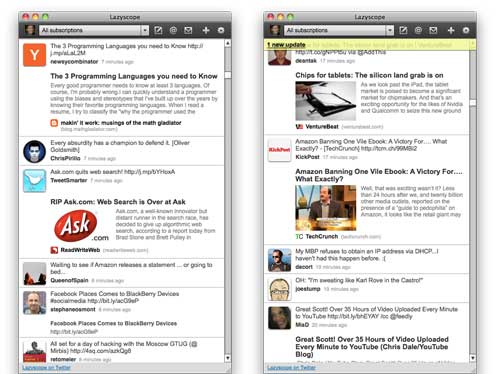
Last week's launch of Lazyscope brought an intriguing new Twitter and RSS client into the world which allowed for full story viewing in a right pane that supported rich media, effectively replicating Twitter's iPad experience on the desktop in a versatile Adobe AIR application. Just over a week later, the application has already seen significant updates that show its potential to become an option for Twitter power users - with the adoption of real-time user streams, a new "mini" single column size and keyboard shortcuts.

Like fellow desktop Twitter client TweetDeck, Lazyscope's support for real-time user streams eliminates the need for a refresh button, as updates flow into the application practically as they are posted to the microblogging network. The more active the users, the more frequent the updates, of course, as they cascade from the top down, simulating the stream in real time.

Lazyscope in Single Column View With User Streams Enabled

The option for a single column view that does not monopolize the screen is also important - as the content viewer (right pane) only opens when an article is selected, and closes when you are click the back arrow to return to the stream. In fact, the single column view is now the default view, giving you your screen real estate back.

Lazyscope in Full Expanded View

In addition to these two updates, Lazyscope, from the makers of Lazyfeed, has turned on keyboard shortcuts, letting you navigate the stream with arrow keys, reposting with the enter key, and my personal favorite, scrolling to the top of the screen with the space bar. As someone who uses keyboard short cuts all day long in Google Reader to go from story to story, doing the same in Lazyscope can make me even more efficient, and as they put it... more lazy.

If you haven't yet tried it, check out Lazyscope at http://www.lazyscope.com.
November 11, 2010 · 3 MIN READ · BY LOUIS GRAY

Leak Corporate Data, Get Caught, Get Fired.

Leak Corporate Data, Get Caught, Get Fired.

After an "anonymous loyal reader" tipped Business Insider on Tuesday to an internal memo from Google saying the company was rewarding employees with both a cash bonus and a raise, news broke Wednesday that the leaker, a Google employee, had been tracked down within hours, and fired. With all proper sympathies to somebody who just lost their job, there can be little flexibility in this regard - for if the person cannot be trusted with information deemed confidential and secret, they shouldn't have a home in a place where strategy and secrets are required. This becomes especially true at a public company like Google, a company that works on many future projects at once in a competitive market.

While the impetus to the reported pay increases is being debated, you can see Google (and other companies that face the same issue) really has little choice.

Unlike Yahoo!, which is leaking like a sieve to smart journalists like Kara Swisher, who seems to have every internal memo that leaves Carol Bartz' desk, Google traditionally has been very good about keeping most of its internal news under wraps, with few exceptions. Their launch of the Google Chrome Web browser caught practically everyone by surprise two years ago, as did their introduction of robot cars just last month. Other projects, like their next iteration of social, and the Nexus One, are discovered, but usually, details are few and far between. So the full-on e-mailing of an internal memo to a blog was a big breach indeed.

The practice of sniffing out rumors around Apple's future announcements has practically spawned an industry. Just prior to Steve Jobs' arrival, leaks were so common that the actual news was boring and anticlimactic. Since Jobs' return, official leaks have practically been extinguished, and violating blogs and anonymous commenters have been sued. The absence of leaks adds to the showmanship and impact the official unveiling of new products and strategy can have, and can help companies avoid the Osborne Effect, which can happen if new products are discussed before the old ones are done shipping.

As a veteran of corporate communications and PR teams at tech companies in the Valley, the usual process for speaking to press is handled by a select few people who know their roles and range. Those found speaking out of turn are challenged and, if necessary, removed, if they cannot be reigned in. During dark days at one startup where I worked, we were under siege from anonymous commenters who trolled industry Web sites saying we were days or weeks away from going out of business. Rumors of layoffs were mentioned, with little merit. But amidst the negative BS, there were elements of truth, with clear insider knowledge that had to be coming from people inside the company - directly or otherwise. At an all-hands meeting, our CEO addressed the anonymous attacks and warned that if anyone were in the room participating in the practice, they would be asked to leave. Eventually, the posts stopped.

As someone who also covers tech companies, I can understand the intrigue of happening on a big story, or an "exclusive" that can raise headlines, have people discussing your scoop, and rave about your access. Access to key people is a major reason why some blogs get traction and others don't. Access to information that is made available without permission can be fun too, if you know where to look. But forwarded internal memos from public companies are cheap - and the people sending them out to the press have a misguided perception of their own importance ahead of loyalty for the company. Leaking internal salary bumps endangered the company in terms of possible disclosures to the SEC, and immediately alerted competitive companies in the Valley that they too may need to adjust their hiring approach to job seekers. This lost element of surprise negates much of the benefit and simply can't be tolerated.

The good news is that the person who made this clear mistake has not yet been outed. For their sake, I hope they stay anonymous, learn from the error and find a new place quick where they don't find the need to play the part of press quite so inviting.

November 10, 2010

November 10, 2010 · 2 MIN READ · BY LOUIS GRAY

Blippy Pumps Profiles With Personality, Adds Product Q&A

Blippy Pumps Profiles With Personality, Adds Product Q&A

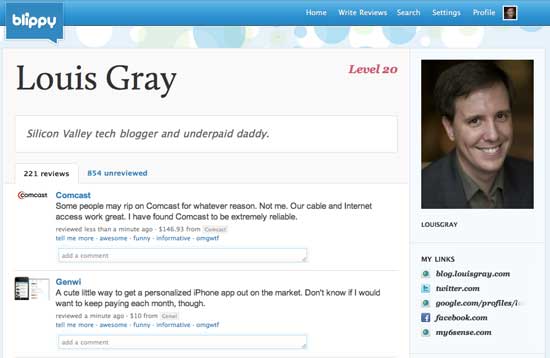
Blippy is going well beyond purchase records, and becoming an ecosystem of brands, products and consumers, essentially replicating a "product graph" much like Facebook's much-vaunted "social graph". This week, the company introduced the capability to ask public questions of product buyers, initiating discussion, and also added fun profile pages that users can customize to make especially personal - from new fonts to layout and links to external sites. While the site is becoming more immersive in terms of offering a more rich product-oriented experience, it is quietly and quickly becoming one of the more engaging and well designed communities on the Web. It's much more than double rainbow 404 pages and spaceships on the login page, so don't get distracted by omgwtf nail clipper giveaways, for there's real meat underneath the shiny package.

Like other good social stream sites, Blippy started with a clean and simple flow of updates, later adding on comments and reactions. Later, came product pages and the ability to write detailed reviews of your every purchase, all collected next to similar responses from other buyers on the network. The addition of the option to start discussions on brands and products in Blippy is a natural extension, one that seems more comfortable than forced Question and Answer sites dedicated for this purpose.

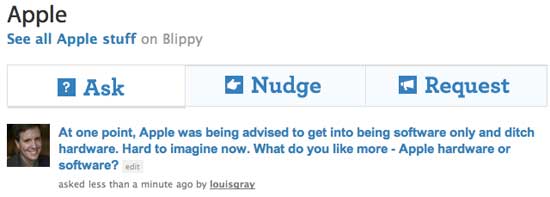
New to Blippy: "Ask" about products or brands to all customers.

Take, for example, my own simple question to Apple customers about whether they were fans of the brand primarily for the company's software or hardware. A someone who distinctly remembers the company near extinction, when it was said they should exit the hardware game, I wanted to see where people's loyalties lie. Unsurprisingly, my quick question, in a matter of minutes, had people praising their software, or saying the marriage of the two was what made them fans.

Customization of Blippy Profiles

On the profile side, while most profiles are remarkably inflexible, such as those on Facebook and Twitter (which at least lets you update the background), Blippy's new profiles allow significant customization. From the country club pimp look of Philip Kaplan to the friendly MizzBlaze or my more traditional approach, you can now change the background, add a profile picture, give your name a fancy font, and add links to your other landing places on the Web. It's pretty sharp. They call it "Fancy".

My Customized Blippy Profile

Pud's Customized Blippy Profile

Blippy is a lot more than boring paper receipts now. It's a lively community with a growing pool of reviews and the ability to launch questions should lead to interesting debate. Get your questions in and update your profile to be snazzy.

November 9, 2010

November 9, 2010 · 5 MIN READ · BY LOUIS GRAY

Android+Keyboard = Win: Switching to the Samsung Epic

Android+Keyboard = Win: Switching to the Samsung Epic

The Samsung Epic 4G from Sprint

When I switched from iPhone to Android after Google I/O this Spring, one of the major reasons I gave for my move was the opportunity to choose between different handsets, if for whatever reason, one offered compelling options lacking in my current model. While there were many reasons I switched away from Apple's ecosystem to that from Google and its partners, the flexibility and many offerings made me more comfortable that I wasn't tying myself to a particular model, but instead, a platform. And after seeing a significant number of positive reviews and sales reports on Samsung's Galaxy S phone - as well as friends' comments that this Android phone "beat the iPhone in every possible way", I checked for myself and left behind the EVO I've been using since May, which had been a Google freebie from the conference.

A Sprint customer, now that I moved the family off AT&T, Sprint's model of the Galaxy S is the Epic, labeled as the Epic 4G, thanks to its using Sprint's slice of the 4G wireless spectrum for advanced features. In contrast to the EVO, which has been a reliable workhorse, the Epic is much lighter, seems more polished both in hardware and software, and - as a kicker - it offers a slide-out keyboard in addition to its virtual keyboard option. Much to the chagrin of my wife, no doubt, I have been gaga over this phone since getting it - wanting to show off each cool little feature, from its rapid shutter speed for photos, to its Apple-like gallery to display images on the device, to the UI details that put Samsung ahead of all other Android devices I've seen to date.

My Samsung Epic 4G Home Screen and Secondary Screen, With Widgets

I switched to the Epic not just because of its well thought-out hardware and software, and the addition of the keyboard, but two more reasons - first, to see how easy it would be, and second, to remove any need for disclaimers in the future, knowing I'd put down my own money for my own Android device, and wasn't living on Google handouts.

When I bought the Epic at the Sprint store in Palo Alto, less than a block from the Apple Store, where others were considering iPhone 4s, my phone number was practically immediately transferred from device to device. After connecting to my Google account, the device also pinged the Android Market and recognized all the applications I had purchased, allowing me to download them again for free. Without a centralized hub on the desktop, like iTunes, Google's over the air handling of this was seamless and almost invisible. Just about the only downside to this process was downloading the free apps, which were not automatically remembered. But as I had the EVO with me still, comparing the two's application libraries made rediscovery simple.

The Phone Pad on the Samsung Epic and Improved Notifications Area

When Steve Jobs introduced the first iPhone and led us to start thinking about the touch interface replacing the keyboard or a stylus, it kicked off a revolution - one in place on all major smartphone platforms. But the ability to open up a real hardware keyboard on the Epic is a great backup for longer e-mails or text messages, or for typing in URLs not previously visited. For any experienced Blackberry touch typist, typing on the Epic is immediately familiar, and the slideout keyboard is very smooth.

Using the Keyboard to Tell My Friend A Happy Birthday Message

Thanks to Android letting manufacturers lead the way in terms of deciding how their phones should appear, there are small nuances between the EVO and Epic that took some relearning. For example, the EVO has its power button on the top of the device, and volume buttons on the right. The Epic has its power button on the right of the device and volume buttons on the left. The EVO's microUSB port is at the bottom of the device, and open, while the Epic's microUSB port is at the top of the device under a protective sliding door. Similarly, the Epic swapped placement for the Home and Menu keys to positions 1 and 2 instead of 2 and 1 on the EVO. It seems like an odd decision, but quickly comfortable.

Samsung's design UI is the best I've seen outside of Apple. The Epic even comes with a Dock with four icons (Phone, Contacts, Messaging and Applications) which are static on all screens. You can't customize them, like on the iPhone, but they are very handy. The Applications folder is especially useful, letting you rapidly access apps not on the home screen, and drop them in new places. You also, like on other Android phones, get the option to add widgets, bookmarks or folders anywhere you like.

In contrast to the EVO, even Samsung's phone pad options are well thought through. The keypad is well defined and colorful with fast access to the call log and contacts. During the call, options to add another call, mute or put the call on speaker are prominent and clearly marked if in use.

The EVO's most maligned drawbacks, its weight and battery, are much improved with the Epic, no doubt behind the Galaxy S's setting sales records in Japan. The phone is clearly easier to carry around than the EVO (and fits in the belt carrier I already had) and doesn't have me looking into buying external batteries, as I did with the other device.

Maybe switching phones every six months seems a little nuts. It's not my usual style. But I wanted to get access to a real keyboard, a clean interface, and experience the breadth of the Android ecosystem as the opportunities are available. Rather than waiting around 18 to 24 months for the next iterative update from Apple or praying it gets access to one more carrier in the US, I'm on a great network that works for me, with access to a fast-growing application marketplace that is now getting interest from the top developers. After all, we just got 45 more levels in Angry Birds today. And I've got a great new screen to play them on.

November 8, 2010

November 8, 2010 · 2 MIN READ · BY LOUIS GRAY

RockMelt's Social Hooks Put Users In Control Of Invite Flow

RockMelt's Social Hooks Put Users In Control Of Invite Flow

Capping initial access to one's service has long proven to be one of the most successful ways to drive buzz around the product. Whether limiting the number of users is designed to reduce strain on the system, to reduce initial support demands during the beta period, or just to get people talking about the product as they beg friends and strangers for access, the process of launching a product to a subset of people has practically become second nature - with multiple layers of "beta" evolving. Today's launch of RockMelt is an interesting tweak on the old model, and a first test of the browser's real integration with Facebook as your social engine.

It is not too uncommon for users who gain early access to a product to have a limited number of invites to pass to their friends. You often see a flurry of posts on blogs or Twitter, or pings via e-mail that amount to "Who wants into Service X? I have 10 invites!" or the invites can be given away in a first come first serve raffle system. Alternatively, the service can do a first in and first out approach, whereby the faster you are to register, the faster you get let in behind the firewall, but all flexibility resides with the service itself. This is the "request and wait and wait and wait" method.

RockMelt has created a unique hybrid of the two, worth noting.

The site, if you don't have access, asks you to connect to Facebook, and request an invite. That puts you in the queue - but not one solely controlled by the company.

Once you have made such a request, a friend of yours who already has access to the browser can see that you have asked to get in, and can, through RockMelt, pass you a code that is exclusive for you. This presents an interesting dilemma, especially if demand far outstrips supply.

In my case, as with all standard new users of RockMelt, I was given three invites to hand out to Facebook friends who wanted to take the new browser for a spin. But dozens and dozens had already made the request, meaning I couldn't give out access to everyone I would like to and forcing me to hand pick three - for whatever reasons I felt.

Should I reward close friends? Family? Business colleagues? Partners? A-Listers who I want to impress? The choice was mine alone.

The dilemma is an intriguing one. I wouldn't want to pass along my invite to someone who I thought wouldn't benefit from access. I wouldn't want to pass an invite to a Facebook connection who was a practical stranger. So I made my choices.

Three folks got RockMelt invites, and the rest didn't. Maybe someone else will take kindly to them later. Maybe I'll get more invites. But RockMelt's twist is an interesting one - which will ensure you aren't giving out codes to people you have no connection with. If the graph is truly to be social, a missing link is just a miss.
November 8, 2010 · 3 MIN READ · BY LOUIS GRAY

Crowded Mature Markets Don't Scare Blekko or RockMelt

Crowded Mature Markets Don't Scare Blekko or RockMelt


Two of the most heavily anticipated and visible product debuts in the past month have been Blekko, the slashtag-happy curated search engine powered by humans and fancy algorithms, and RockMelt, the new social-centric Web browser that drags Facebook alongside throughout your page perusing experience. Both took years of development, sport dozens of employees and raised significant capital. Both are intriguing enough to gain curiosity from early adopter tire kickers. And both are raising eyebrows from skeptics who wonder why otherwise smart folks would charge headlong into what are clearly mature markets with many high profile competitors. For every ubergeek checking out the latest toy, there is somebody else wondering if the world needs "yet another" search engine or Web browser.

Short answer: The world always needs new innovation, and there are countless examples of companies entering into crowded markets that needed some shaking up, who found tremendous success - including in these two markets.

Corollary: To consider either Blekko or RockMelt a success does not require either of them to topple the dominant market leader. Blekko is not a Google search replacement in most cases, and Rockmelt won't necessarily have you uninstalling Firefox. If they can get 1%, 5% or 20% of the market, it is significant indeed. (See: Don Dodge from 2007: Why 1% of search market share is worth over $1 Billion)

Google Takes On Crowded Search Market, Firefox Takes On IE

Google's entry into the search market at a time when Alta Vista could be considered the quality leader, with additional players such as Excite.com, Infoseek, HotBot and yes, Yahoo!, may seem like ancient history now, but the company looked at an industry which needed disrupting. It obviously worked. Meanwhile, Firefox emerged, through Mozilla, out of the ashes of Netscape, burned by the overwhelming market leader, Internet Explorer. It's now safely assumed Firefox is the strong #2 to IE, with Google's own Chrome holding the #3 position and Apple's Safari at #4.

One could highlight the opportunity for reinvention of new markets for some time strictly by looking at Apple and Google alone, even though there are many more examples, from big companies and small alike who have looked big brand names in the face and pushed ahead anyway.

Google Reader Emerges to Take On Bloglines

If you read Chris Wetherell's fantastic two part series about the birth of Google Reader, and Mihai Parparita's companion piece about how he joined the team, you can see significant skepticism over whether the world needed yet another feed reader when NetNewsWire and Bloglines did just fine. Reader now is easily the #1 share holder and Bloglines just closed up shop.

Apple Introduces an MP3 Player and a Phone!

In October of 2001, Apple introduced a hard-disk based MP3 music player. The MP3 player, called iPod, launched with competing players like the Creative Nomad Jukebox and Rio's line of digital audio devices already in the space. That they launched an MP3 player seemed like madness. To others, their launch of the iPhone was similarly crazy, even after the iPod's runaway success. Resident curmudgeon John Dvorak warned in 2007 that Apple should pull the plug, adding "It's the loyalists who keep promoting this device as if it is going to be anything other than another phone in a crowded market."

The crowded market had plenty of room for Apple.

One doesn't have to look too far away from this space to find that Google's Android OS took on the successful iPhone, as well as Symbian, Blackberry, Windows Mobile and others, and found opportunity to grow significant market share. Facebook launched into a market occupied by Friendster and MySpace. Gmail was introduced years after Yahoo! Mail and Hotmail had amassed millions of users apiece.

Is it going to be a challenge for Blekko and RockMelt to separate themselves from aggressive competitors? Absolutely. But often, empty markets without participants are empty for a reason - and crowded markets are there because there is potential seen by multiple players. Blekko and RockMelt each now have the opportunity to compete on their merits, and attract their own target users. It's not necessarily a zero sum game, and both seem to competitive enough to bring value, with enough humility to not trip over their own hubris.

November 7, 2010

November 7, 2010 · 6 MIN READ · BY LOUIS GRAY

The Third Wave of the Web Will Be Uniquely Personal

The Third Wave of the Web Will Be Uniquely Personal


Two weeks ago, I wrote about the increasing attention crisis facing many of us as we work to find relevant and beneficial content from the many different sources that are challenging us for our time and energy. The gist? More content is being created in more places and "can't miss" content is increasing at the same rate, making many of us feel we are constantly in a state of missing things, forced to chew through the noise to find the best updates, but still falling short.

I believe we are on the cusp of a massive change and opportunity on the Web today - one that will no doubt be debated, but one that I am seeing morph in front of us, as the Web evolves, and initial problems are considered solved, while new ones crop up.

The First Wave: Information and Access

The first wave of the Web, and even precursors to the true Web, like Compuserve, Prodigy and AOL, was to deliver information, to connect information, to make it available, and eventually, searchable. The first wave saw the building up of an infrastructure of pages with links and images, audio and video, with structures based around links to show how pages and things were connected. This first wave of the Web was all about information posting, discovery, search and retrieval.

While it may initially have seemed the "winners" of this game would be those providing access to the Web, including ISPs like AOL and Earthlink, browser providers like Netscape, portals, such as Yahoo! and Excite or commerce engines like Amazon and eBay, the largest victor turned out to be Google, who made this massive information pile easily discoverable, monetized and fast to access. While many many other companies made money of information and various pieces of this wave, Google emerged on top of the first wave.

The Second Wave: Social

The second wave of the Web, which is still ongoing, is that of social. With an infrastructure in place to post information, transfer it from person to person and place to place, the friending experience of social connections was duplicated, from offline to online. Sites like Friendster and MySpace erected networks were you could connect person to person and see photos, get reminders on birthdays, and more. Plaxo connected your offline Rolodex. LinkedIn replicated your business network, and Facebook, YouTube, Twitter and Foursquare have emerged to be powerhouses in terms of sharing your every move, by video, by photo, location check-in and status update.

Now, we connect to people and follow or friend one another the way we once searched for keywords and news listings. In this wave, Facebook looks like the clear winner, if there must be just one, setting the agenda for how friend relationships are measured, and counting registrations in the high hundreds of millions. YouTube is the default for sharing video, while Twitter has carved out a solid niche for short updates, and Foursquare is the location space innovator, but Facebook is the giant in the second wave, whose numbers dwarf all challengers.

The Third Wave: Personal

Now that the world's information is posted, linked, indexed and searchable, and friends are connecting, sharing, liking, and following, the quest is on to streamline the noise and give the Web another dimension - one not measured by the data, or who led you to the data, but you as an individual. The third wave of the Web, I believe, is going to be about personalization by individual based on that individual's preferences - explicitly stated or otherwise.

The declaration of the next wave of the Web being personal is not shared universally, of course. Some say the next wave is all about mobile. Others may say the next wave is all about location. But the right approach to 'personal' absolutely encompasses each of these things. With our smartphones and tablets being increasingly powerful, they are practically an extension of us, and we are relying on them to discover relevant things, content, places and products for us as individuals. Similarly, our location is an ingredient of who we are - for where we are impacts our decisions, and what tips are relevant, be it for news, for restaurants, lodging, dating or anything else. So "personal" as an individual is both local and mobile.


my6sense: Personalized Streams for Me on my Mobile


Personal As In Me.

A lot of services say they are "personal", when in fact, most of what they do is actually social.

These services may leverage your social graph to provide personalized recommendations based on what friends or other people similar to you may like - much like television shows group people of similar demographics to guess what commercials are best suited for which episodes in which time slots. The hope may be that the more your friends like something, the more likely you are to click it or buy it. Peer pressure, you know. Meanwhile, other services say they are personal because you have specifically provided them with information about you and what you like, which goes partway to discovering your interests, but is incomplete, and possibly inaccurate, as you may want to indicate that you are something that you are not, or you may have overlooked some of your own interests in the name of rapid completion.

Beyond these initial attempts is a new wave of companies trying to crack the code of the real you. Of course, my6sense is one of those companies. Our goal is to deliver a personalized experience in all possible aspects of your life, finding the right information for you at the right time in the right context, based on you as an individual. But we are not alone. Take, for example, Hunch.com, which is talking about personalizing the Internet, and says they can build a taste profile for you, based on your own unique interests and tastes. Also, in October, Mike Arrington of TechCrunch previewed Gravity, founded by former MySpace executives. In that piece, which he headlined as "The Personalization War", he said "I saw my own Interest Graph based only on my Facebook and Twitter streams over the last several months and it’s scary-accurate."

Recommendations from Hunch.com for Me

Gravity says they will help "The right information find you. Hunch says it "Personalizes the Internet". You've heard me talk about my6sense for some time - discovering your "Digital intuition". Besides the crazy folks like us who are thinking about this constantly, there are other smart companies on the case. Start with personal recommendations from TiVo, Amazon and Netflix. Look at Google Reader Magic and Google's Priority Inbox for Gmail. Look also at LinkedIn's purchase of Mspoke for personal recommendations and Facebook's splitting of the Most Recent feed and that of the News Feed.

Get Inside My Head

The companies looking ahead to the next wave realize it is not enough to serve up the same content to everyone, as each of us is unique. We are not our friends any more than we are our neighbors or our colleagues or even our own spouses. Our interests are unique and we all want to find content tailored to our own interests. While some people are battling with the challenge of information overload and sheer noise, smart engineers are working to solve these problems - the incredible test of mimicking the human brain's ranking function, and learning what to show when, and what to make a lower priority.

The continuing rapid growth of information creation and sharing, combined with pervasive connectivity, increased capability of smartphones and other mobile devices and the growth of location is all pointing us into a direction where the services on the other end have more potential to know you than those of years past, and you have the ability to be inspired by the right information in the right place more than ever before. This is a wave, one that benefits from all these mega-changes in the Web, that small companies and big ones alike are seeing. Maybe there's another big winner in there, just like there was in the last two. Regardless, the direction is clear. Show me my Web for me.

Disclosure: I am the vice president of marketing for my6sense. Hunch and Gravity can be assumed competitors, while other companies mentioned can be considered potential partners, peers or competition, dependent on their own individual business situations.

November 4, 2010

November 4, 2010 · 2 MIN READ · BY LOUIS GRAY

Buzzooka iApp Enhances Google Buzz Mobile Experience

Buzzooka iApp Enhances Google Buzz Mobile Experience

One could be forgiven for thinking all the development around the Google Buzz app ecosystem is weighted heavily toward Android. Sharing a corporate parent, integration between the two platforms, tapping into Google's location and maps database, and the close integration with Gmail besides has made the two a good pair. But there's still a ton of folks out there on iPhones and other Apple devices who have made Buzz part of their social experience. For them, one great option is a new app called Buzzooka - which not only has a fun name, but is fully-featured and intuitive as well.

Available for $1.99 on the iTunes store, Buzzooka replicates the Buzz experience, providing streams from those you follow, a link to your own Google profile, a tab for nearby updates to the stream, and integrated people search. But while Google keeps Buzz embedded in Gmail, making the experience at times feel heavy and slow, Buzzooka just flies - with the most well-known equivalent being that of Twitter for the iPhone. It even offers the option to pull down to refresh.


Seeing Active Buzz Threads in Buzzooka from My Stream and Profile


In Buzzooka, Google Buzz entries display the user's avatar and shared content. You can click on any piece of content to add a like or a comment, mute the thread, or visit the poster's profile. The app lets you see active comment and like streams, complete with small avatars for those engaging, and jump in yourself, or simply post updates directly from within the app.


Viewing Rich Content and HTML In Buzzooka


Buzzooka has some nice twists in the app, especially for being so new. First, the app displays full Web content within itself instead of launching you to the iDevice's Safari browser. Second, it even plays rich media content, such as YouTube videos, which may have been shared. And if you click over to the "Nearby" tab, and scroll through recent updates in your area, the embedded Google map shifts along with the user's location as provided.


Liking an Entry in Buzzooka, Scrolling Nearby Updates


You can configure the Buzzooka experience to show a specific number of posts per screen, and a predetermined number of comments per post. The most active discussions are collapsed, showing the first and last, with the option to expand.


Searching for People, Changing Prefs in Buzzooka


Buzzooka leverages the Google Buzz API, of course, just as many other clients, including TweetDeck, Seesmic and my6sense have. The greater the partner ecosystem, the greater the network's chance for continued growth.

You can find Buzzooka on the iTunes Store here.

Disclosure: I am vice president of marketing for my6sense. Our Android App also offers Buzz consumption and interaction, which could be an assumed competitor to Buzzooka. Also, we are active Google Buzz API partners.
November 4, 2010 · 2 MIN READ · BY LOUIS GRAY

Sonos' Wireless Dock for iDevices: Simple and Sweet

Sonos' Wireless Dock for iDevices: Simple and Sweet

The last year has forever changed the way I consume and enjoy music. The addition of Spotify to my life (and soon the rest of you in the US) made iTunes a vestigal program good only for synching iPad apps. The addition of Sonos leveraged the power of the Web to tap untold number of electronic music streams from around the world, wirelessly throughout the house. That's why I followed my initial test unit with the purchase of two more, and why my YouTube account is full of videos of my kids rocking out to great sound. Today, a small companion piece, a wireless dock for both iPod and iPhone, arrived in my home, and it makes getting music trapped on all those iDevices incredibly simple to get onto my Sonos. It's simple, small, and sounds great.

Thanks to an address mixup, my review wireless dock unit reached me today, a week or so after the true gadget blogs got their hands on the device. But that didn't make the experience any worse for the wear. After opening the envelope marked "Urgent", the device was streaming music from my iPod Touch to my Sonos players in five minutes or less.

The Sonos S5 systems I have in my home are notable for two primary things - there is no digital display, making the device appear as one big speaker, and also, no way to push physical media. No CD slot. No tape deck. No iPod Dock. The Wireless Dock for iPhone and iPod fills that gap, for the many Apple geeks who want to get music from their iTunes to the best speakers in the house.

Adding the Wireless Dock to Sonos, With AutoPlay in the Office

Setting up the device was truly simple. I plugged it in, added the component to my network using Sonos' desktop software, and it saw my iPod as a music source. Now, I can stream the content from this device (or any friends' devices they bring with them) just by plugging it in and selecting it from Sonos. There's still something magical about clicking pause or play on the computer and having it stop a device wirelessly, but Sonos gets it done. I can even control my iPod Touch with my Android phone using the Andronos software on the Android Market.


My Docked iPod Can Stream to My Sonos Speakers

The retail price for the wireless dock is $119, so it's not the cheapest peripheral ever, but it's a solid add-on for existing Sonos equipment owners, and the device is polished enough to have been made by Apple itself. To be honest, Sonos' hardware is some of the best designed gadgetry in the business, beautiful enough to sit in every major room in my house. That they also have access to all my best sound makes music to my ears.

Disclosure: I received the wireless dock from Sonos for free. I received my initial Sonos S5 unit free of cost as well, and have since purchased multiple devices. In theory, I should tell you I also have free access to Spotify Pro as well, but I'd pay for that too if given the chance. :)

November 2, 2010

November 2, 2010 · 2 MIN READ · BY LOUIS GRAY

Lazyscope: An Immersive Twitter Desktop News Experience

Lazyscope: An Immersive Twitter Desktop News Experience

As Twitter becomes an increasingly valuable resource for consuming new content online, replacing RSS for many and augmenting it for others, new and inventive ways to visually deliver this content are being developed, including the ability to "unpack" URLs to provide a preview and excerpt of the shared link - and in some cases, the option to display the entire article altogether. The #NewTwitter release introduced the concept of a rich media pane to the Web. Today, the team behind Lazyfeed releases Lazyscope, a full-fledged Twitter consumption app to help you read all the news in one place. And as a kicker, you can even use it as a full-fledged client.

Lazyfeed made its name initially as an intuitive Web-based RSS client that followed real-time streams to discover keywords you had selected to follow. Its latest release introduced social features to help people follow collections of items and discover what your friends thought were cool. With Lazyscope, the team has extended its reach to the world of Twitter and has developed a cool and immersive way to find content from your stream as it comes in.

Lazyscope Displaying News from Links In Line

Like most desktop Twitter clients, Lazyscope delivers new tweets in a column format, first delivered by TweetDeck. The newest tweets are at the top, with oldest chronologically below. Every tweet that contains a link offers an unpacked long URL, the headline of the article and the first paragraph of that piece. Clicking on the tweet itself displays the full content of the page, including imagery or video, in the right hand pane.

As new updates come in, they await your command to approve as they stack up, just like on the regular Twitter Web site. (2 new updates, 19 new updates, etc.) Also, a notification in the bottom right hand corner alerts you to new entries that may catch your eye. Like the original LazyFeed, the flow itself is addictive.

Lazyscope Makes Reading Twitter News Easy

While the objective of Lazyscope is primarily as a consumption tool, the developers, led by Ethan Gahng (@ethpresso) have included the option for you to post updates from Lazyscope, check mentions by hitting the @ symbol, or check direct messages with the small envelope in the top left corner. You can also select lists to which you are subscribed from the bar next to your avatar.

Alerts from Lazyscope as You Read

But the fun's not done with just Twitter. If you want, you can add subscriptions to RSS feeds within LazyScope, either by subscribing to the news source in the right hand pane, or clicking the + sign in the top right and entering a valid URL. Lazyscope will do the rest, and provide updates from that feed in your column, just like any other news source.

Subscribe to Any Feed Within Lazyscope

In a world when most Twitter clients are quite similar, Lazyscope is one of the coolest and most innovative options I have seen in a long time. This seems to bridge the gap, like Flipboard did on the iPad, to bring a true reading experience to the desktop.

You can find Lazyscope at http://www.lazyscope.com/. They are on Twitter at @lazys.
November 2, 2010 · 2 MIN READ · BY LOUIS GRAY

OpenID Foundation Finally Grabs @openid Twitter Account

OpenID Foundation Finally Grabs @openid Twitter Account

The OpenID protocol, aimed to authenticate users in a decentralized way, helping individuals own their own identities instead of requiring unique accounts for every service, has had something of an ironic issue for some time - given that the OpenID Foundation didn't actually own their own ID for one of the more popular discussion forums out there - Twitter. Today, this issue can be put to rest as Facebook employee and open source advocate David Recordon announced this afternoon they had gained access to the @openid account - giving folks a central place to keep tabs on updates to the protocol.

While OpenID at times has been pilloried for being obtuse, making logins more complicated rather than less, the project has helped push the concept of decentralized identities away from individual domains, including last week's news that Flickr had adopted the standard. The protocol, developed by now Google employee Brad Fitzpatrick in 2005, while at Six Apart, has seen deployment at a significant and influential number of Web services, and has corporate members including Facebook, Google, IBM, Microsoft, PayPal and Yahoo! on the foundation's board of directors. Ironically, nobody from Twitter is involved on the board.

The release of the account may or may not have been related to yesterday's OpenID OAuth Summit, held at Facebook headquarters, which saw stakeholders from a variety of tech companies, including Kevin Marks of BT, Chris Messina and Joseph Smarr of Google and Tantek Çelik, computer scientist at Microformats.org, participate to potentially discuss the differences between the at times complimentary but competing formats. Also, the Internet Identity Workshop (IIW) kicks off today in Mountain View, where many of these same folks will be participating.

Debate on OpenID versus OAuth continues to rage on the Web, of course. Recent entries include the Halloween post on Codebase: OpenID OR OAuth – That is the Question. Regardless of the eventual resolution, proposed as a new agreement called OpenID Connect, adoption of open standards and reduced complexity is a good thing. You can now follow OpenID's happenings at @openid.
November 2, 2010 · 3 MIN READ · BY LOUIS GRAY

Pretty. Functional. Frail. My Macbook Air Hinges Fail.

Pretty. Functional. Frail. My Macbook Air Hinges Fail.


Earlier this year, I switched from my MacBook Pro to a new MacBook Air, aiming to move more of my content to the cloud, and have a less bulky device to take with me from office to office and trip to trip. For the most part, the experience has been very good, and if I can help it, I don't want to go back to thick laptops again, with their spinning hard drives and clunky optical drives. But the beautiful design and thinness of the machine also has made it susceptible to failure. For more than 18 months, MacBook Air's first and second generation customers have complained about defective hinges which are a design flaw with the machine, requiring potentially expensive replacement. Now, mine too have fallen victim.

The front of my MacBook Air with the very obvious crack...

A few weeks ago, when visiting partners with Barak Hachamov, my colleague at my6sense, he opened his MacBook Air, and we both audibly heard a cracking sound. The frame had a horizontal crack through it, and the screen became very wobbly, needing to be supported by something to lean on. He took his laptop to the Apple Store in Palo Alto, and as he resides in Israel and I am local, I was asked to pick it up. A week later, after taking his laptop home, my own MacBook Air decided to join the club.

Without any odd behavior on my part, without requiring any exceptional level of force or falls, or even knocking against anything, my own Air frame is cracked and the hinge has practically come apart at the base. Solidarity with Barak's machine? Perhaps.

The Rear of My MacBook Air, Hinge Askew...

So last night, I was back at the same Apple Store, telling them of my sad story. The folks at the Genius Bar commented on the relative newness of my machine (though not the latest and greatest) and said they see this problem frequently. The good news was there would be no charge, but they didn't have parts on site, so I'll be headed back at least two more times - first to drop it off, and later, of course, to pick it up.

Even without the cost of replacement, for which I am grateful, the interruption is definitely annoying. Assume perfect service, I should be without the laptop for a few days, and there's always the outside chance data could be lost, so I am backing up like a mad fool (again). But it has me thinking as well. By always demanding thinner products, lighter housing, and shinier form factors (See the iPhone 4G for example), are we increasing the chance of breakage? It seems there is an inherent design flaw that affected each of these MacBook Airs, one so prevalent that Apple's own tech support note on troubleshooting them says it could be repaired, even if out of warranty:
"You can take your MacBook Air to an Apple-Authorized Service Provider or Apple Retail Store for evaluation and repair if necessary, even if your product is out of warranty. If you previously paid for a repair for hinge-related issues that were not caused by accidental damage, you may be eligible for a refund. Contact Apple for more information."
Diving deeper, it seems this issue has been hitting Air owners for more than 18 months. About 150 people have contributed to a thread started in February of 2009 on the hinges breaking during normal use. Ars Technica covered the spike in complaints back in March of 2009 and Engadget in late February of 2009. But I didn't buy my own laptop until early 2010. Although it was refurbished, saving me some cash, I would assume the issue was known and examined.

While at the Apple Store, I got my first chance to see the newest MacBook Air devices - both the 13 inch and the 11 inch models. It's tempting, of course, to get this one fixed, wipe the drive, and sell it on eBay or Craigslist, just to move to the next generation, but I would have to warn the recipient that I couldn't guarantee the integrity of the device. It's pretty. It's functional. But it's broken.

November 1, 2010

November 1, 2010 · 2 MIN READ · BY LOUIS GRAY

AddThis Stats Show Spike in Google Buzz Sharing

AddThis Stats Show Spike in Google Buzz Sharing

Over the last 90 days of available statistics, popular multi-network sharing service AddThis shows few surprises in its top services selected by customers. Facebook dominates all options with nearly 40 percent of all shares, with Twitter and e-mail having just under ten percent apiece. But further down the chart, while most services saw single digit moves, up or down, two Google services are seeing significant growth - with Gmail logging an increase of 76%, and its companion network, Google Buzz, spiking, up 296% from the previous 90 day period. Sharing from AddThis to Buzz was good enough for #22 overall, just ahead of others including LinkedIn, Tumblr and Wordpress.

It's tempting to write off the blip as nothing more than a blip - a rule of small numbers. After all, the total percentage of shares to Google Buzz from AddThis totaled .25%, or 1 of every 400 shares. The top 10 services, comprising of Facebook, Twitter, Email, Print, Google, MySpace, Favorites, StumbleUpon, Messenger and Delicious, comprise more than 85% of all shares, leaving scraps for the remaining services - and one knows Google services aren't supposed to be "also rans" outside the top ten in most cases.

Google Buzz Shares Started to Spike on AddThis in Mid September

To dig deeper into the surprising data, I asked AddThis for more clarification.

While the company doesn't yet expose absolute sharing statistics, they reported that the rise in both Google Buzz and its companion Gmail is likely a recovery after a slow summer. The spike in Buzz propels it to the 5th most popular social network overall.

Buzz and Gmail Trending Up on AddThis

"Kids are back in school and sharing up a storm," wrote Justin Thorp, Community Manager for AddThis. "But... even with that, Gmail & Google Buzz are still seeing growth, usage, and excitement."

Aside from the 3-month bump, Thorp reports that StumbleUpon "has been the one that's seen some of the most continuous" growth.

Buzz's Spike Pushes It to the 5th Most Active Social Network on AddThis

Additional AddThis details on Google Buzz reveal that after the United States, which leads by a large margin, the next most active countries sharing to Buzz via AddThis are the Netherlands, India, Russia, Brazil, Germany, China, Canada, the UK, and France.

In contrast, the long since purchased, but still active, FriendFeed statistics show Turkey far outpacing the United States, followed by Italy, India and Pakistan.

While the world awaits Google's next round of social updates, long rumored, but still unclear, the loyal Buzz community eagerly awaits any signs of good news that show engagement and activity in the much-dismissed social sharing network. AddThis' statistics give a glimmer of hope, even if it is small numbers relative to other social tech titans.