In a world where the Web is increasingly consumed on mobile devices, and applications on iOS, Android or other platforms continue to proliferate, developers are turning to in-app purchases to drive revenue, not just for premium applications, but for free applications that often get you in the door, but entice you to pay up for additional features. But what many developers aren't preparing for is a world where consumers have multiple devices, but carry the same apps - putting the customer's data at risk, tied to a single device, even when a centralized cloud solution seems like a reasonable and much more modern, alternative.
Traditionally, premium software vendors have asked customers to pay on a per-install basis. Want to run Adobe Photoshop on multiple computers? You have to pay a multi-user license. Want to run Microsoft Office for the whole family? Get a family pack. But on the mobile side, thanks in large part to Apple's leadership on the iTunes store, and other app stores, including the Android Market (tied to one's Google account), premium and free applications are synched on a per-user basis. Want to upgrade your iPod or iPhone? A sync with iTunes should get your apps back. Purchase the latest Android tablet or phone? Log into Google with your account, and the Android Market will start feeding you your apps.
That said, synchronization of content between devices is comparatively poor. For every cloud-based app like Gmail or Spotify that recognizes your ID and displays your information on every device, one finds applications that live on your phone or tablet, and don't communicate to any parallel installs you have. (See iTunes' guidance on this issue) This leads to the very common issue known by any Angry Birds addict, who finds themselves conquering the same levels from phone to phone to computer or even on Chrome, instead of starting where they left off. If you love killing pigs and burning time, that's wonderful, but I'd bet many people would find it valuable to log in with their account on any device, and continue where they left off. Some apps, like Barnes and Noble's NOOK app, do this very well, but many miss the target.
The situation becomes even more complicated with the advent of in-app purchases. Forget about the Mighty Eagle (just one dollar per level!) in Angry Birds. You can purchase weapons and tools galore for sports games and strategy games on your smartphone, but many application developers are making the purchase much like they did in the traditional sense - assigned by device, not tied to your Apple account or your Google account. That means that not only do your premium purchases not follow you from device to device, but even worse, if you have to reinstall your mobile OS for whatever reason, you've lost the in-app purchase data, and probably a bunch of the app's history as well.
Living on the bleeding edge of early adopterdom as I do, I've learned to be flexible with the occasional bumps. I got hit with this in-app issue this summer when I had the chance to reinstall Honeycomb on my Android tablet from Samsung, only to lose the in-app purchases I'd made on the 9 Innings baseball game, along with dozens and dozens of games played and players acquired. While I didn't have to rebuy the app itself, which is great, I was starting on Opening Day all over again. That's nuts.
I can understand application developers wanting to ensure they receive appropriate payment for their apps being downloaded and enjoyed. I think the functionality of in-app purchases is a great expansion of mobile commerce. But in a Web-centric mobile world with centralized accounts, storing one's application data on the device, without backup in the cloud, seems short sighted. Many of us carry multiple devices, and may some day upgrade our phones and tablets. It'd make more sense for me that we can do so without fear of losing our progress and our premium buys.
September 12, 2011
September 7, 2011
HDS Acquires Network Storage Player BlueArc
This morning, Hitachi Data Systems, a subsidiary of Japan's Hitachi Global, announced the acquisition of network storage provider BlueArc, one of the last independent storage startups that survived the economic turndown of the previous decade. The deal, an all cash transaction, closes a chapter in my own work history, for as many of you know, I spent 8 1/2 years at the startup on the marketing side, from our initial first customer shipments back in early 2001, through being a key part of the team that readied the company for its first attempt to enter the public markets, back in 2007. We eventually withdrew in 2008, before the new team, after I had left in 2009, filed again earlier this summer.
For those who watch the storage networking market closely, with the most popular term being "Big Data" these days, BlueArc's relationship with HDS seemed like it had a high chance to become a marriage for a number of years. After signing a reseller contract that made BlueArc's high end network storage products available to HDS' sales people, rumors about a potential acquisition were printed as far back as 2006. So it took a little while, but appears the two companies were able to work something out - a year after some of the biggest deals in the space were consummated, as EMC purchased Isilon for $2.25 billion in November of 2010 and HP acquired 3Par for $2.35 billion in September of 2010. In December of 2010, Dell purchased Compellent for just under a billion dollars, three years after buying Equallogic for $1.4 billion. All solid proofpoints for why I wrote in August of last year that there are big dollars in big data.
I joined BlueArc in January of 2001 at an interesting point in the dot com boom and bust. Revenue-light dot coms and Web services were falling apart, and a flight to hardware seemed more stable. BlueArc had an incredible roster of respected industry players, and promised technology that was well above competition. Sitting as part of the marketing team as the initial waves of press lauded our innovation was exciting, and people were flocking to know more. It was the very definition of a hype cycle, as product maturation had yet to occur, and it took a few product generations and tweaks of customer messaging to really get the formula predictable. As you can imagine, through 8+ years at a single startup in the Valley, we had our fair share of bumps and turnover, mixed with good news. Crunchbase shows an accurate listing of our funding rounds and while the process was difficult at times, and other companies had seemingly simpler routes to success, many more failed during the time I was there. Simply holding firm, I saw former colleagues update their LinkedIn 2, 3, or 4 times.
The partnership with HDS, signed in late 2006, signaled a change in strategy for the company that made BlueArc's products available for resale, and gave the company multiple paths to revenue - including a much deeper sales force. In a world where IT managers were typically conservative, and often looked as much at a company's viability as to the products themselves, having HDS on board, or even leading the sales march, helped ease some of those fears, especially at the largest named customers. Meanwhile, I focused on improving our messaging for new markets and announcing our direct wins and customer highlights.
Having left the company two years ago myself, I've been removed to some of the most-recent progress, and saw many former colleagues follow suit while others stayed. The company didn't ever go public, though they filed twice, but they were a storage survivor.
Disclosures: I am a common stock shareholder at BlueArc, due to my years employment there.
For those who watch the storage networking market closely, with the most popular term being "Big Data" these days, BlueArc's relationship with HDS seemed like it had a high chance to become a marriage for a number of years. After signing a reseller contract that made BlueArc's high end network storage products available to HDS' sales people, rumors about a potential acquisition were printed as far back as 2006. So it took a little while, but appears the two companies were able to work something out - a year after some of the biggest deals in the space were consummated, as EMC purchased Isilon for $2.25 billion in November of 2010 and HP acquired 3Par for $2.35 billion in September of 2010. In December of 2010, Dell purchased Compellent for just under a billion dollars, three years after buying Equallogic for $1.4 billion. All solid proofpoints for why I wrote in August of last year that there are big dollars in big data.
That said, BlueArc's road to this exit has been a long one. The company launched with its differentiation being marked by speed and scale, the source being its hardware-centric model, when competitors focused on software-based solutions or turned to clustering to achieve scale and power. Hardware generations were launched every 18 months or so, with software updates in between.
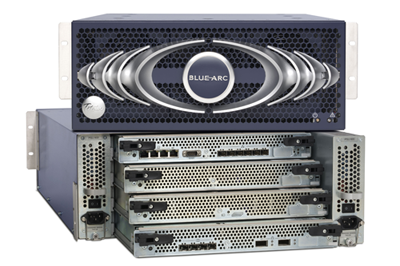
BlueArc's modular network storage system, Titan, announced in 2004.
I joined BlueArc in January of 2001 at an interesting point in the dot com boom and bust. Revenue-light dot coms and Web services were falling apart, and a flight to hardware seemed more stable. BlueArc had an incredible roster of respected industry players, and promised technology that was well above competition. Sitting as part of the marketing team as the initial waves of press lauded our innovation was exciting, and people were flocking to know more. It was the very definition of a hype cycle, as product maturation had yet to occur, and it took a few product generations and tweaks of customer messaging to really get the formula predictable. As you can imagine, through 8+ years at a single startup in the Valley, we had our fair share of bumps and turnover, mixed with good news. Crunchbase shows an accurate listing of our funding rounds and while the process was difficult at times, and other companies had seemingly simpler routes to success, many more failed during the time I was there. Simply holding firm, I saw former colleagues update their LinkedIn 2, 3, or 4 times.
The partnership with HDS, signed in late 2006, signaled a change in strategy for the company that made BlueArc's products available for resale, and gave the company multiple paths to revenue - including a much deeper sales force. In a world where IT managers were typically conservative, and often looked as much at a company's viability as to the products themselves, having HDS on board, or even leading the sales march, helped ease some of those fears, especially at the largest named customers. Meanwhile, I focused on improving our messaging for new markets and announcing our direct wins and customer highlights.
Having left the company two years ago myself, I've been removed to some of the most-recent progress, and saw many former colleagues follow suit while others stayed. The company didn't ever go public, though they filed twice, but they were a storage survivor.
Disclosures: I am a common stock shareholder at BlueArc, due to my years employment there.
September 6, 2011
Being Genuine Is the Best Disclosure Of Them All
Even with the purest of intentions, people have bias, which can rise from an infinite number of sources, be they financial, personal, emotional, career-oriented, or any other. The topic of bias and disclosure flares up often in the increasingly complicated world of blogging and journalism, and as many of us both participate and cover the world in which we work, new rules are being adapted, usually with some push back by those for whom the existing set of rules worked well. In 2009, the Federal Trade Commission (FTC) tried to step in and provide guidelines for bloggers with conflicts, asking those who received compensation for their efforts to disclose it. But even if you assume they intend to eliminate bias, they're not even close to answering for all potential bias cases. Not even my gimmicky and fun set of disclosure icons, put together at the end of 2009, can correctly anticipate every situation. With this weekend's flareup over TechCrunch founder (and AOL employee) Mike Arrington's CrunchFund making headlines again, more lines are being drawn in the sand about what is appropriate for a man of Mike's position to do. His employees have explained they operate independently of his activities. His employer says the rules are different for his organization. His critics have called him names and penned him as having crossed the line. But this topic isn't a new one. It's just got an intriguing name behind it, someone that many of us watch, who draws attention good and bad, depending on your view, thanks to his being visible and arguably, on top, in his field.
More than three years ago (In August 2008), I wrote that "If you look hard enough, conflicts of interest are everywhere." The first topic I brought up back then was if bloggers should cover companies they invest in, and at the time, I said "Investors in a company usually know it very well, especially if it's an early-stage situation, where they will know it better than the general public. It's no secret they'll likely be more positive on the company, but if they're fair and disclose the relationship, you may learn a great deal." In this post, I also said "disclosure is needed" if bloggers joined boards, took day-job positions with a company, or participated in starting or buying a company. It's always good, at least for me, to have the body of work to point to when issues like this come up, as they do regularly. At the end of 2008, again discussing bias, I said, regarding my own preferences, "Even though I like these products, these people, and their ideas, the idea is to continue to be trusted. What liking a product doesn't do is force me to make up things that they don't do, or gloss over clear issues."
It's not my place, as a mere tech blogger and Silicon Valley marketeer, to assess the appropriateness of Mike's new fund. I am not involved, had zero knowledge of it in advance, and don't believe I am impacted by its existence. The story is interesting, and that's it. But the tumult over the discussion is really all about detecting bias and trying to divine one's intent out of their writing - to see if their words can be less trusted due to their outside interests. And that's the crux. Being genuine, transparent and truthful, despite any perceived bias, will always win. Being honest and direct and overdisclosing to the point of amusement, is always better than having to disclose after the fact.

Maybe I should disclose to you that despite never having worked for Mike (we're still talking about Mike Arrington), and having minimal contact over the years, I have never had a bad experience with him. Every experience has been good, be it in person face to face, be it in conversations on the phone, by email, or even Twitter DMs and Facebook messages. The last time I saw Mike was at a swanky Los Altos gathering where we talked briefly. He shook my hand (not something he likes to do) and said it was good to see me. We even talked a bit about Seattle and how he's writing less at TechCrunch. Mike previously invited me to TechCrunch headquarters in Palo Alto (when they were located there) and even gave me the scoop (by a few days) that he had hired MG Siegler away from VentureBeat. You might even try really hard and say that I am biased in favor of TechCrunch because I've previously worked for a company that was covered by the site (when I was working at my6sense), that TechCrunch covered my joining Google, and maybe it's in my best interests to be nice to Mike and the TechCrunch family if I ever want products I am associated with in the future to be viewed nicely. But this points out how hard it is to really determine what's in the author's head. You can't tell me why it is that I wrote something when I did, and you can't know what prompted me to do it.
Enough about Mike. He's a great firestarter for topics though, right?
At the end of last week, there was a quick story on Mashable that listed a few tips on how you could score your next job using social media. It's a pretty typical story for the site - a list style post that has a small number of things you can do to improve your life using the Internet. In the post, the author referenced my joining Google by saying, "take a tip from Louis Gray, whose demonstrated love and dedication for Google+ got him hired as a product evangelist."
With all due respect to the author, whom I don't know, his fast summary was balderdash. I didn't ever say in my post that my love and dedication for Google+ was the reason I was offered a job with Google and he didn't ask. It should be noted I underwent the same hiring process as any other candidate looking to join Google. The same 10+ interviews you have read about, and the interview process started months ago - before Google+ existed. The way I found out Google+ launched was by way of a tweet from Matt Cutts. I didn't get any early look at the product, and didn't get tipped as to when it was launching. The process for my being hired into the social team at the company was well under way before Google+ launched, and I would like to think that reasons I was hired were more tied to my body of work and job history than any excitement about the project itself. (I also haven't cleared this post with Google PR or anyone at Google, and don't plan on making that a habit)
That leads to another level of bias to discuss. After Google approached me late this Spring about possibly joining the company, I was cautious in terms of what I would say about their products or planning. I was cautious not in the perspective of making sure not to say anything that would talk them out of hiring, but in fact, the reverse. I made sure to be just as fair as I always have been, calling out issues that made sense, and praising where it made sense, so that if I were hired or not hired, readers of the blogs would not see any change in my approach. For example, in the months after our discussions began, I said it would take several days to move my music library to Google music and continued to praise Spotify. I even said in mid-July, after more than a half dozen interviews, that I thought Google+ should leverage smart algorithms to personalize the content. I also railed against people pointing their own domains to Google+ instead of their own content, saying "I am hesitant to endorse forwarding your identity to a third party domain you do not control."
But where could I have disclosed "I am currently in the interviewing process at Google"? I couldn't, of course.
Similarly, in the past, I could not disclose if a company I was working with was seeking a venture capital round, an acquisition, a partnership or any number of things where the guarantee of non-disclosure, by agreement, trumped the request for disclosure here. What's more important than seeing if you need every single potential source of bias listed out on the page, as I often do, is if the author has established a record of being truthful, genuine and open to their biases. My posts here and elsewhere are biased, and the number of potential biases that impacts my choices of what I use and what I write about is legion.
Maybe Mark Zuckerberg was really on to something when one of the hallmark statuses available to Facebookers was that of "It's complicated." Life is complicated. It becomes more complicated based on who you know, what you do, who you interact with, what value they provide you, what they say to you and all who impact you and so on. I am confident that even though I am working hard to impact a great project at a visible company, my body of work stands for itself and I stand for something. Bias is complicated and the best way to classify bias is if you can find a direct link to an action that delivers another action which would not have happened without the first. You can try all day to divine the intent of the source, but you can't read their mind. Them being genuine first and always clears it all up.

September 2, 2011
Living In the Browser Is No Myth. It's Possible.
Wrapping up my second full week at Google, I'm still very new here - walking a delicate balance of learning from those already here, while also delivering value on my own. There have been few surprises, given how closely I've worked with the company before joining in an official role, but on a technical level, it's interesting to see how truly cloud-centric the company is. Obviously, being a company who believes strongly that you should never bet against the Internet, and whose many Web services help users migrate away from desktop applications, this makes complete sense. But I honestly live in Chrome, all day. Back in 2009, I wrote a post on how you can clearly separate your work and personal social media personalities, through smart separation of Web browsers and TweetDeck (now part of Twitter). At the time, I told you how I used Safari for personal activity, primarily due to my bookmarks, which also synched with my iPhone, and how I used Firefox for work stuff. Flash forward two years later, and the story is much the same, but I'm using two separate builds of Chrome to do both, and rarely exiting the Web.
For all google.com activity, I use the standard Chrome Web browser, and securely login to my account and those places on the internal network I should have access. In parallel, I run the Canary build of Chrome for Mac OS X, and maintain my personal account there. This means I don't have to get confused about running multiple accounts simultaneously in a single browser, and still see everything I need to. After all, it'd be a mistake to post content intended for a work audience on a publicly facing destination like Google+, and I want to remove the opportunity for such an error.
Aside from separating the two personalities, work and personal, practically everything I need to do is on the Web. Gmail is my launching point for communication with colleagues, including Google Talk for instant chats. Google Calendar tracks others schedules and my own. Google Docs is where all of us collaborate on projects. Think this is a big company secret I'm leaking? Well, it's not. Google uses its own products, and it makes sense.
Early in 2010, I talked about how I could see living in a cloud-centric world when I got my first MacBook Air, dramatically reducing the hard drive space available from my prior model. When I got the option to choose a laptop upon joining here, I again opted for the device with the smaller disk size, instead of a bigger, bulkier, MacBook Pro or its equivalent, as I knew I wouldn't need the bits.
While living in the cloud may not be for everyone yet, the trend toward Web-based applications, faster broadband and expanding WiFi availability, coupled with ever more capable smartphones, makes the opportunity to live in the browser real for more and more folks. It's come to the point where having Microsoft Office applications and Adobe Photoshop available feels like a crutch, or a stopgap as we migrate into the Web. It's the realization, for the most part, of the vision shared by Larry Ellison and Scott McNealy years ago, where the network is the computer, and your profile is portable. Just prove you're you, and get to your data from anywhere.