The world of communication and product delivery is changing as the Web evolves and new services are introduced, enabling us to gain faster access to information, download richer media more quickly, and rapidly voice our opinions and feedback near and far in a wide variety of methods, including text, voice, video and imagery. As customers become more savvy and in tune with these new tools, we are also expecting those offering products and services to adapt, and as such, I thought it made sense to put forth what I believe are key tenets of a new consumer manifesto for today's real-time world.
1. We Want Access to Your Product As Quickly As Possible
We have become an "instant gratification" society. Our short attention spans are being rewarded with ubiquitous access to fast food, the rollout of ever-faster download speeds, near elimination of commercials, thanks to DVRs, and the ability to replace activities that were once limited to venues outside the home with in-home equivalents, including on-demand programming and simulated bowling on our Wiis.
When we order your products, or sign up for your service, we want access to them immediately. We don't want to wait for an approval period, and if the product is physical, we want it shipped quickly at the first possible convenience.
2. We Expect the Product to Work On Any Platform In Any Location
Many of us spend more time in the Web browser and our e-mail than we do in our Operating System software these days. We rapidly grow frustrated with any Web sites or applications that operate differently if you utilize different operating systems or Web browsers, and we expect to have access to your product, or a mobile equivalent, when we are away from our desktops.
3. We Want to See That You Allow for Feedback, Positive and Negative
The time of a siloed product experience is gone. We want to see that you provide a forum or link to a third party site that discusses your business and your products, and connects us with peers, where we can learn from one another in a venue that reaches you as well. And if you do provide a forum or bulletin for us to provide feedback, we will not look kindly on your deleting threads or comments of substance.
4. We Expect That You Respond to Your Customers, Quickly
Customers are talking about your products on their blogs, on Twitter, on Facebook and other aggregation sites. They may send you e-mail or post in public forums. While we can't expect CEOs of the largest companies to respond to every mention, we do expect company representatives to be listening, and for the smallest companies, we do expect founders and entrepreneurs to be accessible.
5. We Expect That You Join and Lead the Conversation
In the absence of communication from you, rumors and negative feedback can snowball. And while you might be coached in handling crisis PR in case something gets out of hand on blogs or Twitter, the best way to get ahead of potential issues is to have a presence in these social areas before problems occur, so that your customers have a place to engage you, and you them, helping to redirect the conversation and react. Additionally, you can use your communication outlets to show thought leadership and teach us better ways to use your product in ways we may not have considered.
6. We Want to See That You Continually Improve Your Product
Thanks to the now assumed two-way conversation with your customers, we expect you will be making incremental updates and improvements that both meet your corporate objectives and satisfy user expectations - beyond fixing bugs. Not only do we now expect instant access and near real-time responses, but we hope for rapid iterations that add to our satisfaction. A stale product will lead to cranky users, and breed disloyalty, as we may migrate to alternatives that appear to be updating more frequently with more agility.
7. We Expect You to Use Your Product and Be Visible
One of the greatest endorsements of your own product is that you use it and make it a part of your own visible activity - making you appear as a peer with a shared experience in parallel to that of your customers. For the smallest companies, including startups with 1-10 employees, we expect to likely see your CEO and founders visibly consuming their own dog food, both exulting in its benefits and suffering through its disappointments. And if you do put up a central example of your employees or founder using your products, don't do it once and never update again, because we'll know about it, and it will a stark reminder of your pandering.
8. We Expect That You Will Embrace or Lead Standards
As we are helping you create a business by selecting your product instead of that of the competition, we expect you will help us, and the ecosystem as a whole, by either embracing existing standards that are agreed upon, or by forging new standards and releasing them to the community for the benefit of all. We reject proprietary methods that don't deliver significant differentiation, or aren't forced by antiquated legalities.
9. We Expect You Are Driven By More than Money Alone
As consumers, we are eager to be seen as your partner, and to contribute to improving the next iteration of your product, or in helping to grow the information base around it, through consistent feedback, formation of user groups, or in creating content related to your product. As such, we do not expect to be seen as blank checks, there to support your bottom line when quarters draw thin. Instead, we want to see that you share a passion for your products and your market, and know that you, as we are, are driven by the potential of what your product can enable us to accomplish. We want to know the story of what you are trying to solve, and how it can help the community, more than we want to hear about your margins and your EPS.
10. We Want You To Treat Us As Informed Consumers and Partners
We have real-time access to news and many of us are rabid information sponges who are experts about you and your product. We don't want to be talked down to, and often have significant history with your organization. We despise the tendency to architect service, support and marketing to the lowest common denominator, and greatly appreciate your expecting that we have a baseline of understanding that includes recent headlines on you and the industry.
While books including the Cluetrain Manifesto and Naked Conversations have chronicled the move by consumers and businesses to e-commerce and a new world of online communications, continued advancements toward real-time news and exchanges of ideas lay the platform for a revamped approach to consumer relations with business. We are finding out more about you than you ever believed possible, and we are more than willing to share it just as quickly - both the good and the bad. Embrace the change and embrace us as partners and we can be your greatest ally. Be truthful, transparent and trusted, and you can help us cross the chasm from customers to fans.
May 10, 2009
May 9, 2009
Good People, Bad Companies: The Intersection of Skill and Luck
Good People, Bad Companies: The Intersection of Skill and Luck

If you have worked at a company that went public or changed the world, you might be given an unfair share of accolades for your part in its success, even if you were actually a pedestrian employee. Similarly, if you happen to have put blood, sweat and tears into an unsuccessful venture, you might be seen as having contributed to that's company's lack of success, or worse, its downfall, giving your resume a black mark. Despite one's best intentions, there is always a strong element of luck in terms of what companies succeed, what products gain share in the market, and, often, if you were hired at the right place at the right time.
In Silicon Valley, the measurement of success and failure can be extremely visible. "Oh. He worked at Google..." says one person in hushed tones to a friend. "And that guy? Let's just say he's on his fourth startup in six years."
But the company name, and the headlines that covered that company's activity over the years, never tell the full story. You don't always know if the person was liked and trusted by their employees. You don't know if they put in 14 hour days or 6 hour days. And you don't know if there was anything they could have done in their role that could have changed the outcome. It's no secret that companies big and small have elite employees, pedestrian employees, and laggards, be they those on the Fortune 500 or ones you've never even heard of.
In a time when the economy is in decline and unemployment is rampant, here and elsewhere, these rapid judgment calls are no doubt having profound effects. How do you explain your way around product failures, hostile takeovers and missed sales quarters? Should the guy whose company chose to go public three months before the market crashed, when yours didn't, giving them $100 million in the bank, and him a nice Mercedes, be considered a better talent than you? Should every former Google employee have a leg up on every former Yahoo! or Ask Jeeves employee, for example?
Watching some industries very closely, it can become clear that people, no matter their role in the organization, will claim the success of their company as their own handiwork. Paraphrasing from a recent release, many of which you've likely seen, a company crowed last month upon getting a new Sales VP, "Prior to joining, (this individual) previously served as a Senior Vice President at (company), where he was responsible for growing sales revenue from $hundreds of millions to $billions." But in the last twelve months, I had actually seen others of this company's alumni report that it was they who had been the driver for the same growth - generating the same similar press release.
Should they all take credit for the same thing, even if one person led worldwide sales, another was a regional area manager, and another oversaw channel efforts in a single territory?
There is something to be said about having been part of a shared experience of success or failure, and learning what to do next, should the opportunity present itself again. In Silicon Valley, where it's well known the vast majority of startups will eventually fail, most of us have two or three companies under our belt that didn't make it. An elite few managed to jump from success to success and not miss a beat. Still others have alternated success with failure, with a healthy mix of effort sprinkled with luck through the process.
It's this knowledge that doesn't get me starry-eyed when I bump into people who played central roles at companies that are household names today - not any more than I look askance at those whose history may be more checkered. All we can do as individuals is deliver our best effort and work to help the company we are at succeed to the level of our abilities. And should that not work, we should take a deep breath, look around, and do it again. Risk is not something to be feared, and with risk always comes the chance that you won't succeed - and it might not always be because of you.
May 8, 2009
Adobe Responds to Service Flub, Promises More Coaching
Adobe Responds to Service Flub, Promises More Coaching
 Earlier this week, I recounted a less then ideal conversation with support representatives from Adobe around my attempting to buy the downloadable version of the company's Creative Suite product. One support rep urged me to buy the physical copy, and another called it a "very big order", despite it just being a single version of a single product. Later in the day, after another amusing live chat with an online support rep, I managed to get Creative Suite after all, about 24 hours after my initial purchase attempt.
To complete the story, today, I got a call from an Adobe representative, apologizing for what she called "inadequate information" I had received, and she added "we will see that the Agent is coached appropriately."
While I felt somewhat sheepish for airing out my grievances for the exchange on the blog, I said I tend to be transparent for both good and bad experiences, and she took the feedback well. Despite Adobe's being lamented on some social sites for not being very active, she wrote me in an e-mail:
"The feedback you provided is excellent, and we welcome any opportunity to be able to coach our staff, improve upon current processes, and understand a customer’s opinion of our services. You are welcome to continue to send comments our way."While, yes, this could be a corporate spokesperson doing their best to reduce the temperature of a frustrated customer, it was a solid response, one that shows they are listening in a world where the customers also get a turn at the microphone.
The back and forth with Adobe at the beginning of the week can now pretty much be seen as a blip. I have the software. It works, and I was only charged once. And now, I know they can hear me.
Every Piece of the Infrastructure Carries Potential to Fail
Every Piece of the Infrastructure Carries Potential to Fail
 Though it may end up being a temporary blip, at this moment FriendFeed is down, following a scheduled outage at Twitter this afternoon. And while that's not really news, it comes on the heels of many discussing the potential for failure that third-party URL shorteners bring to the Web. For every fan of TinyURL or bit.ly, there are others who say relying on another service to be a go-between between the user and the intended data is just begging for trouble. But the truth is that in a network, when there are multiple items with potential to fail between the user and the data, any one of those pieces in many cases can bring the entire system down to its knees.
- Storage can fail.
- Servers can fail.
- Networks can fail.
- Routers can fail.
- Lines can be cut.
- Services can close down.
- Users can delete images or pages.
On Wednesday, in the middle of testing a third-party Twitter service, I linked to the Guardian using a URL shortener called tr.im, required to get the service to work. Later that night, tr.im failed, and it broke all links that were being used.
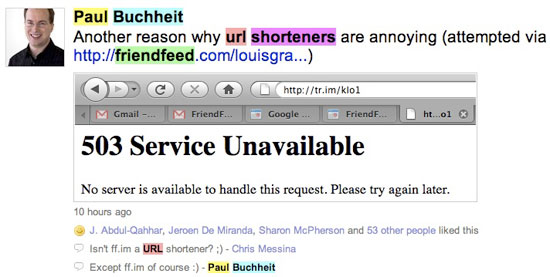
The conversation (in Google cache)
In response, Paul Buchheit, co-founder of FriendFeed, with a long history at Google, Microsoft and Intel prior to his latest efforts, referenced the break, calling it "another reason why url shorteners are annoying."
But FriendFeed itself has a URL shortener, called ff.im, which it uses when sending updates to Twitter. Paul added in the thread, "Except ff.im of course :)"
But guess what? Because FriendFeed is down (for now), also down are the ff.im links, making them as likely to fail as any other third party shortener. I could rant up and down saying that FriendFeed and ff.im should be served from different data centers, or offer better redundancy, but I won't. Nobody loves downtime, and FriendFeed by and large has had a fantastic track record of staying up. But as they become a more integrated part of the ecosystem, they too will get more opportunities to fail and need to take the same safeguards to protect the infrastructure as do all the other players.
Things will fail. We will live, but we know that there is no such thing as a fully redundant failsafe machine. Every hop delivers the potential to turn into a skip, and not in a good way.