
Silicon Valley Technology Commentary & Archives · Est. 2006 3,032 Posts · 2006–2026

June 10, 2009

June 10, 2009 · 2 MIN READ · BY LOUIS GRAY

Floxee Offers Customizable Twitter Directory, Grouping, Statistics

Floxee Offers Customizable Twitter Directory, Grouping, Statistics

As companies and organizations flock to Twitter, there has grown a need to display all the activity from these groups in a central location, rather than seeing each individual stream fed into the massive update waterfall that is Twitter at large. A new tool, available in private beta now, called Floxee, lets you display a select group of Twitter users and their updates alongside a live search stream on keywords you define.

The result is a tweet stream with your own corporate design, displaying just those updates from users you have hand selected alongside tweets from the community at large about you or your service.
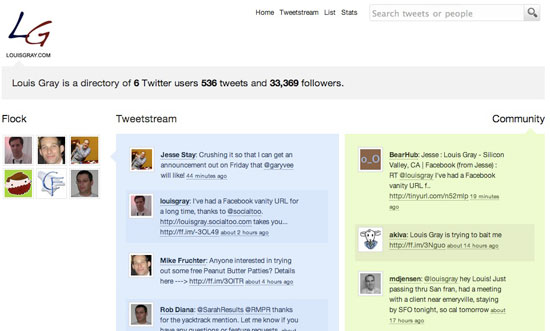

The Main LouisGray.com Floxee Page

I gained access to the product, and have an early version of the site up, at http://louisgray.floxee.com/, populated by Twitter accounts from me, Jesse Stay, Mike Fruchter, Rob Diana, Ken Stewart and Phil Glockner, some of the other writers whose names you've seen here this year.
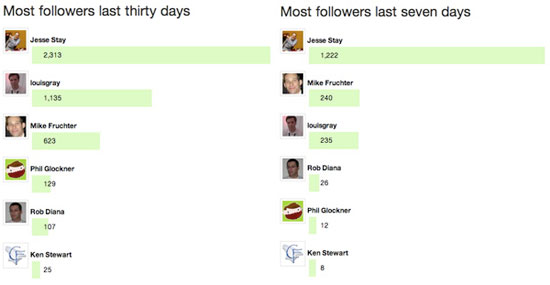

Floxee Watches Who Is Gaining Followers Quickly

Floxee watches each of these six accounts for updates, and even goes so far as to dive into TwitterCounter and provide statistics on our group, including statistics on who has the most followed accounts over the last 7 or 30 days, who is the most active, and guesses as to who is the most conversational or political.
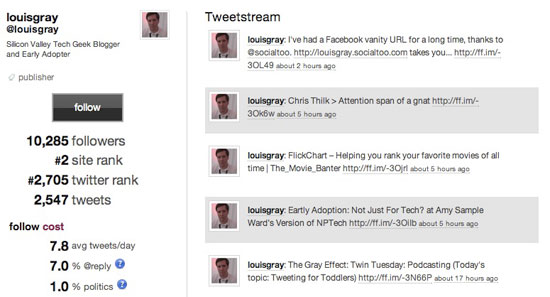

Floxee Has My Twitter Details Down, Relative to the Group

Floxee also lets you dive down into each individual account. For example, you can see that Jesse averages more than 25 tweets a day, and has piled up more than 18,000 followers, ranking first among our small group, while in contrast, I post updates less than 8 times a day, and only reply to people with 7 percent of my updates.
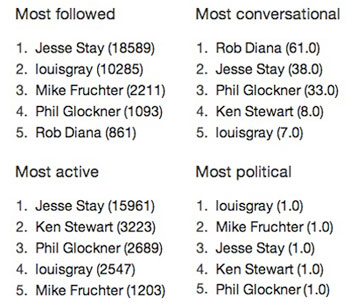

Floxee Also Knows Who Replies and Who Blasts Links or Politics

For large multi-author blogs, Floxee can offer an interesting desination page to show what the team is thinking. For small or medium size businesses adopting Twitter, it could also be a good place to see the public updates from colleagues and watch the company's impact online.

You can get into the private beta by checking out floxee.com. Don't forget to check ours out at louisgray.floxee.com

June 9, 2009

June 9, 2009 · 1 MIN READ · BY LOUIS GRAY

FFundercats Podcast Episode 32: Things That Make You Go Bing

FFundercats Podcast Episode 32: Things That Make You Go Bing

In April, we had the opportunity to first take part in the epic whirlwind of social media fun that is the FFundercats, FFundercats, a project undertaken by Josh Haley and Johnny Worthington, who have teamed up to create a fun weekly show centered around all things FriendFeed. At that time, they claimed I tried to "drop science" and explain how we operate in this real-time world. Missing the duo, I begged, pleaded and bribed the pair to be back on this last Friday, and, luckily they let me return.


Friday's podcast focused on some of the major topics you have seen us discuss in the last few weeks, including the "Blame Drew's Cancer" phenomenon, my new (used) car, the introductions of Google Wave and Microsoft Bing, as well as other items that keep FriendFeed's community going. And, as per usual, there was a highly active chat throughout the show, which you can find here.

You can check out the podcast on the FFundercats site, or subscribe to the podcast in iTunes.
June 9, 2009 · 3 MIN READ · BY LOUIS GRAY

AT&T Has Us Approach Intersection of Doing "Right", Common Sense

AT&T Has Us Approach Intersection of Doing "Right", Common Sense

For the most part, I believe people are good and try to honor the law. Most people, regardless of religion or upbringing, believe it is wrong to lie, to steal or to cheat. But sometimes, there comes a perceived imbalance that drives a mob of people to collectively break the law and flaunt the rules, until the teeming anarchy threatens to break down the system, save it for a clear thinking authority figure who steps in and offers an acceptable alternative. We saw this with the boom of Napster and again with the rise of peer to peer networks for video trading. We saw it two years ago when users gloriously jailbroke their iPhones to install much-desired apps, and we are possibly seeing it again now that it looks like many existing iPhone 3G owners, shackled to AT&T for their service, are going to be unable to perform tasks possible from other carriers.

Going back to the root of the first two examples, with Peer to Peer networks and Napster, why were people sharing files and downloading like mad? For many people, it wasn't a matter of wanting to steal from the record companies, or to defraud artists. From the many stories I read and the people I talked to in that era, the most active Napster users were also among the ones with the largest legitimate music collections, the ones who made visiting a record store or concert a regular occurrence. But there came an imbalance between the ease of acquisition and the price of acquisition of the media, as prices for individual CDs rose from the $9.99 range to $13, $15, $18 and beyond.

Napster, Kazaa and other peer to peer networks, offered an alternative that delivered music of all types quickly, depending on download speeds, and for extremely low cost (free). And instead of downloading full albums, users could find individual tracks and get those alone.

It took a realistic alternative, like iTunes, that offered low per-track pricing and easy, trusted, downloads to push people to move away from illegal options, and for the most part, they have. Similarly, options like Netflix, Amazon Unbox and iTunes again provided users with trusted inexpensive video downloads that were less costly than the rapidly-rising theater experience, with its $10+ tickets (not to mention inability to pause the film).

In each case, consumers, with common sense, grew tired of the restrictions placed on them from an uncaring monopolistic industry. And while the traditional entertainment and media moguls are still reeling from having to adjust to the new rules placed on them by consumers, other old world giants think they can play the game and be a gatekeeper. AT&T's woes were painfully shown by Apple yesterday, who quietly called out the carrier for being behind in practically every important way - not enabling tethering for the iPhone, being incapable of supporting MMS, and giving all of us early adopters a dramatic case of sticker shock when we considered upgrading.

The world of common sense again says that if customers want to pay for cutting edge technology and are willing to pay for your services, they will. But they don't like being forced into a less than ideal situation that makes them feel like they are paying top dollar and getting lowest rung support.

I haven't slammed AT&T much and haven't championed them either. Phone services, like electricity and water, are a utility - something that should just work in the background. The fact that we are even talking about them now means something has failed. It's a relatively quiet group of folks, so far, who feel wronged by the phone monolith's position, but if the failures continue, they will start to break the rules, because common sense says they should, and eventually, the wrong will be right.
June 9, 2009 · 3 MIN READ · BY LOUIS GRAY

Palm and Bing Triumph Over Low Bars They Set for Themselves

Palm and Bing Triumph Over Low Bars They Set for Themselves

Amidst the buzz from Apple's Worldwide Developers Conference that took over the tech news world today, in the shadows, something very weird has happened. Companies that were once market leaders, and then, later, laughed at as the ugly stepchildren in tech, are being championed once again. And this time, they are being lauded not because they are the best necessarily, but because they are doing a good enough job to avoid ridicule - a good enough job for us to praise them for not completely being full of fail. Of course, I'm talking about Palm's new Pre and Microsoft's latest search entry, Bing.

I have never seen, touched or tasted a Palm Pre. I've heard they are hard to come by, and they were only available initially to a select list of reviewers. So far, the reviews are good, and the Pre is being seen as a real challenger to the iPhone. While we all ignore the traditional market leaders, like Nokia, Sony Ericsson or Motorola, it is Palm, Apple and Google who have us talking about phones. And Palm, despite being brand new and having an application store with a few dozen applications, compared with the tens of thousands on the iTunes Store, is giving people pause because it is even coming up at all. We had left them for dead, and they are rising like Lazarus, becoming part of the conversation, when most of us expected them to just go away.

Similarly, Microsoft's Bing continues to get positive writeups as people realize you can search with it and not suffer a fatal disk error. Over the weekend, a site was built that showed Bing going head to head with Google and Yahoo!, in a blind test, and doing very well, more so than likely any of us would have anticipated. While it still was losing, the results, showing it competitive at all, were enough to change our perceptions a bit - after years of seeing Microsoft unable to impress us while under assault from Mountain View.

It's quite odd, really. Maybe it has something to do with the fact that much of the tech blogosphere likes so much to rally around failures that when something miraculous like Bing being ahead of Yahoo! search in market share for a 24-hour period happens, it becomes front page news - or that the Pre actually had people waiting in line for its debut. We were all prepared to write about the disaster, so when something resembling a middling success struck, it caught us all by surprise.

But a few days of positive headlines and friendly nods cannot a market share leader make.

Palm wades into a hostile cell phone environment where Apple leads in mindshare and has the ears of thousands of developers looking to make serious coin. Google has extended their reach to many different applications beyond vanilla search - from YouTube to Google Reader, GMail, Maps, Earth, Docs and so much more, making replacing a search engine or swapping out mobile phones, once a choice has been made, that much more difficult. As I wrote on FriendFeed, and said in Jesse Stay's first podcast tonight, even if the Pre and the iPhone were feature equal, it's the integration with iTunes and all its applications that makes the difference for me now. I'm invested in this platform, and I'd venture a guess that a ton of other people are too, AT&T or not.

As for Bing? Google is the default search engine in my Safari. I trust Google to get the right results, and even catch myself searching it for results from my own blog posts' history often. Bing is a cute alternative - something to use if Google ever ticks me off, or magically, goes down for any extended period. But it hasn't delivered the "wow" experience that tells me a good reason to switch. Microsoft may have built a better mousetrap than their previous models, but they don't have enough bait.

Microsoft and Palm. One, the current and longtime leader in operating systems and office software. The other, the onetime leader in handheld operating systems. Now, today, both have tarnished brands looking for a little spitshine. They may have gotten a little buffing, but not enough to have me seeing them in a new light.