Silicon Valley Technology Commentary & Archives · Est. 2006 3,031 Posts · 2006–2026

December 2, 2009

December 2, 2009 · 3 MIN READ · BY LOUIS GRAY

Meg Whitman's eBay Resume a Target In CA Governor Race

Meg Whitman's eBay Resume a Target In CA Governor Race

Although there is a full month left before the calendar flips to 2010, candidates for next year's gubernatorial candidacy in California are already lining up to take the state's top spot when Arnold Schwarzenegger leaves office. Among them is Silicon Valley notable Meg Whitman, whose years at the helm of eBay are being made the centerpiece for much of her promotional advertising, including radio spots and a good part of her online presence. Early polls have her tied with repeat runner Jerry Brown at 41% in a hypothetical matchup. But as great a story as eBay has been, the company's focus just lends itself to creative opponents and speechwriters.

Start with the tagline... Will Meg Put Your Children's Future Up for Auction?

Of course, replacing "your children's future" with "your business" or "your home" or whatever your favorite buzzword is still works.

And don't forget what auctions are all about... Selling out to the Highest Bidder. Without saying I think Meg is any better or any worse than Brown, in a world of politics where lobbyists are frowned upon and outside influence is distrusted, one could spin Meg's approach to politics or issues as doing just that.

After all, can't you just name a "Buy It Now" price at eBay? What is the price for a politician?

Whitman's bio, an impressive record including her education at Princeton and a Harvard MBA, floats through her work with Bain & Co., Stride Rite, Procter and Gamble, FTD, Hasbro and Disney - talking about her taking what ended up bring a dream job, when she joined eBay in 1998, and delivered an "unparalleled business success story", saying she "revolutionized the way goods are bought, sold and paid-for on line."

There is no question eBay changed the game online - managing to fight off competition from Amazon, Yahoo! and others - an unquestioned success. But if I were in politics, I would highlight the fact that eBay is the place to take old junk you don't want any more, or a place to find last year's models today. Meg Whitman's audio ads are talking about "change", just like every other politician talks about change to elicit voter interest, even as eBay's current campaign says things like "This season's shows still look great on last season's HD TV."

While it's easy to anticipate GOP opposition targeting Brown, who served from 1975-83 in the role of governor, as recycling old ideas, being tied so much to a company that champions this very thing doesn't exactly put Whitman in the driver's seat in terms of next generation forward-looking thinking.

Additionally, during Whitman's tenure at eBay, at 2005, the company very visibly purchased Skype for $3.1 billion. While the company also purchased PayPal on her watch, which has been a fantastic success, the majority of Skype was sold from eBay earlier this year, with a valuation well under that mark, after the deal never really made sense after years of stalling. Brown and other opponents' handlers could see the Skype buy as a costly billion dollar gamble that distracted eBay from its core business. With California being in such budget peril these days, it's a story that almost writes itself.

Regardless of your political leanings, it is clear these kinds of comparisons are going to come up. And lest you think we have moved on in politics away from soundbites and taglines, we haven't. If Whitman becomes the GOP candidate, or a front-runner, eBay could be as much a hindrance as it ever was a benefit. Her opponents should be dreaming of fun taglines, and her team should be getting ready to respond when they do.

December 2, 2009 · 1 MIN READ · BY LOUIS GRAY

Cinch Enables Embedding of Simple Podcasts

Cinch Enables Embedding of Simple Podcasts

About five weeks ago, I told you about CinchCast, an iPhone application that lets you record audio and post it directly to social networks. As I have used the application a number of times since, my most-awaited feature has been the ability to embed these podcasts, so I can later make them available to you here on the blog. Today, they made the move, meaning I can, as with YouTube videos and other media, simply post the code and have it display in any posts.

Now, any CinchCast that you make, or those you see on CinchCast.com, can be embedded.

Here are a few recent ones from me:

Nov. 30th: The news that TechCrunch's CrunchPad is dead is quite disappointing.
Nov. 12th: Apple should have provided clarity and priority support to FaceBook's iPhone app.
Oct. 27th: Being a journalist is about using all your resources to get the story right - not about being uncaring.
Oct. 26th: Is social media wasting companies both time and money?
Although I use Cinch via the iPhone, you can also call in your podcasts by using their 800 number. But that would be more boring. I like this new feature a lot.

November 30, 2009

November 30, 2009 · 2 MIN READ · BY LOUIS GRAY

The Tablet Business Is Clearly Not Easy Business

The Tablet Business Is Clearly Not Easy Business


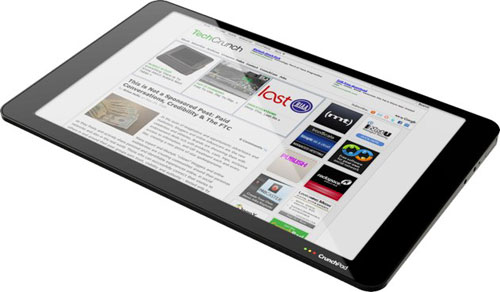
We are nearing the end of 2009, and the world of tablet PCs is just as fuzzy as it was at the beginning of this year. Despite continued rumormongering and finger waving about guesses on what Cupertino has planned, Apple's long-anticipated tablet remains unseen and more discussion has been devoted to its reported slips than has been made about its potential specifications. Meanwhile, as you no doubt saw, Michael Arrington of TechCrunch made the abrupt announcement this morning that the CrunchPad project had been put to rest before it was able to debut - the victim of relationships gone awry between client and vendor. While the two examples are significantly different, they both demonstrate how hard it has been for companies big or small to make headway into this space.

Despite seeing only the earliest of prototypes, and not ever seeing the product run myself, I was bullish on the CrunchPad's potential for a few reasons. The first was due to its promised low cost, starting at $299, and later said to be closer to $400. The second was the recognition that computing is moving away from the folders and desktop metaphor, and more to a Web-centric cloud (as discussed with Apple vs. Google), with applications running on Web services instead of CPUs. Third, I wanted the opportunity not to avoid Apple, but to support a new challenger - as I saw a respected peer and occasional acquaintance try to take the leap from creating content to creating hardware.

As I mentioned in a pair of posts in July, I said I was leaning to choose CrunchPad over Apple, and guessed Mike could be as much known for the success of the device as he has been for the success of his blog network, if it were to take off. Now, barring a complete reversal, it looks like not only can't I get my hands on a CrunchPad, but we won't get to see Mike and his team fight the operational and sales challenges common in any hardware firm.

These challenges look to be exacerbated when you add the word "tablet" - either due to the challenging engineering demands on cramming so much utility in a slim technology device, reducing costs, or in finding the right market. Even if I find the concept of a tablet intriguing, I am still wondering where I would put a laptop down, and pick up a tablet, or when I would holster the iPhone and pick the tablet up. It occupies an uncomfortable middle ground which hasn't yet been solved, in mass, by manufacturers keen on penetrating the space. Even Google's Chrome OS, which looks like a clear candidate for such a project, looks to be focused on NetBooks, which are not quite tablets and not quite laptops. Once you divide up the potential market, it's one full of slivers, without much pie.

Unlike others who are calling the CrunchPad vaporware, I am not. I see no good coming from seeing this product never reach the market. Even if it were to have shipped and not found dramatic traction, it would have had a chance, and given customers choice.
November 30, 2009 · 4 MIN READ · BY LOUIS GRAY

Disclose This: I Can't Disclose Everything Everywhere!

Disclose This: I Can't Disclose Everything Everywhere!

Though hubbub around the FTC's plans to require bloggers to disclose relationships with companies, services and products has lessened over the last few weeks, the December 1st date for enactment is rapidly approaching. As promised before, and many other times, I will make any relationships I have that are beyond "typical" clear to you as best as I am able. But, as you can expect, as communication vehicles evolve, even today's best-attempt laws aren't ready for how I am operating. With so much of my downstream activity being automated due to activity elsewhere around the Web, the potential for disclosure sometimes doesn't even come up.

Long-time site visitors know that for the first 3 years of my writing on the blog, I was extremely careful not to talk about my company, its employees, partners, customers or even talk about the industry. In 2008 and this year, I started to have some unpaid advisory roles that included a minor equity share, and told you about that, disclosing where it made sense. And now, with my new role at Paladin Advisors Group (@paladinag), I am growing the client roster, attracting some enterprise companies, and startups who want to work with me more closely.

So that's a good thing, right? I agree. I am excited about the new possibilities as I sign up new clients and advisory roles, because my entanglement in the Web is changing - from an interested observer and consumer to one that can play more of an activist role, shaping the tools we are using now or will use soon. Yet, as I add such entanglements, I am thinking about where I can possibly disclose - not so I am covered by the FTC, but so I am covered with you, because your trust is more important than whatever the FTC dreams up.

(And to be honest, I've given it a lot of thought, and it's probably true that in many cases, advisors to a company, or its VCs, should be trusted a great deal more than a typical consumer, as they actually know the product and company better than just about anyone)

Here's where I perceive gaps from the FTC to my workflow:

1) Archived Posts and Discussions of Current Clients

Very often, my new clients are ones I have written about before. My previously writing on them was no doubt due to my interest, and they came to know me either prior to the story, or because of it. Now that I have a working relationship with a client, for example, with my6sense, should I retroactively go tag all previous posts that mentioned them with a new Disclosure text?

Also - should it be perceived that maybe I covered them in a positive light before, because I was angling for an advisory role? Even if there was no professional role before, should one assume that was the case, or is this coincidence?

2) Liking of 3rd Party Content On Current Clients

I won't even waste my time reading every word of the FTC's script, but other folks, including SiliconAngle's Mark Hopkins have done the dirty work. The obvious places to disclose are, of course, in blog posts, and in Tweets. But what about other people's content, where I can add visibility to their own comments, even if I was not the original author?

For example, should I not "Like" comments by the client or other shares of the client's work that others have made on Facebook and FriendFeed? Is it assumed that I would only "like" a post about a feature release because of the relationship? What about adding their items to Delicious or other networks?

3) Automation Can Prevent Disclosure

If I see a blog post by a client and share it in Google Reader, do I also have to add a note when I share that they are a client? What if I retweet their official Twitter account? Notwithstanding that Twitter won't let you make any additional comments on their new retweet functionality, one almost runs out of characters.

If you also remember that I have a fairly robust social media workflow, much of the way I get data around the Web is by letting other networks do the heavy lifting. Bookmarks I make on Delicious and items I share on Google Reader automatically get tweeted - and I never get a chance to disclose - if there is any relationship. This is essentially what could be construed as a crime of omission, one that is not egregious, but could still be looked at sideways, if one feels that I did not make best efforts to make a relationship clear.

In October, I said the disclosure rules would have little effect, largely because I believe people who skirt the rules today will continue to do so, and while there will be some showcase examples of enforcement, they will be a small percentage of infractions indeed. I still don't think this will be dramatic. But it always seems like the people who try to change the rules are changing them for the way the Web was, not the way the Web is. And if I can easily find loopholes or places to work around the rules, the people who are the real bad guys will walk all over this thing.