Silicon Valley Technology Commentary & Archives · Est. 2006 3,032 Posts · 2006–2026

May 29, 2009

May 29, 2009 · 3 MIN READ · BY LOUIS GRAY

Google's Blogger Challenge: Win the Marathon and Don't Bonk.

Google's Blogger Challenge: Win the Marathon and Don't Bonk.

Sometimes I feel like I am a rarity in the tech blogging world, considering I haven't moved away from the Blogger platform and onto the more frequently celebrated, higher geek cred option, WordPress. In fact, I'm such an oddity that I am not even on the newest version of Blogger. I still cling to the "Old" Blogger and post my stories using FTP, as it's something that has worked for me for the better part of three and a half years. But while I haven't made the switch, many have - falling in love with WordPress' wide array of extensions and open source mentality. I've even had offers for people to help me move off Blogger to WordPress, and have, so far, resisted.

With this going on, there's no question Google's Blogger platform has a perception problem. While it is on record as the largest blogging platform on the Web today, ahead of Six Apart's TypePad, LiveJournal and WordPress, it is largely seen as not leading the innovation curve - even if mommybloggers (like my wife) use it and love it.

Some aspects of Blogger feel like they haven't changed in maybe five years, and surprisingly, that perception is actually true. Today I had lunch at Google Headquarters with Rick Klau, who is a Product Manager on the Blogger team at Google, and we talked at length about the current state of the platform, as well as what is planned in upcoming releases to help the product become even more on par, and in some cases, ahead of the competition. He said that for the most part, Google has just "kept the product alive" in maintenance mode, not adding too many features. Meanwhile a good number of the features being tested in the product's "Draft" area, similar to Google Labs, are unknown to the majority of the product's users.

But even in keeping the product going, there's been a tremendous amount of effort from people Rick said were "working their butts off". He wrote me in an e-mail after our lunch, saying, "There's been a ton of largely invisible innovation over the last few years - things that don't get seen because they just work, but enable the massive scale at which Blogger operates."

Klau joined Google as part of the company's acquisition of FeedBurner in mid 2007, and since that purchase, neither FeedBurner nor Blogger have been spared the arrows from critics who recognize the value of their services, but expect more, myself included. Klau agreed with my comments this afternoon saying that users see Google as having the combination of tremendous brain power and seemingly infinite technical infrastructure resources, making any hiccups practically inexcusable. I've always said I favor the little guy over a large monolith like Google, and users are easily tweaked when products produce incorrect results or have outages that last hours - both of which I've highlighted before in darker days.

But Klau also noted the platform is under a constant around-the-clock battle with spammers and other hackers attempting distributed denial of service (DDOS) attacks and working to find ways to blast spam into comments on the millions of blogs on the Blogger platform worldwide. In fact, the Blogger team has three people in three continents around the world dedicated to keeping the sites up and the riffraff out.

To fully appreciate life as a Blogger user, Klau did the opposite of what many have done of late, moving from WordPress to the Blogger platform with his own blog. He now gets the privilege to see both the good and the bad of his product from the perspective of the company's large user base - and despite the competitive state, he sounded eager at what the future will bring, and the opportunities available, with top resources available from the Mountain View search giant, including potential integration with newly announced products elsewhere within the company.

"I feel like we're in a marathon, and I am beginning with a 10 mile headstart," Klau said. And while it may have been true that in recent years, Blogger had been sitting idly, or jogging in place to hold their position, it is clearly no longer the case now, as I learned during my talk with Klau today. The team is running again.

May 29, 2009 · 4 MIN READ · BY LOUIS GRAY

Today's Real-Time Web Makes Blogging and RSS Seem "Too Slow"

Today's Real-Time Web Makes Blogging and RSS Seem "Too Slow"

Thursday evening, I had the opportunity to attend one of the semi-regular open houses held at FriendFeed headquarters in Mountain View. (See pictures from Brian Solis, who also attended) While on other occasions, I may have taken the chance to pick the brains of the small team, yesterday I ended up spending the bulk of the time talking to others in the industry, including Edelman's Steve Rubel and TechCrunch IT's Steve Gillmor on what they thought the future of communication, information discovery and blogging would be, amidst the dramatic expansion of microblogging and real-time updates and alerts. And while we all had our own viewpoints on the future of RSS, we agreed that what has been status quo for the last five to ten years is changing underneath us, moving toward a world that is faster, driven as much by what will be our preset queries and searches, rather than through subscriptions and static pages.
Gillmor famously argued earlier this month that RSS should "rest in peace". Gillmor's summary started off by saying, "It’s time to get completely off RSS and switch to Twitter. RSS just doesn’t cut it anymore," and continuing onward, making a case that the immediacy of Twitter made it the source for news discovery, not tools like Google Reader, which I use to find all the data from my sources on a daily basis. As he told Steve Rubel and me yesterday evening, the post "went global" faster than anything he had ever written before, and judging by the more than 500 comments received on TechCrunch, as well as the many follow-on pieces I've seen, it stirred up a great deal of controversy - which is to be expected when making such a black and white claim.

Meanwhile, Steve Rubel, author of MicroPersuasion, who has been blogging on that site since early 2004, said that to him, blogging seemed "slow", when contrasted with the lightning fast communications seen from tools like FriendFeed and Twitter. He made the analogy that when you take the time to compose a blog post and you launch it over the wall, that readers have to look it over and make a choice as to whether they will respond, or if they will simply hit 'J' in their RSS reader and move along. In contrast, he said sending a note to Twitter was like introducing ants in someone's house, making them immediately take action.

Gillmor's unique writing style no doubt stemmed much of the confusion around his "Rest in Peace, RSS" story, which I fundamentally disagreed with the first time around and ignored. But in yesterday's discussion, it became more clear what he was trying to propose - not so much a full-fledged abandonment of RSS readers for Twitter, but instead, pushing for a reader-like tool that would follow microblogging services, decode shortened URLs on the fly, and then deliver the option to read full text of a piece.

In essence, rather than waiting the 20 to 60 minutes it can sometimes take RSS to propagate, thanks to latency from FeedBurner, for the most part, Gillmor's approach would take seconds - where a blog publisher or news distributor could post an update to Twitter or FriendFeed and have the same type of result, only a lot faster. This comes at a time when Gillmor and others are saying that referrals to blog posts are decreasing from RSS readers and increasing from microblogging sites, as readers do their link discovery outside of the reader.

Although Gillmor said we should just "switch to Twitter", he isn't even waiting for Twitter to bring back his much-beloved 'Track' to monitor keywords. Instead, he expects that FriendFeed will more quickly arrive at a tool that delivers realtime alerts to e-mail or instant messaging tools than Twitter - which makes sense as the aggregator has already set up e-mail and IM tools for lists and has delivered saved searches, two of the three components needed to make 'Track' a reality - and not just across Twitter, but across the more than 50 social sites FriendFeed supports.

As Gillmor told us both, he sees posts from louisgray.com "immediately" when I add them to FriendFeed, even if it takes much more time for them to enter Google Reader. And yes, that's because I, as a publisher, follow a specific process when posting, to author it and immediately afterward send it to Twitter and then pull it into FriendFeed, all before I manually ping FeedBurner. It's a conscious decision on my part, but one that helps his case.

RSS is not dead. Far from it. We're all using RSS every day, powering our Web portals, and helping to distribute blog and news content everywhere. But if it is about getting things discovered most quickly, and getting a response from readers very quickly, there's a reason you see people looking elsewhere, just like there's a reason I use a tool that pulls comments from FriendFeed into louisgray.com on my blog posts. I know some people will get to my content somewhere else faster. And if an enterprising software developer, like Nick Bradbury, can make a tool that turns links on Twitter into the same type of tool we see in RSS readers, maybe we'll be onto something new.

May 28, 2009

May 28, 2009 · 2 MIN READ · BY LOUIS GRAY

RakedIn Takes On Portals With Focused Finance Site

RakedIn Takes On Portals With Focused Finance Site

Today, a good amount of the news we get about businesses and the individuals at these companies comes from horizontal portals and news organizations that have other priorities - be it search at Yahoo! and Google, or politics and entertainment, like at CNN. Meanwhile, social sites like LinkedIn and business tools like Jigsaw and Hoovers are accruing personal details about many companies. A new site, debuting today, called RakedIn, has launched, trying to interweave the personalities behind the businesses you watch with up to date stock and financial information, as well as company overviews, with key leaders and board members.
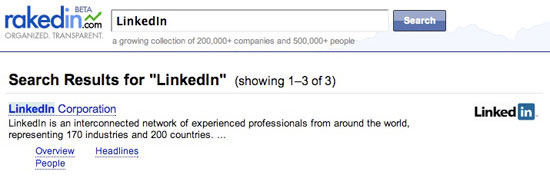
RakedIn, launched by Mike Yavonditte, the former CEO of Quigo, who left AOL following that company's $340 million acquisition at the end of 2007, says it now has a collection of more than 200,000 companies and half a million people covered on its site, on day one, a number it anticipates to continue growing over time.


RakedIn's Search Engine Finds Data On LinkedIn


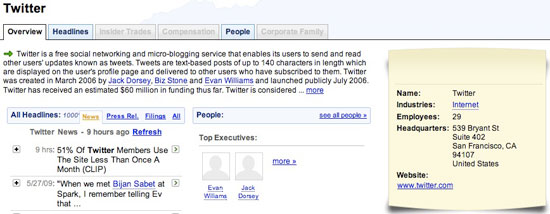
RakedIn's Profile of Twitter, the Company

The site's front page displays featured headlines and an update on the day's stock markets, headlines from across a wide range of industries, and the day's biggest losers or gainers. Aiming to have the most up to date information available, you can dice the information by industry, or even by press releases, company filings, or other news. The site even helpfully tells you if there are more headlines that have loaded as you read the current news - saying they have "raked in" new updates.


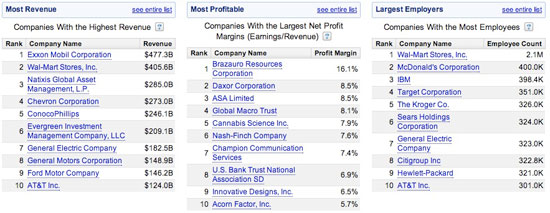
A Sample from RakedIn's Financial Data Headlines


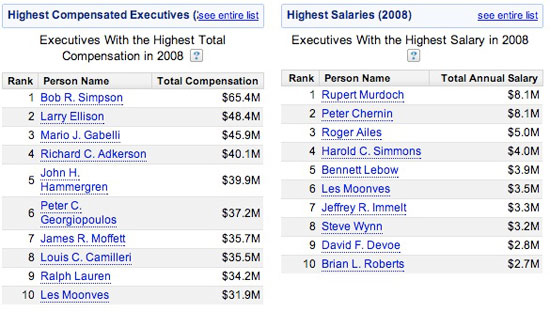
RakedIn Also Shows Detail On Individuals Across Companies

Like Yahoo! Finance and Google Finance, you can dive down into any specific company, such as Microsoft, Google, Yahoo! or any of the Dow components. A company page, assuming it is public, will highlight the latest news, insider trades, employee compensation and other personnel highlights - as well as where the company ranks versus its peers. (For example, Microsoft has the highest earnings in Washington State and is the 88th largest employer overall tracked)


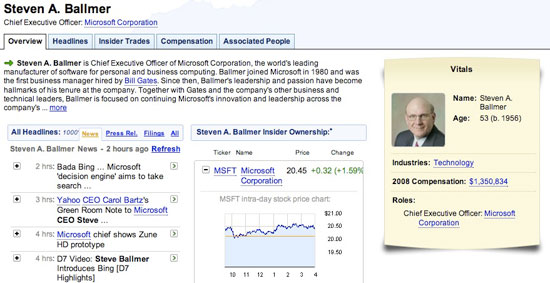
RakedIn's Profile of Microsoft's Steve Ballmer

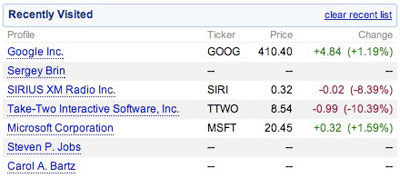
One of the biggest aspects of RakedIn is the benefits of near real-time. During market hours, you can see stocks rise and fall, and headlines slot their way in to company pages. And the site even tracks your most recently viewed pages, giving you fast access should you want to return.


My Recent Activity on RakedIn Is Tracked

And for the largest companies, you can see how their extended families operate. For example, for EMC Corporation, you can see its related businesses, including VMware, Iomega and Documentum, as well as their estimated revenues, profits and employee counts.

RakedIn has a wealth of information, especially for a inaugural debut. And their focus might give people a very real alternative to the portals who are simply aggregating data from everywhere. Check it out at www.rakedin.com.
May 28, 2009 · 3 MIN READ · BY LOUIS GRAY

Omnipresent Omniture Makes Facebook Apps Omnipotent

Omnipresent Omniture Makes Facebook Apps Omnipotent

By Jesse Stay of Stay N' Alive (Facebook/FriendFeed)

The Facebook Platform just got a whole lot more interesting today as the all-powerful Analytics company, Omniture, Inc. released a new suite of analytics libraries for developers writing for the Facebook Platform. The analytics aim to improve, in heavy detail how Facebook developers' apps are being used on the Facebook Platform. What's interesting about the launch though is, in the rumored upcoming introduction of a Facebook Payments platform, the potential implications for e-commerce on Facebook that this brings.

Omniture, a company with probably most of the major online retailers on its client roster, provides Analytics tools for companies such as BackCountry.com (my former employer) and others to be able to track users of their websites. Earlier this year they announced an iPhone Analytics suite, enabling iPhone app developers to track the use of their iPhone applications. E-Commerce and retailers can use the software to track conversions from click to actual purchase within links and ads. At their Omniture Summit conference earlier this year they even showed a demo of being able to track someone who visits an e-commerce site, and then ends up at a physical store location to actually purchase the item. The cross-pollenation of their various stats products to enable companies to know almost everything about their customers is quite honestly, a little scary. That's what makes Omniture so useful and powerful to their clients - it's the breadth of what they offer and the ability to see a customer across multiple products that makes them one-of-a-kind.


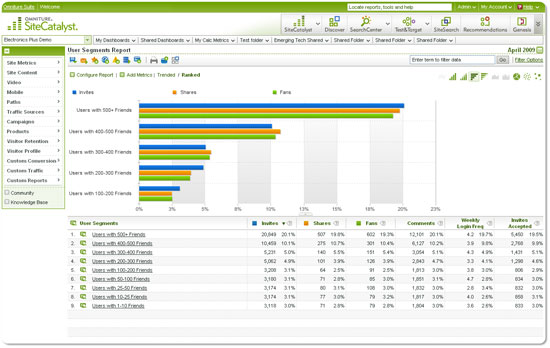
This Facebook announcement just made the customers that they track all the more real. With this tracking, Omniture is now able to identify purchasers on the websites they frequent by age, sex, location, network, interests, the demographics of their friends, the number of their friends, and much, much more. It's this user segmentation that will make companies like Amazon and Apple and Wal-Mart want to create Facebook applications to drive users to buy things on Facebook. All of the sudden, Facebook Apps just became very interactive advertisements.

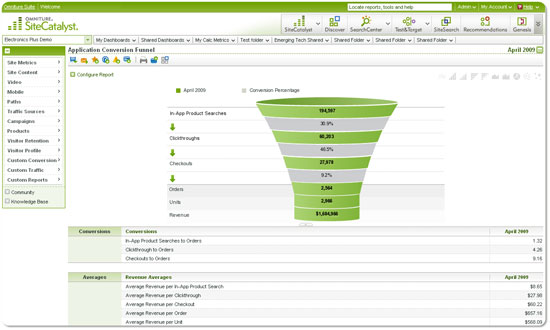
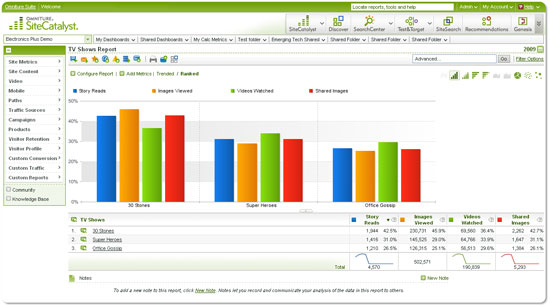
One strategy many Facebook app developers employ is the creation of multiple niche communities under the umbrella of a much larger app company. Such a strategy encourages more wall posts by users from the app and a much more targeted experience within each application the developer launches. In addition to driving and tracking conversion, Omniture has made it very easy, using their SiteCatalyst product, to track and manage multiple Facebook applications at one time. For instance, an example they used was 3 TV Show apps, and the ability to track the number of times images were viewed within the apps vs. times videos were played or stories read. Such a strategy could enable a similar media company to compare various campaigns and determine what was most successful.


The Facebook App Analytics market is ripe with competition right now. With analytics companies such as Sometrics and Kontagent which both have free products at the moment, Omniture may not hit the smaller, core app developers which make up some of the top applications on Facebook. However, with the breadth of information Omniture provides and ability to truly track user engagement and conversion across multiple products, those developers could now seriously have some competition on their hands by much bigger players in the industry that can afford to pay for it. I am told that already at least one major media company has begun to use the product. At the same time, Omniture also provides smaller packages more affordable to the small and medium-sized business, so the smaller developers are not out of luck entirely.

This is a big move for both Omniture and Facebook, and will hopefully bring out some interesting new applications from many of the online retailers which are already using their software to track performance and conversion in their increasingly offsite online presence. In the wake of a coming payments platform for Facebook, Omniture could bring some interesting things to the network. It will be very interesting to watch and see how companies begin to use this and what information comes from the wealth of information Omniture provides.

Read more by Jesse Stay at Stay N' Alive.