Silicon Valley Technology Commentary & Archives · Est. 2006 3,045 Posts · 2006–2026

June 19, 2014

June 19, 2014 · 6 MIN READ · BY LOUIS GRAY

The Myth of the Billion Dollar Startup

The Myth of the Billion Dollar Startup

According to the Wall Street Journal, there are now as many as thirty companies who consider themselves startups valued at a billion dollars or more, based on how much money they’ve raised through private equity funding, and how much of the company they gave up to get that funding. But while the meme of “yet another billion dollar startup” is a fun one, the reality is that these are instead highly valued private companies who operate like public companies, and have the same kind of deep resources that most public companies have, but haven’t yet taken that leap to the retail trading markets - supported by changes in the venture funding process and new rules that make being a public company harder.

Often, it’s too easy to label a private company as a “startup”, no matter the number of employees working there, no matter their revenue achieved, or how many years they’ve been in business or selling product. Uber, who has raised a reported $1.6 billion dollars, and sports an $18.2 billion valuation, is not a startup. Spotify, which has raised $521 million dollars, and is valued above $4 billion, is not a startup. The same holds true for Dropbox, Jawbone, Square, GoPro and other companies that have significant market traction and name recognition, but aren’t yet traded on the open markets.


Using data we know, press reports show Uber with hundreds of millions in revenue (and a billion-plus in bookings) with plans to hire more than 1,000 people this year. Spotify is said to have more than 1,200 employees, tens of millions of users, and partnerships with every major label to have a practically unlimited supply of music. Dropbox reportedly is north of 500 employees, and 300 million users. So you can dismiss the concept of these companies being startups.

A startup embodies an idea on the way to becoming a product on the path to becoming a successful company. Startups bring to mind working with single to double digit employees, making ends meet by taking risk, putting in crazy hours, and never really having quite enough resources to relax or reduce the pace of innovation. Startups are scrappy, not luxurious.

What's Made the Billion Dollar "Startup" Possible and Desired

What’s happened is that these companies have found ways to gain fast access to high amounts of capital, without needing to give up the majority of their company, and without needing to go public. And that’s largely due to two major developments that have changed the industry since I started working in Silicon Valley more than fifteen years ago.

The first major development was the introduction of the Sarbanes-Oxley Act in 2002, which aims to protect retail investors through improved accounting and financial responsibility - setting high standards, requirements and auditing paths for public companies and those intending to soon become public. The act rose out of the companies built on vapor and lies, from Enron, Tyco, Worldcom and others, but while this was beneficial, it also added on additional headaches and costs to companies looking to graduate from private to public. Some, if they could, would prefer to stay private as long as possible, to avoid this scrutiny, as well as reporting to Wall Street every quarter, and being subject to their demands and whims.

The second big development was the rise of markets where early startup employees could sell their options before the company even went public. While in the late 1990s and early 2000s, employees would have to see their company go public to get any money out of their options, and then be subject to subsequent lockup periods, you see people leaving companies like Twitter, Facebook, and others even before the IPO date, with millions of dollars in their pockets, through transactions on Second Market and the rise of funds like Lower Case Capital, who make those options real, by exchanging real money for options.

The combination of those two elements reduces the demand from inside the company to go public - both from the restless employees and from the busy management. And you see the change in the way these companies now raise money. Instead of a small seed round, followed by an A round, companies raise millions in the seed round, and skip that step. Instead of a Mezzanine round followed by an IPO, companies will sometimes raise the hundreds of millions they would previously have gotten through IPO in a private round that extends their runway even further. You can see that with Sunrun raising $150 million in a single round, which included $100 million from an unnamed public investor, or Uber’s latest $1.2 billion round.


If going public is a pain, and the benefits of going public aren’t there, then why go? So they don’t. Companies get funded and grow even larger, employees get rich and can cash out their shares, and when the company eventually does decide to file and place their shares on the NASDAQ or NYSE, instead of the big pop and sustained rise you used to see, retail investors find the big multiple increases have already taken place in the private markets, and the existing investors are the ones who get the lion’s share of the reward.

Prior to joining Google, I spent 8 ½ years at the venture funded BlueArc, a network storage company which took in more than a quarter billion dollars in funding over its lifespan before being acquired by Hitachi Data Systems in 2011 (two years after I had left). When we raised $72 million in May of 2001, and were valued at more than $300 million, we hadn’t yet shipped a single unit for revenue. But you needed nearly $100 million to get off the ground in the hardware space - and that continues with companies like Pure Storage, who just raised $225 million at a 3 billion valuation in April. BlueArc may have been like a startup in 2001, but by 2004 and 2007 or so, when we were years into selling, had hundreds of customers and multiple product generations, we weren’t a startup. Just a private company that happened to be highly valued.

So let’s recognize the world has changed a bit over the last two decades and call them for what they are. These aren’t startups - and most of the upside from investing in these companies comes before they even go public, not after the fact. The companies are disincentivized to be on the public market, and their employees, in many cases, are already getting the rewards that others of us could only dream of. We’ve got to come up with new terms and for emerging companies and tell them to check their startup credentials at the door.

Disclosures: I used to work at BlueArc for 8 ½ years. I am a customer of SunRun and love their products. I work at Google, which you could assume competes with DropBox, Twitter and Facebook in some ways, and yes, some of my friends at Google Ventures are investors in Uber, but I have no bias in favor or against the company as a result.


May 2, 2014

May 2, 2014 · 4 MIN READ · BY LOUIS GRAY

Staying Ahead of the Curve on Tech Trends Isn't Trivial

Staying Ahead of the Curve on Tech Trends Isn't Trivial

When it comes to picking choices in tech, making the wrong decision on formats, manufacturer, or version can set you back in terms of dollars, leave you with rapidly obsoleted hardware, or find you investing time in something that provides you with non-optimal returns.

As an early adopter, you have a higher tolerance for risk and you take bets on product direction before the rest of the population may agree with you, and your choice to move one direction can act as the initial spark in a good situation, or as the canary in the coal mine, in a negative one. This thought crossed my mind as we saw the news yesterday to Sony's recent struggles, largely tied to their ongoing challenges hawking Blu-ray.

As Sony was quoted in the Verge, "demand for physical media" was "contracting faster than anticipated," and they were left holding the bag. But this really shouldn't have come as a surprise. More than three years ago, I said I was through with physical media, and I haven't looked back. Between streaming video and audio services like Netflix, Spotify and Google Music, or eBooks from Google Play and Amazon, the Web has taken over where physical media couldn't compete.

And let's be honest for you Netflix users? How many of you still get the DVDs? Netflix is a perfect example of a company that saw the transition coming and pivoted to where the trend was going. Now they're overwhelmingly known for their streaming services instead the traditional red envelopes.

The last five years have seen pronounced trends that in hindsight are impossible to ignore, from the rise of smartphones and debut of functional, popular, tablets, and the integration of social networking in all aspects of society. You can debate the ebbs and flows of financials for some of the larger social networking sites, but you can't deny their immediate impact.

On the tablet and smartphone side, there were two obvious trends that people could recognize right away if they kept an open mind. The first was that the iPad was going to be a hit. The second was that Android, due to its partner-friendly approach and rapid iteration, was the horse to bet on.

Without pulling an +MG Siegler and calling this post "I was right. Let me tell you why...", I'll highlight a few bits from both topics.

Let's Talk iPad

Immediately reacting to the iPad's introduction in January 2010, I didn't go over the moon and claim the new consumer tablet would solve world hunger and eliminate illnesses in our lifetime. But I did see it for exactly what it was, concluding, "They are going to sell a ton of these machines, and you'll see them in places you never expected. Casual computing and content consumption are going to drive it." That's exactly what happened, with the hindsight of four-plus years.

The iPad may actually have sold too quickly and been too successful a product to keep Apple beating expectations, but it found a niche between the smartphone and the laptop, and set the stage for the tablet being the first computing experience for my young kids.

Companies that bet against the iPad (or tablets in general) have found themselves swimming upstream, defending an antiquated platform and in some cases, extracting revenue from fatigued customers, whose numbers are decreasing.

Let's Talk Android

While Apple was pushing the iPad and doing tremendously well, iOS wasn't the smartphone OS I ended up enjoying, for a whole bunch of reasons. Six months into the iPad's lifespan, I turned in my iPhone and turned to Android, saying at the time, "a bet on Android is a bet on the future. I am betting on an ecosystem and an application environment that encourages best of breed developers to move their product to a growing population of smartphones, and I expect to reap the benefits. "

There's no question in my mind now that was the right move - and you have to keep in mind that was more than a year before I entertained the opportunity of joining Google myself. I saw the trendlines that pointed to Android being the quantity leader, with greater partnerships and a fast-growing developer ecosystem that brought top apps to the hundreds of millions of users, and that's exactly what happened.

Let's Talk Smaller Tablets


Soon enough, the first generation iPads I bought aged, and another trend emerged - of the small form factor tablet, starting with the Samsung Galaxy Tab, which I preferred, and later the Nexus 7. This 6-7 inch form factor was a perfect fit for customers, as you could see with the rise of the Galaxy Note, ever larger standard smartphone sizes and the rise of the Kindle Fire and Nexus 7 line. Even Apple capitulated eventually with their own iPad Mini, although they're not usually the ones to admit they were late to an idea.

So what am I getting at? I'm not here to tell you I have a crystal ball that tells the future. But you can see, with your own eyes and experiences, what the trends are going to be, and being stubborn because something has always worked one way doesn't mean it's a good idea. You have to evolve as a user, as a developer, as a businessperson, or as a company, to make sure you're impacting that change and choosing wisely. Or you'll end up with a home full of VHS tapes. Don't forget to Rewind.

Usual Disclosures: I work at Google which is behind the Android operating system and is a partner or competitor with many of the companies in this post, like Samsung, Apple, Amazon, Netflix, Spotify and more.

April 15, 2014

April 15, 2014 · 4 MIN READ · BY LOUIS GRAY

Why Nest Protect Reporting an Emergency Filled Me With Comfort

Why Nest Protect Reporting an Emergency Filled Me With Comfort

/via https://twitter.com/louisgray/status/456120763343327232

This morning, my Nexus 5 chirped with a notification I hadn't seen before. While I was at the office, my Nest application was telling me, in no uncertain terms, that there was an Emergency in the kitchen at home. There was smoke, and the alarm from our Nest Protect smoke alarm was sounding. I called home quickly, and my wife told me, embarrassed, there was simply a small issue with the microwave, and all was fine.

While getting alerted to something you can't immediately do something about is no doubt unsettling, it's also reassuring - especially when you consider the alternative (and status quo) is to not be notified until you come home and your house is ash. The Nest Protect alarm correctly detected smoke, communicated (in English) what the problem was, and notified me immediately on a device I always have with me. And as my wife confirmed, the device was being quite direct with her. "There's smoke in the kitchen," was the message from all our devices around the house.


I Can See Status of My 4 Nest Protects from My Phone

Prior to Google's acquisition of Nest in January, I had purchased four Nest Protect smoke alarms in December, to start an upgrade that felt long overdue. As is recommended by code, our home has smoke detectors in just about every room, and their ancient look and behavior, matched only by their limited abilities and nuisances when functioning, give us something of a love/hate relationship. Their every noisy chirp when batteries ran low had us racing from corner to corner in the house, trying to track down the decaying device, and their overreactions to burnt toast or anything else had us all too eager to leave them simply disconnected - which was no good.

So I was more than happy to take down four of the dusty beige models with no personality and start putting Protects in their place. With a little setup, each of the new devices connected, by Wifi, to one another, and they now hang quietly in our major traffic areas, waiting for any hint of trouble. And one perk, which few talk about, is the Protects' ability to function as a nightlight - providing illumination in near darkness, invaluable for the quiet tiptoeing in the hallways, past sleeping children at night.

Adding the Protects to our home in December seemed like a logical move after getting the Thermostat last year. And while they don't see as much activity as the Thermostat, which is constantly keeping our temperature in check, it's comforting to see their current status in the app, and know that all is well.

Today's "Emergency" was quickly resolved, and I got another update.

There's not much to be excited about when it comes to the world of smoke detectors. But as Nest said when they first introduced the Protect series of smoke alarms, "Safety shouldn't be annoying." Too often, people end up in the same situation we had been, where the alarms in their homes were sitting to the side, with batteries out, or batteries had simply gone out and were useless shells - doing nothing to ensure the safety of the people who needed them to work.

Like Sonos, you can view the status and manage any of the devices by name - usually tied to their location. As we placed Protects in my electronics-heavy office, the hallway between my kids' bedrooms, the kitchen and our living room, it's easy to know which device is following status of each location, and in times of assumed crisis, they work in concert to let you know an action has to be taken.

There's really two ways to do smoke alarms: The old way and the Nest way. Every older smoke alarm in my home is now assumed to be a liability, waiting for its time to be replaced. They don't talk my language, they don't look good, and they aren't equipped for this gadget-centric age. I've never gotten a notification from my older alarms, and I never will. Today's alert - even if it was a small one - confirmed that going with Nest was a good idea. And whether you think I'm biased because I work at Google, and can now count the Nest team as colleagues, consider I paid full retail for these devices (including the thermostat), and did so without any knowledge of an impending buy. That they're now working on our team is actually pretty cool. It's always good to have smart software impact my life.

Disclosures: Nest, as mentioned, is a subsidiary of Google, where I work. I purchased the devices prior to the acquisition, and haven't gotten any kind of discount or any favors for being on the same team now. I just have a bias in favor of products that work well.

April 14, 2014

April 14, 2014 · 4 MIN READ · BY LOUIS GRAY

Automatic Takes On My Driving Data, Says Slow Down

Automatic Takes On My Driving Data, Says Slow Down

Data makes you smarter, and can make you improve your behavior. The more we learn about how what we consume impacts our bodies, how exercise can help you lose weight, and how smart energy use can reduce costs and be helpful for the environment, improves all our life decisions.

I've been a staunch Fitbit fanatic for about two years now, quickly brought Nest and Sunrun into my home to reduce our energy demands, and am now sporting a new device in my car that tracks my speed and acceleration, to help me save money on gas and be more efficient overall. The app's name is Automatic - which I first talked about back in May, but only finally received a week or two ago, when they completed the first rollout of their app on the Android platform. And now, every single time I drive my car, no matter where I'm going, the app (and the dongle which attaches by Bluetooth to keep things updated) are watching and alerting me to when I make any moves that aren't perfect.

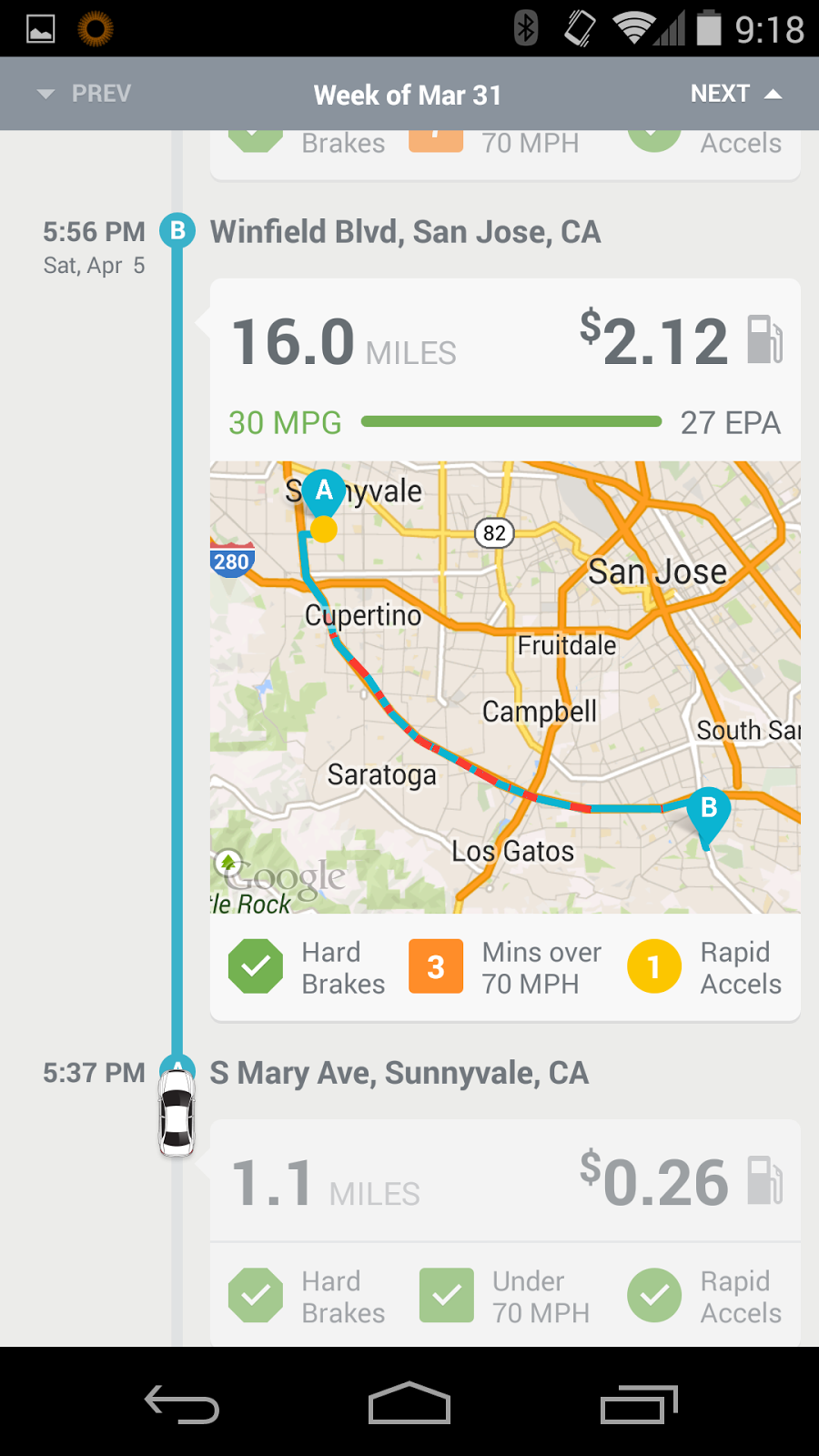
Trip reports from Automatic Show Costs, Quality of Driving

Setting up Automatic was, as you would expect, very easy. I unpacked the device, plugged it into my car's on-board computer, connected it to my phone through their dedicated app, and was good to go. The pairing tracks every trip, including distance, speed and estimated miles per gallon, and uses that data to provide an estimated cost of the trip and an overall score, starting with 100 for driving perfection, and deducting any time I step out of line.

You Can Scroll Through Previous Trips and Get a Score from Automatic

Automatic's assumptions for what makes for bad driving are simple as well. It's assumed that if you are driving over 70 miles an hour, that you're using more fuel than you should. So every time I get out on open highway in my BMW, capable of doing much more than 70, and I hit that mark, the Automatic device makes a chirping sound, telling me to slow down. If I stay above 70 for a sustained amount of time, the alerts continue and seemingly change tenor to be more dramatic.

I also get alerted if I accelerate too quickly from a stop, or if I brake too suddenly (though I haven't yet encountered that in my small sample size of use so far). So if I peel out of an intersection, Automatic bleep bloops at me and marks it on my permanent record (so to speak) through the app, so I can feel guilty later.

I Can Even Locate My Car and Diagnose With Automatic

And like any good app that monitors driving, Automatic is set up to be your wingman should any problems arise. The dongle monitors engine health, and promises to avoid your needing to go to the dealership for repairs if your check engine light goes on, taking away one of life's greatest mysteries. Same goes for the hopefully unlikely chance you're in a crash. Using its crash alert capabilities, Automatic swears it can report any accident to the proper authorities, even if you're unable to. I hope to never ever use this feature, but any added value in my book is a good thing.

So what of my trips? I haven't taken the car out for a long drive of any massive length since getting started. As I found when I started using Fitbit and later, the Nest thermostat and SunRun solar panels, simply having the data in front of me had me thinking about the sources of the data a little bit more. I walked more. I ate less. I turned down the heat and root for sunny days to save me money. To avoid getting yelled at by my Automatic, I find myself hovering around 68-69 miles an hour instead of above 70, so my overall score gets closer to 100.

The Automatic Link dongle for your car - not so big.

But I'd also like to give Automatic more data - like telling it to alert me if I'm going 10 MPH or more above the posted speed limits, or to set the speed warning at 75 instead of 70, little things that would make the device and accompanying app a little better and more personal, instead of acting like one size fits all. Also, by looking at the data, I found the one time I sustained my speed above 70, on highway 280 here in the Valley, I actually had higher miles per gallon than average. So it could be what's always considered bad, maybe isn't.

It's early days for Automatic for me, and I'm bullish on the trend of gadgets making us all smarter. So if I can withstand the occasional sharp chirp from my Automatic Link telling me I'm a non-ideal driver, over time I'll get even better. And I'm looking forward to even more data as the sample size increases. You can check out Automatic at https://www.automatic.com/.