
Two weeks ago, the company recalibrated its systems, and has pretty much thrown all previous years' data out the window, replacing it with new histories. So if you were using the site to get a good picture of your neighborhood, they're hoping you'll ignore what you already know and start fresh.
Coming up on the one year mark in our home which we purchased last summer, I've kept an eye on the surrounding market, both on Zillow and Redfin, to not only watch our own home's data, but seeing new sales come and go. In an economy which is by no means perfect, the weekly data coming from Zillow from its frequent "Zestimates", and tagged on my weekly Mint.com emails was pretty bad all Spring. My email archive shows eight separate consecutive downward revisions of our own home value, shaving off sixty thousand dollars in equity. While I have no intention of moving again any time soon, it was hardly reassuring.
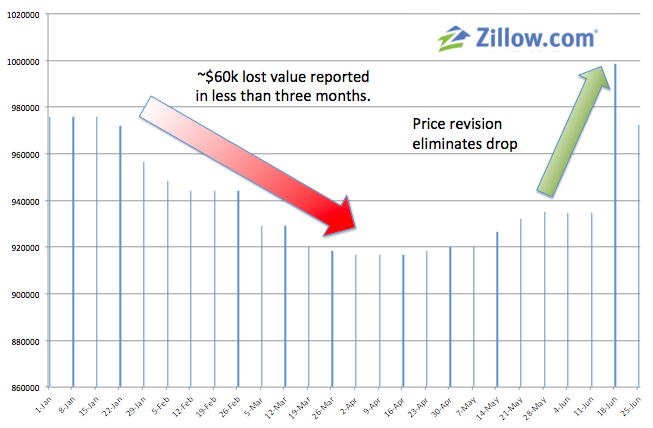
Zillow Told Us Our Home Price Was Crashing, Then Changed Its Data

Zillow's New Data Is Smoother, Doesn't Show Crash
I even complained about the continued drops and negative feedback I saw through Zillow on one of my less-trafficked Twitter accounts, citing the $67k drop of almost 10 percent in just under three months.

Clearly the Reported Price Drops Were Weighing On Me
But on June 13th, Zillow wiped the slate clean and the year's data doesn't show such a steep decline after all, showing a comparatively straight line with a near-static value and a minimum of variance. Instead of a sharp downfall I had assumed was true this Spring, the gap between highest Zestimate and lowest is only about $20k, less than a third of the bloodbath I was seeing.
Pricing one's home for sale or financing is a delicate one, a dance of recent area sales, market trends, and all manner of comparables. But Zillow's move has me questioning not just our own home's value, and the year's graph, but all estimates I bump into, and of course, their own projections for values in years past.
In an FAQ on Zillow's site related to "Zestimate Improvements", they mention that you "Possibly" could see changes in history, thanks to algorithm edits going back to 2006, arguing for improved "current accuracy" and "historical accuracy" - adding "We are now working on re-doing all the history."

An Excerpt from Zillow's FAQ
It's likely they know what they are doing, and with more data, they were losing confidence in both their current and historical values. But it sure didn't seem like the company was unsure about its competence before the move, and I'm not sure they're confident about their current data any more.
8 Comments
I saw the opposite happen to me personally a few weeks back and it really affects me while i'm trying to sell my existing house while my new one is on the verge of being completely being built. My house has been on the market for 3 months now and many people look at Zillow as being an 'official source' of appraisal. The change they did a few weeks back actually suddenly dropped my house's value down $30K on top of the downward trend that was already occurring before the Zestimate change. this has forced me to drop out price yet again mostly due to perception plus more competition of new houses being put on the market in my local area. I'll be dealing with double mortgages in a matter of a month or so but Zillow could have done a much better job at its readjustments in my opinion but I hope that they are right in their new calculations for better accuracy in the future.
Best of luck Mark. I'm considering putting my house up as well depending on moving out west. My pop uses Zillow all the time.
Thanks Mark, hope you stay on the East Coast though... We are always 3 hours ahead in innovating for the day!
We bought our house on February 1; Zillow does not include the sale data, but they show a catastrophic drop in the value of the home of > 30% of what we paid for it.
This is nothing. After a slide of 130K (15%) over the past year on my property, Zillow's overnight changes took another 100K (13.5%) off of my value, and flatlined the last year of history. This is truly shocking. Especially considering that some of my neighbor's histories haven't been affected. In fact, two doors down, a house that's similar to mine still has approximately the same value as both of ours did before (260K higher than mine is currently). I'm fine with Zillow changing how they calculate the values, since they weren't terribly accurate before anyway. BUT, to change history...there is no integrity in that, no matter the explanation. Historical value is historical value. I doubt that I can take Zillow seriously after this.
There is a good reason many famous quotes are popular. A couple apply here: "Lies, Damn Lies and Statistics" and "History is Written by the Victors".
Most people naively accept statistics as proof. If they played with analytics solutions long enough they would realize that you can make the data 'prove' just about anything you want by selecting different date ranges.
Data is not black and white and it can change. Anyone with an AdWords account can test this for themselves by testing different ad copy. They will find that while ads usually test similarly that is not always true. Sometimes an ad that tested best one time doesn't the next.
Many people also do not realize the misleading character of averaging. Calculating the median is far more accurate and less misleading.
Manipulating historical data to make it comply with desired current media spin is one possible explanation for the Zestimate changes. Correcting inaccuracies made visible to excessive downturns over time is another. The question to ponder is which one is it?
There are still many trying to sell the illusion of recovery to the masses while the currency printing presses are running overtime and prices for staples like food and fuel are spiraling upward. If you want to see a good example of misleading stats, read up on which unemployed are counted and which are ignored. Those who believe this recovery illusion are going to be shocked when the inevitable happens.
The worst is yet to come and those who are prepared will be less affected. There are some exceptional resources linked from my post on What Caused the Great Depression. I highly recommend anyone who doesn't want the shock of their life come by and do some reeearch there.
The value of my home went down over $30K, but in my case it doesn't matter because I'm not selling at the moment. Whether Zillow will be hurt by this move remains to be seen, since the vast majority of people do not directly use Zillow (although their real estate agents might).
Revising historical data? In my opinion, Zillow is now in the "What a joke!" category. A couple months ago Zillow showed my home slipping under $600K for the first time since 2003. Now I see that it was estimated below $500K in January of 2009. (The previous ZEstimate had been around $640K for that time frame).